Cash for Junk Cars No Title: NJ Seller’s Guide
Yes, you can get cash for a vehicle without the title in New Jersey. In most common situations, a government-issued photo ID plus a current or expired vehicle registration in your name is enough to move forward. The New Jersey Motor Vehicle Commission (MVC) governs ownership transfers, and licensed buyers like Tristatecashforcars work within those rules to handle no-title sales every day. Your single next step: gather what you have and call a buyer who handles the paperwork.
Before you call, have these ready:
- Government-issued photo ID (driver’s license or passport)
- Current or expired vehicle registration in your name
- Bill of sale if you have one
- Insurance card or declarations page showing the VIN
- Vehicle details: year, make, model, mileage, and whether it runs
- VIN (usually on the dashboard near the windshield or the driver’s door jamb)
- License plate status (still attached or already removed)
Table of Contents
- What documents do buyers commonly accept when you don’t have the title?
- Is it legal in New Jersey to sell a vehicle without the title?
- What proof of ownership do buyers and the MVC actually accept?
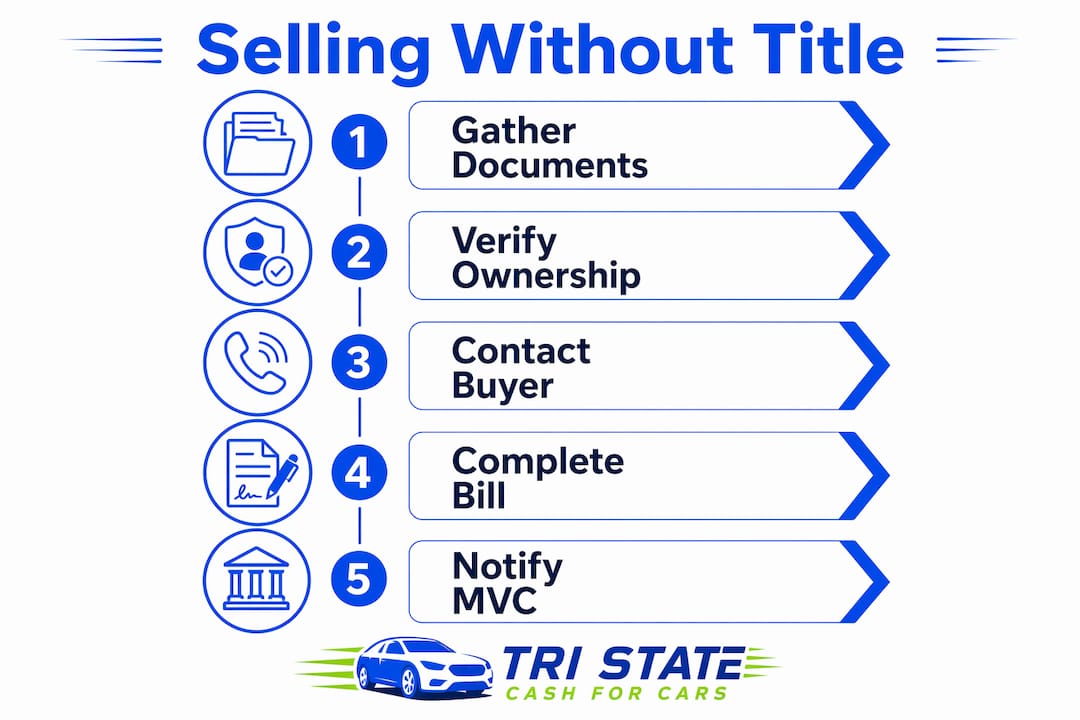
- How to sell your vehicle in New Jersey when you don’t have the title
- When should you get a duplicate or bonded title before selling?
- How much can you expect to get for a no-title vehicle in New Jersey?
- What are the risks and red flags when selling without a title?
- How Tristatecashforcars helps New Jersey sellers who don’t have a title
- Key Takeaways
- Why the paperwork matters more than the title itself
- Get a same-day offer from Tristatecashforcars, no title required
- Official resources and reputable sources to check before you sell
- FAQ
What documents do buyers commonly accept when you don’t have the title?
The registration is your strongest substitute. Licensed buyers accept a government-issued photo ID paired with a current or expired registration in your name as sufficient proof of ownership for most no-title transactions. The registration shows the MVC already linked your name to that VIN, which is the core thing any buyer needs to verify.
A bill of sale matters most when the registration is in someone else’s name or when the vehicle changed hands informally. A signed bill of sale, even handwritten, creates a documented transfer that establishes the chain of ownership between you and the previous owner.
Insurance records are a secondary option. A declarations page or insurance card that lists your name and the VIN confirms you were the insured party, which supports your ownership claim when other documents are thin.
For inherited vehicles, estate paperwork such as letters testamentary or a probate court order substitutes for a title. If the vehicle had an outstanding loan, a lien release letter from the lender is required before any buyer can take it.
Also have the vehicle details ready:
- Full VIN (17 characters)
- Year, make, and model
- Approximate mileage
- Whether the vehicle runs or needs a tow
- Current location (address or cross streets)
- Plate status
Pro Tip: Registration in your name is the single document that speeds approval most. If yours is expired, bring it anyway. Buyers care that it matches your ID and the VIN, not that it’s current.
Is it legal in New Jersey to sell a vehicle without the title?
The short answer is yes, with conditions. New Jersey does not require a physical title for every private vehicle transaction, particularly for low-value or salvage vehicles sold to licensed recyclers and buyers. What the state does require is that ownership be clearly established and that the transfer be properly documented to protect both parties.
The MVC handles ownership records and title issuance in New Jersey. When a licensed buyer purchases a vehicle without a title, they typically file the transfer paperwork with the MVC on the seller’s behalf. That filing removes the seller’s name from the vehicle’s record, which ends any future liability for tickets, accidents, or environmental violations tied to that VIN.
A missing title is a paperwork hurdle, not a permanent barrier. Buyers focus on verifying the VIN and establishing a clear chain of ownership through registration or a bill of sale. When those documents exist and match, the transaction can proceed legally and quickly.
Situations that complicate a no-title sale:
- Inherited vehicle: The title is still in the deceased owner’s name. You’ll need estate paperwork or a court order before most buyers will proceed.
- Outstanding lien: A lender holds the title. You need a lien release before the vehicle can legally transfer.
- Title never transferred after purchase: You bought the car but never put it in your name. You may need to track down the previous owner for a signed title or bill of sale.
- Salvage or rebuilt title: These carry their own MVC requirements and may limit which buyers will accept the vehicle.
After the sale, notify the MVC that you’ve transferred the vehicle. This step protects you from liability if the buyer doesn’t file promptly.
What proof of ownership do buyers and the MVC actually accept?
Alternative documents work because they accomplish the same goal as a title: they prove you are the rightful owner of that specific VIN. Buyers verify ownership by cross-referencing your documents against MVC records and running the VIN through a history check.
Documents that commonly work in New Jersey:
- Current or expired registration in your name (strongest substitute)
- Government-issued photo ID matching the registration name
- Signed bill of sale from the previous owner
- Insurance records listing your name and the VIN
- Lien release letter from the lender (if the loan is paid off)
- Letters testamentary or probate order (for inherited vehicles)
- Notarized affidavit of ownership (some buyers require this for older vehicles)
The VIN check is non-negotiable. Every legitimate buyer will run the VIN to confirm the vehicle isn’t stolen and to verify the ownership record matches what you’ve presented. If the VIN has been altered or the records don’t match your documents, the sale stops there.
A bill of sale creates a paper trail even when registration is available. For no-title transactions, a signed bill of sale documenting the transfer date, purchase price, buyer and seller names, and VIN gives both parties legal protection after the handoff.

Pro Tip: If your registration is in a name that doesn’t match your current ID (name change after marriage, for example), bring supporting documentation like a marriage certificate. Buyers need the names to connect.
How to sell your vehicle in New Jersey when you don’t have the title
The process is straightforward once you know which steps handle the no-title situation specifically.
-
Get quotes and disclose the title status upfront. Call or submit an online quote request. Tell every buyer immediately that you don’t have the title and describe which documents you do have. Buyers who handle no-title sales will confirm what they need; those who don’t will tell you now rather than at pickup.
-
Gather your documents. Pull together your photo ID, registration, bill of sale if available, and any supporting paperwork (lien release, estate documents). Take clear photos of the VIN plate on the dashboard.
-
Confirm the buyer handles paperwork. Before scheduling pickup, ask explicitly: “Will you file the transfer paperwork with the MVC after pickup?” A reputable buyer says yes. If they hedge, that’s a signal to move on.
-
Schedule pickup and towing. Most licensed buyers offer free towing. Confirm the pickup window and the exact payment method (cash, check, or electronic transfer at pickup).
-
Remove your license plates before the vehicle leaves. Plates are the registrant’s property and must be returned to the MVC or transferred to another vehicle. Never let a vehicle leave with your plates still attached.
-
Sign the bill of sale at pickup. The buyer brings the bill of sale. Review it, confirm the VIN, purchase price, and your name are correct, then sign. Keep your copy.
-
Accept payment. Payment happens at pickup, not after. If a buyer asks you to wait for a check in the mail, that’s a red flag.
-
Notify the MVC. File a notice of transfer with the New Jersey MVC after the sale. This formally removes your liability for the vehicle.
Pro Tip: Ask these three questions on the call: “Do you accept vehicles without a title?” “Will you file the MVC transfer paperwork?” “Is the offer you give me now the amount I’ll receive at pickup?” All three should get a clear yes. Anything vague means keep calling.
When should you get a duplicate or bonded title before selling?
Sometimes getting a title first makes sense. The decision comes down to how much the vehicle is worth, how quickly you need cash, and whether a buyer will accept your current documents.
A duplicate title is for situations where you were the titled owner and simply lost the document. You apply through the New Jersey MVC, pay a fee, and receive a replacement. The process typically takes a variable amount of time depending on how you apply (in person is faster than mail).

A bonded title applies when the ownership chain has a gap, such as when you bought a vehicle without ever receiving a proper title from the seller. You purchase a surety bond for a value tied to the vehicle’s worth, then apply to the MVC. The bond protects anyone with a prior claim against the vehicle. New Jersey follows a similar framework to other states, though specific bond amounts and process steps are determined by the MVC.
| Situation | Best path | Approximate time | When a buyer requires it |
|---|---|---|---|
| Lost your title, name is on MVC record | Duplicate title | Days to weeks | Higher-value vehicles |
| Bought car without title, ownership gap | Bonded title | Several weeks | Vehicles with unclear history |
| Low-value vehicle, registration in your name | Sell as-is with docs | Same day | Rarely required |
| Inherited vehicle, estate in process | Estate paperwork | Varies | Most buyers require it |
The trade-off is straightforward. Waiting for a duplicate title may increase your payout because some buyers offer more when a clean title is present. For a vehicle worth a few hundred dollars in scrap, the MVC fee and wait time probably aren’t worth it. For a truck or SUV with significant parts value, the math can shift.
How much can you expect to get for a no-title vehicle in New Jersey?
Buyers set offers based on scrap weight, parts demand, and towing distance, not primarily on paperwork. A missing title adds administrative work for the buyer, but it rarely reduces the offer dramatically when ownership is clearly documented. The vehicle’s physical condition and the current scrap metal market drive the number far more than whether you have the title in hand.
The components that move the needle most are the catalytic converter (high precious metal content), the engine condition, and the overall weight of the vehicle. A heavier truck or SUV will consistently fetch more than a small sedan at the same condition level, simply because there’s more metal and more reusable parts.
Factors that affect your offer:
- Vehicle weight and metal content
- Engine and transmission condition
- Catalytic converter presence (stolen or missing converters reduce value noticeably)
- Current regional scrap metal prices
- Towing distance from the buyer’s yard
- Whether the vehicle runs under its own power
For a rough sense of range: a small sedan in poor condition typically brings less than a full-size truck or van with a working drivetrain. Tristatecashforcars provides instant cash offers based on your vehicle’s specific details, so the best way to know your number is to get a quote with the VIN and condition details ready.
You can also improve your offer by providing clear VIN photos, confirming the catalytic converter is intact, and being accurate about whether the vehicle runs. Buyers price in uncertainty, so the more specific you are, the tighter and fairer the quote.
What are the risks and red flags when selling without a title?
No-title sales attract a small number of bad actors. Knowing the warning signs protects you from scams and from lingering legal liability after the sale.
Red flags to watch for:
- Buyer refuses to provide a bill of sale or asks you to skip paperwork entirely
- Offer is dramatically higher than every other quote with no explanation
- Buyer pressures you to hand over the vehicle before payment clears
- No business name, license, or verifiable address when you ask
- Buyer says they’ll “handle the MVC later” without committing to a timeline
- Payment promised by mail or wire transfer after pickup
Steps to protect yourself:
- Always get a signed bill of sale documenting the VIN, sale price, date, and both parties’ names
- Remove license plates before the vehicle leaves your property
- File a notice of transfer with the New Jersey MVC the same day as the sale
- Verify the buyer’s business license or ask for their dealer/recycler number
- Take photos of the VIN, odometer, and the vehicle’s condition before pickup
- Accept payment at pickup only, in cash or a verified check
A quick search of the buyer’s business name through the Better Business Bureau or the New Jersey Division of Consumer Affairs takes two minutes and can save you significant headaches. Legitimate buyers welcome the scrutiny.
How Tristatecashforcars helps New Jersey sellers who don’t have a title
Tristatecashforcars handles no-title sales as a standard part of their service, not an exception. When you contact them, they confirm which documents you have, provide an instant guaranteed offer, and send a team to your location for pickup. The offer they give you on the call is the amount you receive at pickup, with no last-minute adjustments.
What the service covers for no-title sellers:
- Instant offer based on your vehicle’s VIN, condition, and location
- Free towing and on-site pickup anywhere in New Jersey
- Bill of sale prepared and signed at pickup
- Transfer paperwork filed with the MVC to remove your liability
- Cash in hand at pickup, typically within the same day
The paperwork handling is the part that matters most for no-title situations. Because Tristatecashforcars files the MVC transfer documentation, your name comes off the vehicle’s record without you having to navigate the process yourself. For sellers dealing with an inherited vehicle or a lost title, that’s the difference between a same-day resolution and weeks of back-and-forth.
For more detail on how the no-title process works in New Jersey, Tristatecashforcars has a dedicated resource at no-title NJ guidance. Sellers with more complex situations, such as estate vehicles or lost-title cases, can find specific guidance at the lost title and estate guide.
Key Takeaways
Selling a vehicle without a title in New Jersey is legal and practical when you have alternative ownership documents and work with a licensed buyer who handles the MVC transfer paperwork.
| Point | Details |
|---|---|
| Registration is your strongest substitute | A current or expired registration in your name, paired with a photo ID, satisfies most licensed buyers. |
| Paperwork absence rarely tanks the offer | Buyers price on scrap weight and parts value; a missing title adds process, not proportionate loss in value. |
| Always get a signed bill of sale | A bill of sale documents the transfer, protects you from future liability, and is standard for no-title sales. |
| Remove plates and notify the MVC | Remove license plates before pickup and file a notice of transfer the same day to end your liability. |
| Tristatecashforcars handles no-title sales end-to-end | Instant offer, free towing, bill of sale at pickup, and MVC paperwork filing included for New Jersey sellers. |
Why the paperwork matters more than the title itself
Most sellers fixate on the missing title as the obstacle. The real question buyers are answering is simpler: can they verify that you own this vehicle and that no one else has a competing claim? When a registration in your name matches the VIN and your ID, that question is answered. The title is the cleanest way to answer it, but it’s not the only way.
What gets sellers into trouble isn’t the missing title. It’s skipping the bill of sale, leaving plates on the vehicle, or failing to notify the MVC. Those are the steps that leave you exposed months later when a parking ticket or an accident report comes back to your address for a vehicle you no longer own.
Working with a buyer who files the transfer paperwork isn’t just convenient. It’s the mechanism that actually closes your liability. A buyer who takes the vehicle and promises to “handle it later” is handing you the risk. A buyer who files the MVC paperwork the same day is removing it.
Tristatecashforcars operates in New Jersey with full knowledge of MVC procedures and local scrap market conditions. That combination, knowing the paperwork process and knowing what the vehicle is worth, is what produces a fair offer and a clean transaction for sellers who don’t have time to figure it out themselves.
Get a same-day offer from Tristatecashforcars, no title required
Selling a vehicle without a title in New Jersey doesn’t have to mean weeks of DMV visits or lowball offers. Tristatecashforcars gives you an instant guaranteed offer, sends a team to your location for free pickup, handles the bill of sale and MVC transfer paperwork on-site, and pays you at pickup. No surprises, no waiting.
The process starts with your vehicle details: year, make, model, VIN, and condition. From there, you get a real number, not a range. If you’re ready to move forward, request your instant offer or visit the Tristatecashforcars service page to schedule same-day pickup in New Jersey.
This article is general information, not legal advice. Confirm current MVC requirements and title procedures with the New Jersey Motor Vehicle Commission or a qualified professional for your specific situation.
Official resources and reputable sources to check before you sell
Before completing any vehicle transfer in New Jersey, verify current requirements directly with official sources. Rules and fees can change, and the MVC is the authoritative source for title and transfer procedures in the state.
- New Jersey Motor Vehicle Commission (MVC): Check nj.gov/mvc for current duplicate title application steps, bonded title requirements, notice of transfer forms, and fee schedules.
- Tristatecashforcars no-title resource: The NJ no-title guide explains exactly which documents Tristatecashforcars accepts and how the process works for New Jersey sellers.
- Tristatecashforcars seller guide: The NY and NJ seller guide covers alternative ownership documents and selling options across the Tri State area.
- Environmental and disposal rules: Contact the New Jersey Department of Environmental Protection or your county recycling coordinator to confirm any local requirements for vehicle disposal, particularly for fluid drainage and parts handling.
- Keep copies of everything: Retain your signed bill of sale, the buyer’s receipt or payment confirmation, and your MVC notice of transfer filing for at least three years after the sale.
If you use a local marketplace to explore private-sale alternatives before deciding on a direct buyer, make sure any private buyer provides a signed bill of sale and that you still file the MVC transfer notice yourself.
FAQ
Can you sell a vehicle without a title in New Jersey?
Yes. New Jersey allows no-title sales when alternative proof of ownership, such as a registration in your name plus a government-issued photo ID, is available and the buyer is a licensed purchaser who files the MVC transfer paperwork.
How do you get a replacement title for a vehicle in New Jersey?
Apply for a duplicate title through the New Jersey MVC by submitting the required form, proof of identity, and the applicable fee. In-person applications at an MVC agency are typically processed faster than mail-in requests.
How much will you get for a no-title vehicle in New Jersey?
Offers vary based on scrap weight, parts demand, and the vehicle’s condition. A missing title rarely reduces the offer significantly when ownership is clearly documented; the catalytic converter, engine condition, and vehicle weight drive the number far more than paperwork.
Is a vehicle worthless without a title?
No. Licensed buyers regularly purchase vehicles without titles when alternative ownership documents are present. The vehicle’s value comes from its metal content and reusable parts, not the title itself.
What is the $3,000 rule for cars?
Some states allow simplified ownership transfer processes for vehicles valued below a certain threshold without requiring a full title transfer. New Jersey’s specific thresholds and procedures are set by the MVC; confirm the current rules directly at nj.gov/mvc before relying on any general figure.