Tickets, DMV Fees & Dead Cars: What to Do With a Junk Car Sitting in Your Driveway
TL;DR
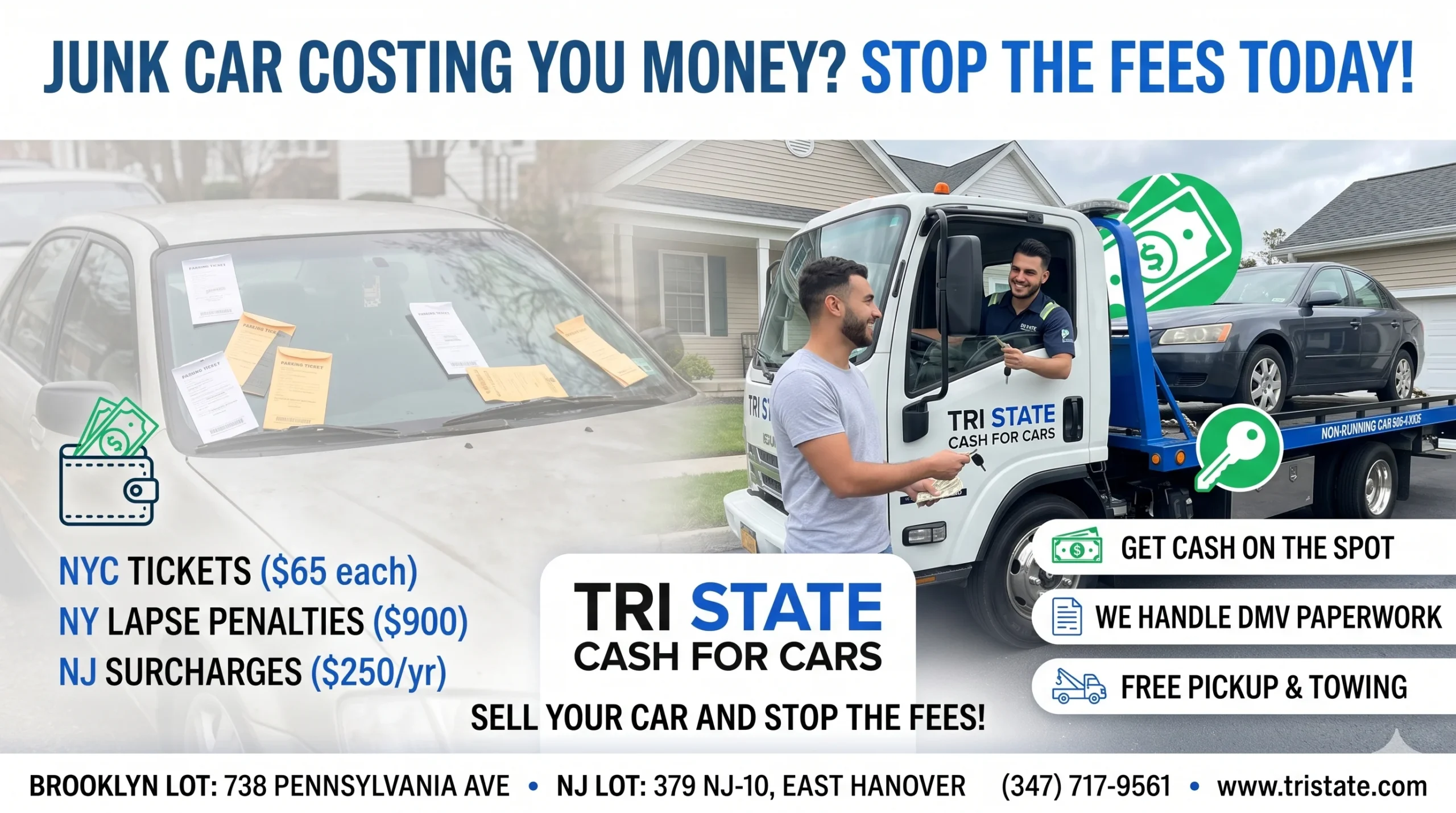
- A junk car in your driveway costs money even parked. NYC summonses run $65 each, a New York insurance lapse can reach $900, and New Jersey adds a $250-a-year uninsured surcharge.
- Once a repair hits half the car’s value, fixing it rarely pays off, and flood damage wipes out most of a car’s worth.
- A dead car still has cash value, and you don’t have to tow it yourself.
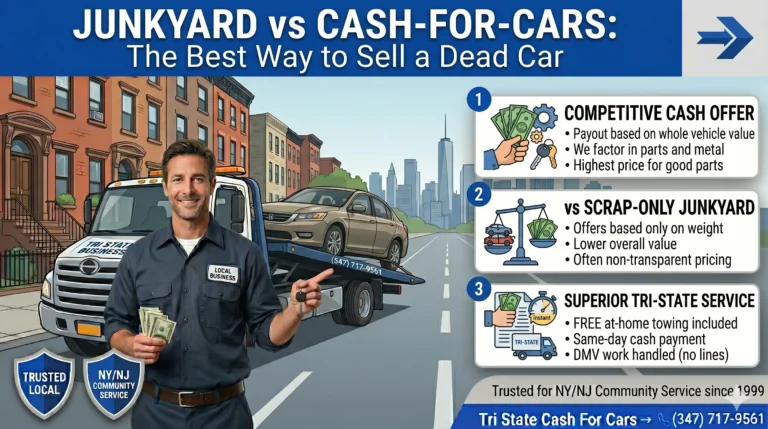
- Tri State Cash For Cars buys non-running and unregistered cars across Brooklyn and North Jersey, pays cash on the spot, and handles the DMV paperwork.
You keep getting tickets because an unregistered or uninspected car parked on a public street in New York or New Jersey breaks the law every day it sits there, even if you never start it. In NYC, an expired registration or inspection sticker is a $65 parking summons each time an officer passes, per the Department of Finance. The fix is to stop owning the problem.
Why does the DMV still want fees on a car I can’t drive?
The DMV keeps charging because your registration and insurance stay active until you cancel them, not when you stop driving. New York requires continuous liability insurance on any registered car, even one parked. Cancel it without surrendering your plates first and the lapse penalty reaches $900 over 90 days, per the NY DMV. New Jersey adds a $250-a-year uninsured surcharge for three years. Surrendering plates stops the clock, and Tri State Cash For Cars walks owners through it before pickup.
Why is my mechanic’s repair quote never worth it on such an old car?
A repair stops being worth it once it costs about half the car’s market value, the line most mechanics and Kelley Blue Book draw. An engine job runs $3,000 to $7,000 and a transmission $2,500 to $4,500, often more than the car is worth. On a car valued under $5,000, one major repair erases any reason to keep it. Selling it as-is to a buyer like Tri State Cash For Cars puts cash in your pocket instead of into a shop.
Why does a flood-damaged car lose almost all of its value?
A flood-damaged car loses most of its value because water destroys the wiring, electronics, brakes, and engine from the inside, then keeps corroding after it dries. Flood-titled cars usually keep only 10 to 30 percent of clean-title value. CARFAX counted up to 482,000 flood cars on U.S. roads entering 2025, with New Jersey among the top states. If your car took on water, a buyer that accepts flood and salvage cars is the cleaner exit.
How do I get rid of a junk car that doesn’t run in Brooklyn?
The fastest way to clear a non-running car in Brooklyn is to sell it to a licensed cash-for-cars buyer that tows it free. DSNY only hauls an abandoned car away if it has no plates and is worth under $1,250, and that path is slow. Scrap yards pay metal value but make you arrange transport. Tri State Cash For Cars buys dead cars in every borough from its Brooklyn lot at 738 Pennsylvania Ave and pays cash the same day.
What can I do with a car that’s too expensive to repair?
You have five real options for a car that costs too much to fix: sell it as-is, part it out, scrap it, donate it for a tax write-off, or sell it to a cash-for-cars buyer. Private sales drag on and attract lowballers. Parting it out eats weeks. Scrap pays only steel value, roughly $160 to $210 a ton in 2025. Selling to Tri State Cash For Cars combines a fair cash offer, free pickup, and finished paperwork in one visit.
How do I sell a non-running car without towing it myself?
You sell a non-running car without towing it yourself by using a buyer that builds free pickup into the offer. They quote you by phone or online, schedule a pickup, then send a driver who checks the car, pays you on the spot, and tows it away. You never touch a tow truck. Tri State Cash For Cars does this across New York, New Jersey, and Connecticut, often within 24 to 48 hours of your call.
Frequently Asked Questions
Can I sell a car that’s been sitting in my driveway for years?
Yes. Cars that sat for years usually have dead batteries, flat tires, and gummed-up fluids, but cash-for-cars buyers take them regardless of whether they run. The one thing you need is proof of ownership, normally the title or a duplicate. Tri State Cash For Cars regularly buys cars that haven’t moved in years.
How does free junk car removal actually work in New Jersey?
You get a quote, schedule a free pickup, sign the title over at the curb, and get paid on the spot. Afterward you file a Notice of Sale (Form OS/SS-UTA) with the NJ MVC and surrender your plates. An active registration isn’t required as long as you hold the title. Tri State Cash For Cars handles pickup from its East Hanover lot at 379 NJ-10.
What paperwork do I need to junk a car in New York?
You need the title signed over and your plates surrendered to the DMV, which gives you an FS-6T receipt as proof you’re off the hook. If an insurer totaled the car, you’ll also have a salvage certificate. If you have no title, request a duplicate or sell to a licensed buyer that accepts a bill of sale and ID. Tri State Cash For Cars helps Brooklyn sellers sort this before pickup.