Selling a Car With Cosmetic Damage: Fix It or Sell As-Is?
Yes, you can sell a car with cosmetic damage, and in most cases you should not spend much fixing it first. Dents, scratches, peeling clear coat and scuffed bumpers lower what a buyer will pay, but usually by less than a shop would charge to remove them. If you are in New York, New Jersey or Connecticut, we send a team to your location, give you a cash offer, handle the paperwork and pay at pickup, whether the car runs or not.
This guide explains what counts as cosmetic, what repairs really cost, how to do the math on your own car, and how to sell without the hassle of listings and lowball haggling.
TL;DR
- Cosmetic damage affects looks, not safety or drivability. Dents, scratches, faded paint, scuffed bumpers and torn upholstery all qualify.
- A common rule of thumb: repair only if the cost is a small share of the car’s value (roughly 5 to 10%). On an older car, $500 or more of bodywork rarely pays back.
- Dealers and buyers price cosmetic work at retail rates, so your repair has to save more than it costs to be worth doing.
- Disclose what you know, state the mileage in writing, and sell the car “as-is” with the paperwork done right.
- We pay the offer we quote at pickup, in NY, NJ and CT, and handle the paperwork for you.
Table of Contents
- What counts as cosmetic damage
- How cosmetic damage affects your offer
- What cosmetic repairs cost
- Fix it or sell it as-is: a simple test
- Why selling to a dealer or on a listing often frustrates people
- Disclosure: what to tell the buyer
- Paperwork to have ready
- How to get the most from a cosmetically damaged car
- Perspective
- Get an offer without repairing anything
- FAQ
- Sources
What counts as cosmetic damage
Cosmetic damage changes how a car looks without changing how it drives or how safe it is. Typical examples:
- Door dings, small dents and hail pocks
- Surface scratches and deeper scratches that reach the paint
- Scuffed or cracked bumper covers
- Faded, peeling or oxidized paint and clear coat
- Cracked trim, missing badges, worn or torn seats, stained carpet
The line is safety and function. A crumpled frame, a bent suspension part, an airbag warning light or a damaged sensor is no longer cosmetic, even if it came from the same fender bender. Be honest with yourself about which side your car is on, because it changes the price and what you need to tell a buyer.
Hail is a good example of damage that is cosmetic on the surface but covers many panels at once. If that is your situation, our guide on selling a hail damaged car for fair cash walks through how to price it.
How cosmetic damage affects your offer
Every buyer prices damage by asking what it costs to make the car sellable again. A dealer adds the repair at retail rates, then subtracts a margin for the time and risk of reselling. That is why a $300 fix on your driveway can turn into a much larger deduction on an appraisal sheet.
A professional dent repair technician writing for DentPicks makes the same point: appraisers deduct reconditioning at retail rates, which usually run higher than what a repair actually costs you. The practical lesson is that the deduction can be larger than the repair bill, which is exactly why people wonder whether to fix first.
The answer depends on three things:
- How visible the damage is. One door ding is easy to overlook. A crumpled quarter panel is the first thing a buyer sees.
- The car’s value. The same $800 scrape matters a lot on a $4,000 car and very little on a $30,000 one.
- Who is buying. A retail shopper wants a clean car. A buyer who plans to wholesale, resell or part out the vehicle prices the damage differently and often cares more about the title, mileage and condition of the mechanical parts.
What cosmetic repairs cost
Autotrader’s February 2026 guide on fixing dents and scrapes on an older car gives typical costs for non-luxury vehicles:
| Damage | Typical repair cost |
|---|---|
| Small dent, paint intact | $100 to $250 |
| Minor bumper scuffs | $150 to $600 |
| Deeper scratch or dent needing repaint | $400 to $800+ per panel |
| Multi-panel bodywork | $1,000 to $1,500+ |
| Bumper replacement with paint | $700 to $1,500+ |
The bumper range is wide because modern bumpers often hide parking sensors and driver-assistance hardware, and trim level changes the price. Treat these numbers as a starting point and get a written quote for your own car.
Fix it or sell it as-is: a simple test
Autotrader’s rule of thumb is that a repair costing roughly 5 to 10% of the car’s value is often reasonable, while anything above about 10% is usually not worth it unless it involves safety, rust risk or a lease turn-in. On a car worth only a few thousand dollars, it says that spending $500 or more on cosmetic damage often does not make sense.
Here is the test in three steps.
- Get one written quote. Ask a body shop to price the specific damage.
- Estimate the gain. Compare what buyers would offer for the car damaged and for the car repaired. The gap is your possible gain.
- Subtract. The DentPicks example is a good one: a $900 repair that raises an appraisal by $1,000 nets you only $100, and that is before the days without your car and the time spent dropping it off.
A worked example
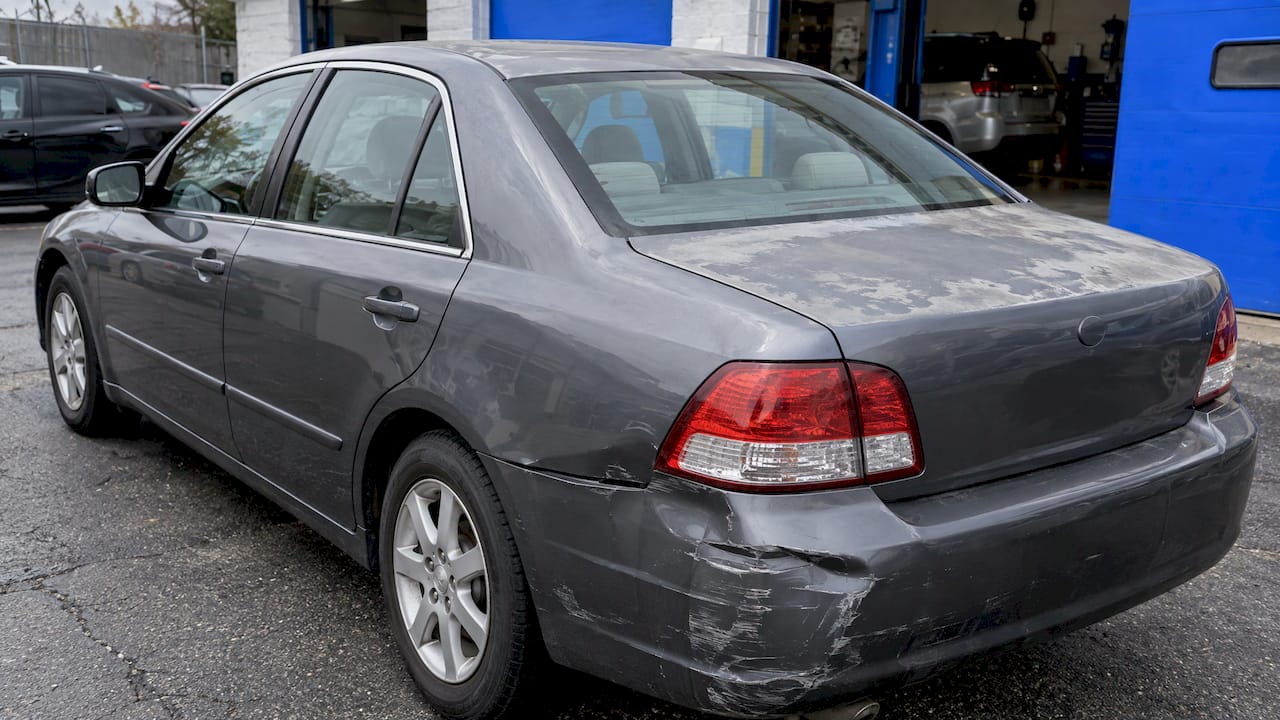
Say your 2012 sedan is worth about $5,000 with a scraped, dented rear bumper and a faded hood. A body shop quotes $1,200 to fix both. That is 24% of the car’s value, well above the 10% guideline. Even if the repair lifted your offers by $1,200, you would break even after weeks of effort. Selling as-is saves the money, the time and the risk of finding more problems once the panels come off.
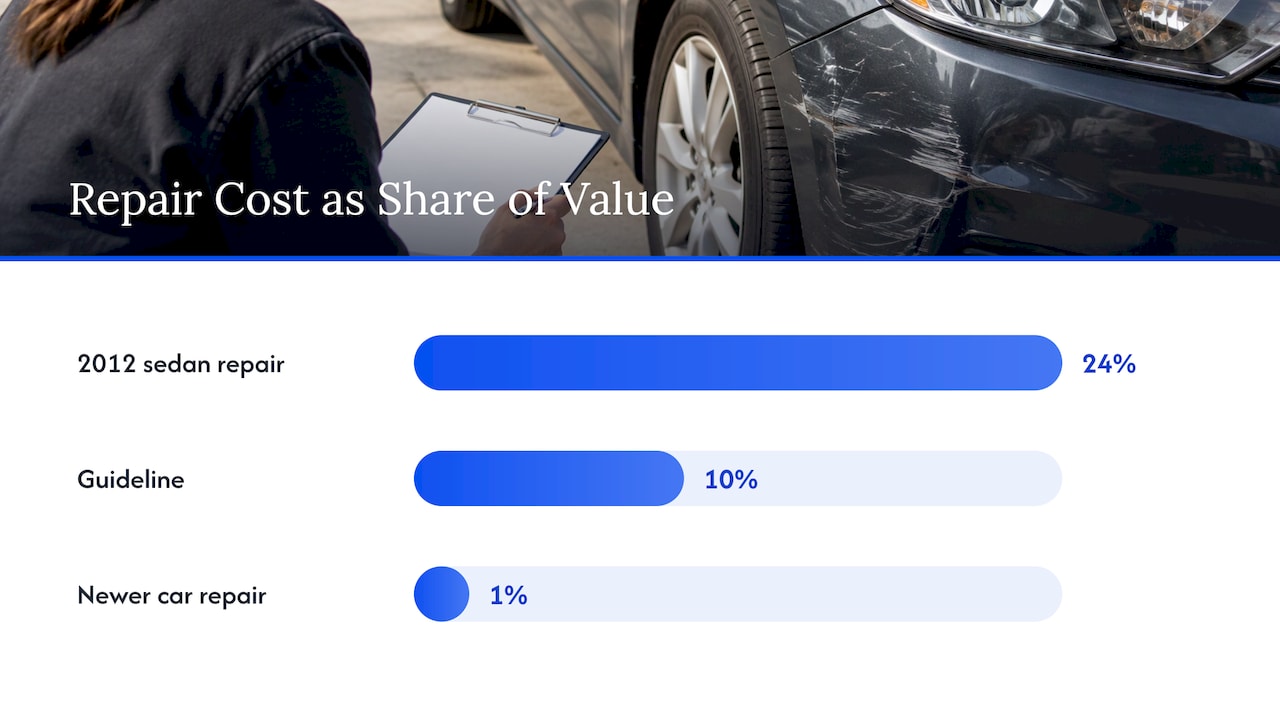
Now take a newer car worth $20,000 with one $200 paintless dent repair on a door. That is 1%, a quick job, and it makes sense to do it before showing the car to retail buyers.
When repair is worth it
- The repair is small and cheap compared with the car’s value.
- The damage is a safety issue, such as a cracked windshield in the driver’s view or a loose bumper cover.
- You are returning a leased vehicle and will be billed for excess wear.
- You are listing the car for sale to retail buyers and have time to wait.
If none of these apply, and especially if you want the car gone quickly, selling as-is is the cleaner route.

Why selling to a dealer or on a listing often frustrates people
Sellers with cosmetic damage usually try three routes, and each has a friction point.
- Dealer trade-in. The appraiser walks around the car, points at every scratch, and deducts reconditioning at retail rates. The offer is often shaped by what the dealer needs for its own lot.
- Private listing. You photograph the car, answer messages, schedule showings and deal with no-shows. Buyers use every visible flaw as a reason to negotiate, and each new buyer sees the dents again.
- Waiting for the perfect buyer. The longer a car sits, the more it costs you in insurance, registration and parking.
If you want speed and certainty, a direct cash buyer who comes to you removes most of those steps. Our fast car sale options for NY, NJ and CT page compares a 24 to 72 hour cash sale with slower routes that may bring more money.
Disclosure: what to tell the buyer
Cosmetic damage is visible, so there is little to hide. The risk comes from what you know and the buyer cannot see. Two principles apply across the country:
- Mileage must be stated in writing. Progressive’s private-sale guide says sellers should disclose mileage as required by federal law, pass on any transferable warranty, and state clearly that the car is sold “as-is” when there is no warranty.
- “As-is” has limits. It puts the risk of unknown problems on the buyer, but it is not a license to stay silent about a defect you know about. Rules differ by state, so if you are unsure about a particular problem, check with your state’s motor vehicle agency or a lawyer.
The simplest approach is to describe the damage plainly, take dated photos, and put “sold as-is” on the bill of sale. If the car has ever carried a salvage brand, the rules are stricter; read our guide to legally selling a salvage title car before you do anything else.
Paperwork to have ready
Cosmetic damage does not change the paperwork, but a clean paper trail protects you after the car leaves.
- Title. Have it in hand and signed where required. If a lender holds it, the payoff has to be settled as part of the sale; our car buying service process explains how that works, even with a loan.
- Bill of sale. Include the date, price, VIN, mileage, both parties’ names and an “as-is” statement.
- Odometer reading. Write the true mileage.
- Plates and insurance. In New York, plates come off before you cancel coverage; see NY car sale paperwork for private sellers. New Jersey has its own steps, covered in 3 forms for NJ car sale paperwork.
- Records. Keep copies of the signed documents and photos of the car at handover.
If you want to see what gets signed on pickup day, our car pickup paperwork guide lists it in order.
How to get the most from a cosmetically damaged car
You cannot make dents disappear cheaply, but you can make the car look like one worth buying.
- Wash and vacuum it. A clean car reads as a cared-for car. Remove trash and personal items.
- Fix the small things that cost nothing. Replace a missing badge, clean the glass and top off fluids.
- Photograph the damage honestly. Clear photos in daylight keep the offer from changing later.
- Gather your records. Service receipts and a clean title show the car has been looked after.
- Be exact about the condition. An offer based on accurate details is one that holds at pickup. Our guide on closing the gap in instant car offer accuracy shows what to report so the number does not move.
Perspective
Most people who call us about cosmetic damage have already spent a weekend worrying about it. They are weighing a $700 body shop bill against an offer they expect to be low, and they usually do not need to.
Our approach is built around removing that worry. We quote you a price, and we commit to paying that stated price at pickup. A team comes to where the car is, the paperwork is handled, and payment is same-day. A scraped bumper or a dented door does not turn into a surprise at the curb.
We buy cars, SUVs, trucks, vans and commercial vehicles in New York, New Jersey and Connecticut, running or not, with or without a title. If your car has cosmetic damage, the best use of your time is to keep your money, skip the repair shop and get an offer.
Eric
Get an offer without repairing anything
If you decide to sell as-is, our Sell Your Car service is built for that. We give you a cash offer, send a team to your location, handle the paperwork and pay at pickup. Cars with dents, scratches, faded paint or a damaged bumper are the kind we take every day, running or non-running, and you do not need a clean title to start the conversation.

If you would like to see how an on-site visit works before you book, read about our on-site car appraisal, or learn how a pickup sale works from your own driveway. If the damage goes beyond cosmetic, our guide to selling a damaged car fast for fair cash covers it.
FAQ
Can I sell a car with dents and scratches?
Yes. Cosmetic damage does not stop a sale. It changes the price, because buyers deduct what it would cost to recondition the car. Describe the damage honestly, state the mileage in writing and sell it as-is, and you can close the sale in a day.
Will insurance total a car for cosmetic damage?
Rarely. An insurer declares a car a total loss when repair costs approach the car’s value, and cosmetic damage on its own is usually far cheaper than that. If a claim has already been filed, ask your insurer how it is being handled before you sell, because a settlement can affect who owns the car and its title status.
Should I fix a dent before selling?
Only when the repair is small compared with the car’s value. A common rule of thumb is about 5 to 10% of value, and on an older car, bodywork over roughly $500 often fails to pay back. Get a written quote and compare it with the extra money the repair would bring.
Do I need to disclose cosmetic damage?
Visible damage is easy to describe, and describing it protects you. Disclose anything you know about that a buyer could not see, state the true mileage in writing, and put “as-is” on the bill of sale. State rules vary, so confirm the specifics with your state’s motor vehicle agency.
Can I sell a damaged car without a title?
We buy vehicles with or without a title in New York, New Jersey and Connecticut. Tell us what documents you have when you ask for your offer, and we will explain what is needed for pickup.
Sources
- Should You Fix Dents and Scrapes in Your Older Car? (Autotrader)
- Should I Repair Dents Before Selling or Trading In My Car? (DentPicks)
- How to Sell a Car Privately (Progressive)