
File NJ Odometer Disclosure Right With OS/SS-2 and Onsite Cash Help
If you’re selling or buying a vehicle in New Jersey and the deal requires reporting mileage, you need to complete an odometer disclosure using NJ MVC Form OS/SS-2. Download it from the New Jersey Motor Vehicle Commission’s forms page, fill it out with the seller and buyer signatures, and submit it alongside the assigned title promptly. Digital signatures work, but only when paired with a Certificate of Completion.
TL;DR:
- Completing the form requires an accurate VIN, exact mileage in whole miles, and selecting only the appropriate mileage status box to avoid rejection.
- Digital signatures are permitted only with an attached Certificate of Completion, ensuring verification; otherwise, wet signatures remain the simplest option.
- Exempt vehicles include those over 20 model years old, with GVWR over 16,000 pounds, or when the title already contains a completed odometer section.
- Submissions must be made within 10 working days from sale, with all required documents, to avoid penalties and ensure the mileage becomes the official record.
- Most errors stem from incomplete or incorrectly filled forms, so thoroughness and double-checking are essential to prevent delays or rejection at MVC.
Table of Contents
- What Is Form OS/SS-2 and When You Must Use It
- Where to Get the Official Form and How Digital Signing Works
- Step-by-Step: Completing the Odometer Disclosure Without Mistakes
- Notarization, Power of Attorney, and Special Signing Cases
- Submission Logistics: Timeline, Documents, and Fees
- Penalties and Buyer Remedies if Mileage Is Misrepresented
- How Tri State Cash For Cars Helps With Odometer Disclosure and Title Transfer
- What the Rules Actually Ask of You (and What They Don’t)
- Get Your Vehicle Sold Without Wrestling the MVC Yourself
- Sources
- FAQ
What Is Form OS/SS-2 and When You Must Use It
Form OS/SS-2 is the official odometer disclosure statement New Jersey requires as a supplement to the vehicle’s title during ownership transfer. It exists because titles don’t always have room, or the right format, to capture a legally binding mileage statement from both parties. Think of it as the paperwork that turns “the odometer read 84,213 miles” into a sworn, enforceable fact.
Under N.J. Admin. Code § 13:21-5.9, both private sellers and dealers must disclose mileage in writing at the time of transfer for qualifying vehicles. Dealers also carry recordkeeping duties that private sellers don’t, since dealer transactions get audited more closely.
Not every sale needs the form, though. Common exemptions include:
- Vehicles that are 20 model years old or older
- Vehicles with a gross vehicle weight rating (GVWR) over 16,000 pounds
- Certain transfers where the title itself already contains a completed odometer section that meets disclosure requirements
Here’s where people get tripped up: some New Jersey titles have a built-in odometer block, and sellers assume that’s enough. It sometimes is. But if that section is incomplete, illegible, or the transaction involves a lien release, power of attorney, or a corrected title, the MVC will usually ask for the standalone OS/SS-2 anyway. A NHTSA rule revision effective January 1, 2021, also updated which model years fall under federal disclosure requirements, and New Jersey’s practice follows that federal baseline. If you’re unsure whether your situation qualifies, filling out OS/SS-2 costs you nothing and protects you either way.
Where to Get the Official Form and How Digital Signing Works
The only source you should trust for OS/SS-2 is the NJ MVC forms page or an MVC agency counter. Both give you the current, legally accepted version of the form.
You’ll find copies of OS/SS-2 floating around on third-party legal document sites and fillable-PDF services. Some are fine for reference. None of them are the official copy, and if the MVC updates a field or a disclosure line, those third-party versions can lag behind without you knowing. Stick with the government PDF.
A few things to keep in mind when sourcing and signing the form:
- The OS/SS-2 PDF must accompany a fully assigned Certificate of Title or Manufacturer’s Certificate of Origin, not stand alone.
- Wet ink signatures are always accepted and remain the simplest option for most private sales.
- Digital signatures are allowed, but only when each digital signer’s signature comes with a Certificate of Completion attached to the document package.
- A Certificate of Completion is essentially an audit trail, a record generated by an e-signature platform confirming who signed, when, and from where. Without it, the MVC treats a digital signature as unverifiable and can reject the whole submission.
If you’re doing an e-signature closing because the buyer or seller lives out of state, confirm your signing platform generates that certificate automatically. Not all of them do by default.
Step-by-Step: Completing the Odometer Disclosure Without Mistakes
Most rejected odometer disclosures fail for the same handful of reasons, and nearly all of them are avoidable if you slow down for five minutes. Here’s the order that keeps you out of trouble.
-
Copy the VIN character by character. Pull it from the title itself, not from memory or a text message. Compare it against the VIN plate on the vehicle before you submit anything. A single transposed digit is enough to bounce the whole form.
-
Record the odometer reading in whole miles only. New Jersey’s odometer guidance is explicit: no tenths, no decimals. If the odometer shows 84,213.7, you write 84,213. Trying to preserve that extra precision is one of the most common reasons the MVC kicks a form back.
-
Check exactly one status box. The form gives you three options: the mileage shown is the actual mileage, the mileage exceeds the odometer’s mechanical limits, or the odometer reading is not the actual mileage (a warning that the number can’t be trusted, often tied to a replaced or tampered odometer). Checking more than one box, or leaving all three blank, is grounds for rejection.
-
Sign in the right order and add dates. The seller signs first, then the buyer. Both signatures need to be dated the actual day each party signed, not a single date applied to both. Include printed names and current addresses next to each signature line. MVC clerks compare these against the ID you present, and a mismatch stalls the process.
-
Gather your supporting documents before you go to the counter. You’ll need the assigned Certificate of Title (or MCO for a new vehicle), a government-issued photo ID, and proof of insurance when the transaction requires it. Bring the completed OS/SS-2 as a separate document rather than folded into the title paperwork.
Pro Tip: Keep a photocopy of the completed OS/SS-2 and the front and back of the title before you submit them. If the MVC has a processing question weeks later, having your own copy saves you from starting the paperwork over from scratch.
The LegalClarity guide on completing OS/SS-2 notes that incomplete submissions, missing signatures, or a form that isn’t paired with a fully assigned title are the most frequent causes of delay at MVC agencies. None of that is complicated to avoid. It just requires treating the form as seriously as the title itself, not as an afterthought you fill out in the parking lot.
Notarization, Power of Attorney, and Special Signing Cases
Most standard odometer disclosures don’t need a notary. A private seller and buyer signing OS/SS-2 as part of a normal transfer can typically get by with wet signatures and matching ID, no notarization required.
That changes in a few specific situations:
- Mileage corrections. If you’re amending a previously filed odometer statement, such as fixing a transposed digit or correcting a status box that was checked in error, the MVC often requires the corrected signature to be notarized before it will accept the amendment.
- Odometer replacement. When a vehicle has had its odometer physically replaced, the correction process typically needs a mechanic’s signed statement and documentation of the installation, and the MVC may brand the resulting title “N/A” to flag that the mileage shown is not the vehicle’s actual accumulated mileage.
- Power of attorney signings. According to MVC’s POA and odometer statement guidelines, a third party signing on someone else’s behalf, often in manufacturer buyback or lemon law cases, generally must have physical custody of the vehicle at the time of signing so they can actually verify the odometer reading. A generic power of attorney without that custody requirement usually isn’t sufficient; you need a limited POA that specifically authorizes the odometer disclosure.
The MVC’s POA guidance also references a documented grace period for dealers adjusting to updated buyback and odometer statement procedures, so if you’re working through a manufacturer repurchase, it’s worth confirming current timelines directly with the agency rather than assuming last year’s rules still apply.
Submission Logistics: Timeline, Documents, and Fees
New Jersey gives you 10 working days from the date of sale to submit the assigned title and completed odometer disclosure to the MVC. That clock starts the day the seller signs over the vehicle, not the day you get around to the paperwork.
Before you head to an MVC agency, assemble:
- The assigned Certificate of Title, with the odometer section completed or the standalone OS/SS-2 attached
- A bill of sale, if your transaction included one
- Government-issued photo ID for the buyer
- Proof of insurance, when the registration transaction requires it
Miss the 10 working day window and you’re looking at a $25 late penalty on top of standard title and registration fees. It’s a modest amount, but there’s no reason to pay it when the fix is just showing up on time. If you’re also navigating New Jersey’s sales tax rules around the same title transfer window, it’s worth handling both pieces of paperwork in the same trip.
Once the MVC processes your submission, the mileage you disclosed becomes the mileage of record on the new certificate of title. That number follows the vehicle into its next sale, which is exactly why accuracy on this form matters even after your own transaction closes.
Penalties and Buyer Remedies if Mileage Is Misrepresented
Odometer fraud isn’t a paperwork technicality. It’s a federal crime, and New Jersey adds its own layer of consumer protection on top of it.
Federal law makes willful odometer tampering or false disclosure a criminal offense that can carry imprisonment, alongside civil exposure. Under 49 U.S.C. § 32710, a buyer who was defrauded can sue for treble damages (three times actual damages) or $10,000, whichever amount is greater. That floor exists specifically so a defrauded buyer isn’t stuck arguing over a small dollar figure in court.
New Jersey’s Consumer Fraud Act can stack on top of that federal remedy, potentially adding treble damages and attorney’s fees at the state level, which creates real financial exposure for a seller who knowingly misrepresents mileage. The MVC also has administrative enforcement authority separate from any lawsuit.
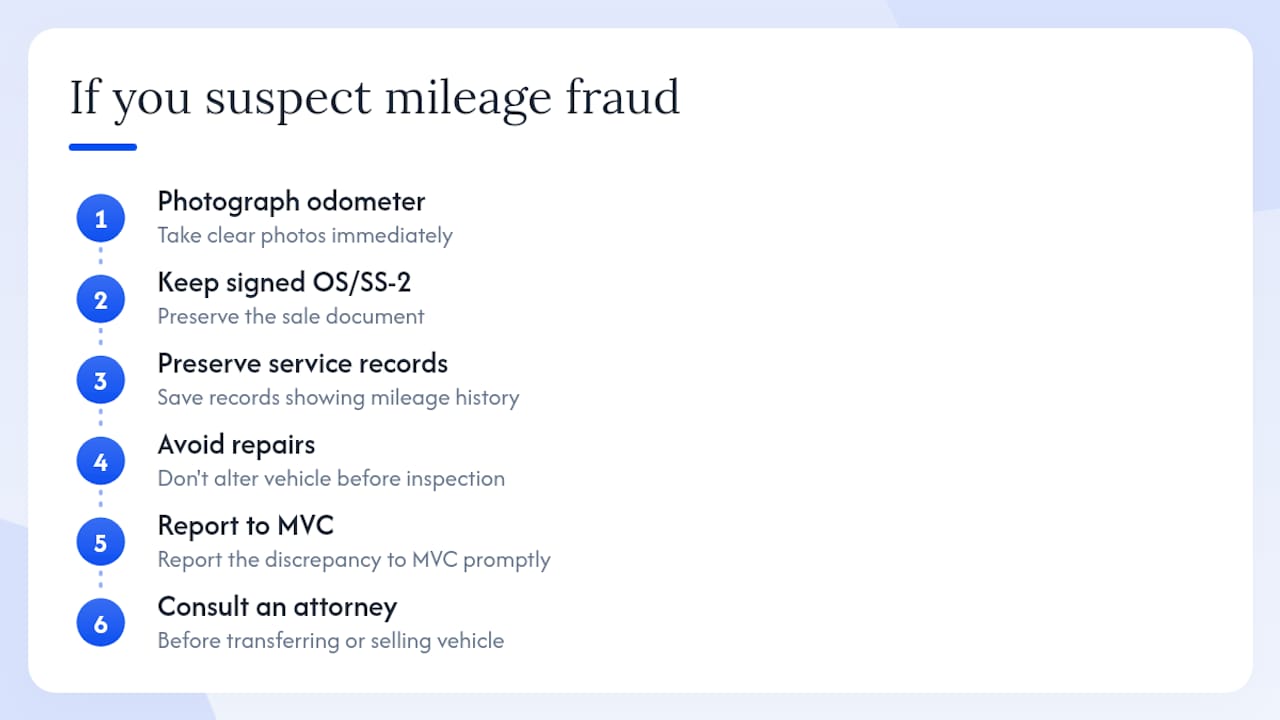
If you suspect a vehicle’s mileage was misrepresented after a purchase, document everything immediately: photograph the odometer, keep the signed OS/SS-2, preserve any service records showing a different mileage history, and avoid making repairs that could complicate an inspection. Report the discrepancy to the MVC and consult an attorney before the vehicle changes hands again.
How Tri State Cash For Cars Helps With Odometer Disclosure and Title Transfer
Filling out OS/SS-2 correctly is one more task on a list that already includes finding a buyer, negotiating price, and coordinating a handoff. A service provider may send someone to your location, make a cash offer, and handle the paperwork on-site, including completing the odometer disclosure as part of the title reassignment.
You still need to have your original title (or Manufacturer’s Certificate of Origin) and a valid photo ID ready at pickup. The legal filing requirements for New Jersey cannot be waived, and the OS/SS-2 still has to be completed accurately regardless of who’s holding the pen. What changes is who’s managing the process: instead of researching form fields and MVC office hours yourself, the paperwork may be completed at the point of sale, with payment occurring at pickup rather than promised for later.
What the Rules Actually Ask of You (and What They Don’t)
Most of the confusion around odometer disclosure in New Jersey isn’t about the law being unclear. It’s about sellers assuming the title’s built-in odometer section is automatically enough, when in practice a standalone OS/SS-2 is often the safer move, especially with a corrected title, a power of attorney, or a lien release in the mix.
The conventional advice, “just fill out the title,” undersells how often that section trips people up on formatting alone. Tenths of a mile, a missing status checkbox, an unnotarized correction: these are small errors with outsized consequences, because the MVC doesn’t process partial compliance. It rejects the whole submission and sends you back to start over.
If you take one thing from this, prioritize getting the form itself right before you worry about anything else. The 10 working day window matters, but it matters less than submitting a form that’s actually correct the first time. A rejected form doesn’t just cost you the $25 late fee risk. It costs you a second trip to the MVC.
— Eric
Get Your Vehicle Sold Without Wrestling the MVC Yourself
Using a specialized cash-for-cars service can be an alternative to spending an afternoon at the MVC counter over a rejected form. Instead of downloading OS/SS-2, double checking every field, and hoping your signatures line up with your ID, you could receive a cash offer and assistance with the paperwork at pickup.
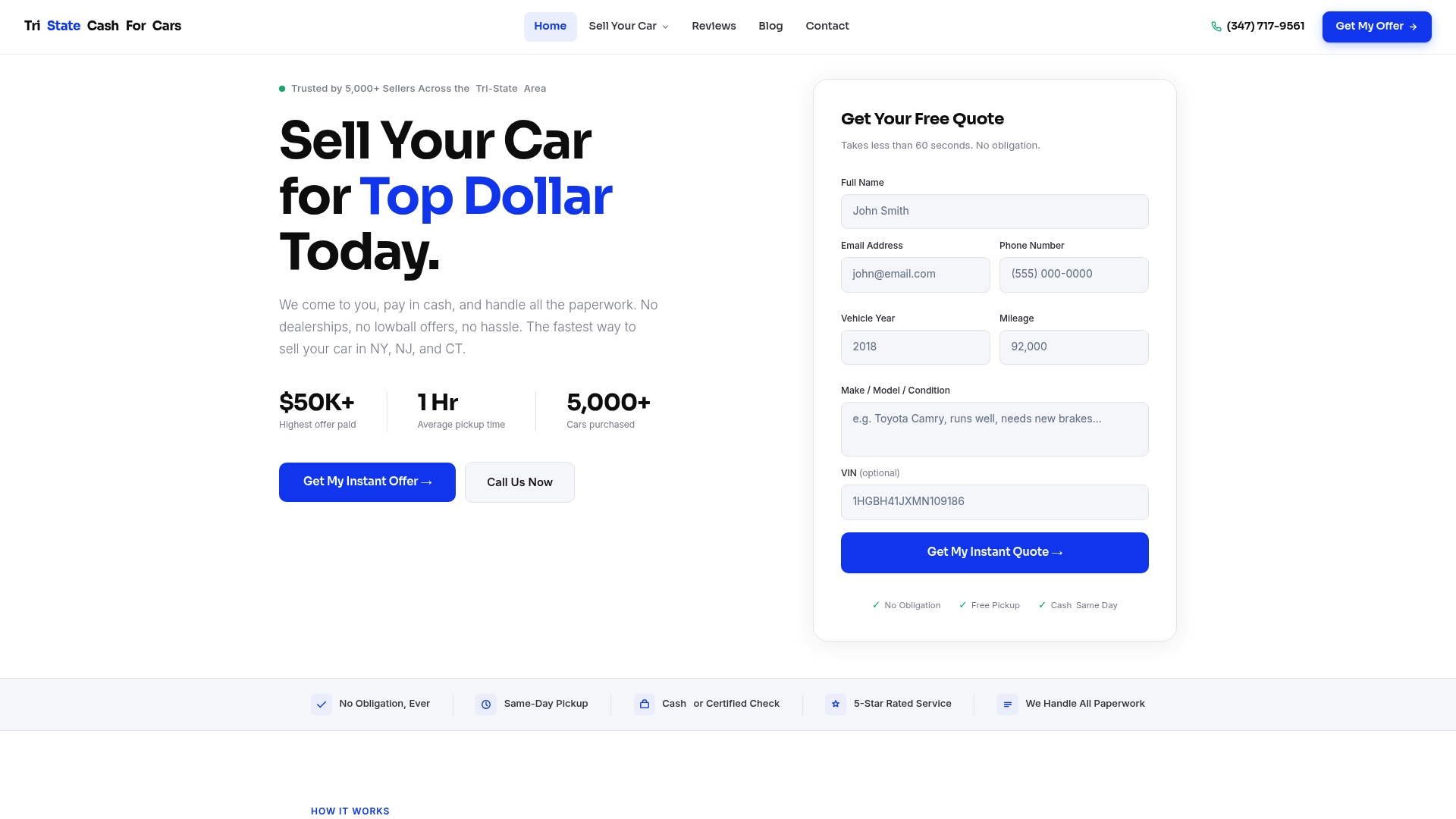
A typical appointment with a cash-for-cars service involves having your title and ID ready, an evaluation of the vehicle, an offer being made, and upon acceptance, payment happening at pickup rather than days later. There’s no separate trip to file the odometer disclosure afterward, because it is part of the same appointment. This process can work for various vehicle types regardless of running condition.
If you’re ready to see what your vehicle is worth without adding another form to your to-do list, check guaranteed cash offers and pickup scheduling and get a number today.
Sources
- N.J. Admin. Code § 13:21-5.9 – Transferring of ownership on certain motor vehicles
- NJ MVC guidance on odometer/mileage statements (GU30)
FAQ
Where can I find the odometer disclosure statement in New Jersey?
The official OS/SS-2 form is available on the NJ MVC forms page or as a direct PDF download, and it’s also available at MVC agency offices.
What does exempt from odometer disclosure mean?
A vehicle is typically exempt from odometer disclosure if it’s 20 model years old or older, or if it has a gross vehicle weight rating over 16,000 pounds; these categories are excluded under both federal and New Jersey rules.
Does an odometer disclosure need to be notarized?
Standard odometer disclosures signed by the buyer and seller generally don’t require notarization, but corrections to a previously filed statement or certain replacement-odometer cases typically do.
Can the odometer disclosure be completed online or digitally?
Digital signatures are accepted on Form OS/SS-2, but only when each signature is accompanied by a Certificate of Completion verifying who signed and when; without it, the MVC treats the submission as unverifiable.