10 Day Title Window: Why Most NJ Sellers Owe No Car Sale Tax
Most private sellers in New Jersey owe nothing when they sell a personal vehicle. There’s no sales tax charged to you as the seller, and income tax only comes into play if you actually sold the car for more than you paid for it, adjusted for a few factors. The buyer, not you, handles sales tax when they title and register the vehicle at the NJ Motor Vehicle Commission. Your job is paperwork, not a tax bill.
TL;DR:
- Most private sellers in New Jersey do not owe sales tax, as the buyer is responsible for paying it when registering the vehicle.
- Only gains from appreciation of collector or classic cars, barter transactions, or business-use vehicles with claimed depreciation require reporting taxable gains.
- Accurate paperwork, including a truthful title, detailed bill of sale, and proper lien resolution, is essential to avoid legal and tax issues.
- Sellers must transfer the title within 10 working days and remove plates immediately to avoid liabilities or penalties.
- Most post-sale disputes stem from sloppy documentation rather than tax obligations, emphasizing the importance of thorough, timely paperwork.
Table of Contents
- When Does Car Sale Tax in NJ Actually Apply?
- Seller Paperwork Checklist for a Private Sale in NJ
- How Long Do You Have to Transfer the Title in NJ?
- How to Report a Taxable Gain, If You Have One
- Common Mistakes That Turn a Simple Sale Into a Headache
- A Publisher’s Perspective on Reducing Paperwork Risk
- Sell Your Car Fast Without the Paperwork Guesswork
- Where to Verify These Rules Yourself
- Sources
- FAQ
When Does Car Sale Tax in NJ Actually Apply?
The rule that trips people up is a simple one: sales tax on a used vehicle transaction is the buyer’s responsibility paid at the counter when they title and register the car at the MVC. You don’t collect it, file it, or send a check to the state. That part of “car sale tax nj” searches worry about doesn’t touch sellers at all.
Where it gets more interesting is capital gains. New Jersey residents must report a taxable gain in the year it’s realized, and that applies to a car sale just like it applies to stock or a house, according to the Division of Taxation. The math is proceeds minus adjusted basis. Since almost every daily driver loses value the moment it leaves the lot, most people sell for less than they paid, which means there’s no gain and nothing to report.
The exception is the vehicle that goes the other direction. A well-kept 1969 Camaro or a low-mileage classic Bronco can actually appreciate, and if you bought it for $12,000 a decade ago and sold it for $28,000 last month, that $16,000 difference is a reportable gain. A few situations where sellers should pay closer attention:
- Collector or classic cars that have gained value since purchase.
- Barter or trade transactions, where you swap a car for goods, services, or another vehicle. These transactions are generally taxable based on fair market value, regardless of the form of payment.
- Business-use vehicles where depreciation was claimed, since that changes your adjusted basis.
A normal used-car sale, say a 2016 Honda Civic sold for $9,000 after you paid $18,000 new, generates a loss not a gain. No tax event, no filing requirement. Confuse those two categories and you either overpay a tax you don’t owe or, worse, skip a report you actually needed to file.
Seller Paperwork Checklist for a Private Sale in NJ
Get the paperwork right and the tax question mostly takes care of itself. Here’s the order that actually works:
- Complete the certificate of title accurately. Fill in the sale price, the date of sale, and the exact odometer reading. Don’t round the mileage or fudge the price. If the MVC or the Division of Taxation ever cross-checks the sale against market data, an honest title is your best defense.
- Write a detailed bill of sale. Include both names, the VIN, sale price, date, and odometer reading. Notarizing it isn’t always required, but it adds weight if the price is unusual.
- Add a seller’s affidavit when the price is unusually low. If you’re selling to a family member for $500 on a car worth $6,000, or unloading a car with major mechanical problems for cheap, document why. The state may request proof when a sale price looks inconsistent with market value.
- Resolve any lien before you sign anything. If a lender’s name is on the title, you need a payoff and a lien release first. Coordinate directly with the bank, sometimes the buyer’s payment goes straight to the lienholder to clear it at closing.
- Remove your plates and keep copies of everything. Once the sale is done, take the plates off before the buyer drives away.
Pro Tip: Scan or photograph the signed title, the bill of sale, and your ID at the moment of sale. If a question ever comes up about the transaction, having dated digital copies beats digging through a glove box six months later. For a fuller walkthrough of this process, see our guide to selling a car privately in NJ.
How Long Do You Have to Transfer the Title in NJ?
You have 10 working days from the sale date to get the title transferred, and missing that window can trigger a $25 penalty tied to the transfer, per MVC guidance. The buyer pays sales tax directly to the MVC when they title and register, not to you, but you should still hold onto your bill of sale and title copy in case the sale price ever needs backing up later.

These figures come from MVC’s fee guidance, and they apply regardless of what the car sold for.
How to Report a Taxable Gain, If You Have One
If your sale actually produced a gain, the calculation starts with your adjusted basis, which is what you originally paid, plus the cost of documented improvements, minus anything already deducted (like depreciation if the car was used for business). Subtract that basis from your sale proceeds, and whatever’s left over is your gain.
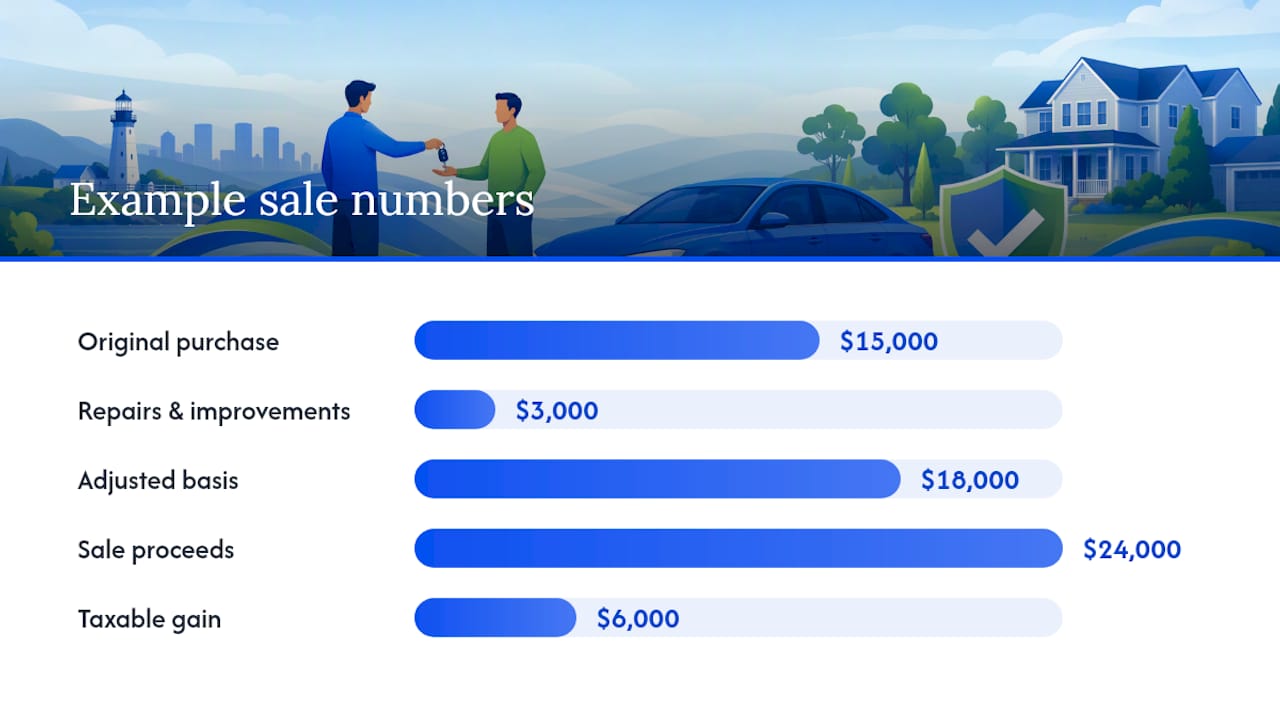
Here’s a simple version: say you bought a restored classic for $15,000, put another $3,000 into a new transmission and paint job with receipts to prove it, and sold it two years later for $24,000. Your adjusted basis is $18,000. Your gain is $6,000, and that’s the number New Jersey expects reported on your state return for the year you sold it.
A few things to keep on file if this applies to you:
- The original purchase receipt or bill of sale.
- Receipts for any major repairs or restoration work that add to your basis.
- The final sale’s bill of sale and title copy, showing date and price.
If the math gets complicated, especially with a business-use vehicle or a car you inherited, a tax professional can sort out the basis calculation faster than you can guess at it. For the overwhelming majority of sellers moving a regular used car, though, this section simply won’t apply.
Common Mistakes That Turn a Simple Sale Into a Headache
A few avoidable errors cause most of the post-sale trouble sellers run into:
- Leaving plates on the car. You stay on the hook for tickets and violations until the transfer is confirmed, so pull them the moment the deal closes and hang onto proof of removal.
- Underpricing the title to help the buyer save money. This can flag the sale for review and creates a paper trail that contradicts what actually happened.
- Signing over a title while a lien is still active. That’s not a valid transfer, and it can leave both parties in legal limbo.
Pro Tip: Keep a single folder, digital or physical, with the signed title, bill of sale, and a photo of your plates being removed. It takes five minutes and settles almost any dispute before it starts.
A Publisher’s Perspective on Reducing Paperwork Risk
Most of the tax questions sellers worry about never materialize. The real risk isn’t a surprise tax bill. It’s sloppy paperwork that creates confusion months later. That’s exactly why we built our process the way we did: Tri State Cash For Cars sends someone to you, handles the title, and makes sure plates come off and documentation is correct on the spot. Fewer loose ends, less chance the Division of Taxation ever has a reason to ask a question in the first place.
— Eric
Sell Your Car Fast Without the Paperwork Guesswork
There are services that come to you, provide a cash offer on the spot, and handle title paperwork to help with the transfer window and lien coordination.
This makes the most sense if you need cash quickly, don’t want to chase a buyer through Facebook Marketplace, or you’re dealing with a vehicle that has a lien, damage, or isn’t running. Some buyers may pay at pickup without waiting on a check to clear. Before they arrive, have your signed title or loan payoff information if there’s a lien, a valid photo ID, and your keys and any spare fobs ready.
Check what your vehicle could get with our cash offer near you, or browse our full cash seller’s guide to see exactly how the pickup process works.
Where to Verify These Rules Yourself
Check title and transfer rules directly with the NJ MVC, capital gains reporting with the Division of Taxation, or start a sale today at Tri State Cash For Cars.
This article is general information, not a substitute for advice from a qualified financial advisor. Consult a qualified financial professional about your own circumstances before acting on anything here.
Sources
FAQ
Do I Owe Sales Tax When I Sell My Car in NJ?
No. The buyer pays sales tax when they title and register the vehicle at the MVC, not you as the seller.
What if I Trade My Car for Another Vehicle Instead of Cash?
Barter and trade transactions are still taxable based on fair market value, according to the Division of Taxation, even though no cash changed hands.
When Should I Remove My License Plates After Selling?
Remove them immediately at the time of sale. You remain liable for tickets and violations on the vehicle until the transfer is confirmed with the MVC.
Can I Sell a Car in NJ That Still Has a Lien?
Only after the lien is satisfied. Coordinate with the lender for a payoff and lien release before signing the title, or use a service like Tri State Cash For Cars to help manage that step.
Will I Ever Have to Report a Car Sale on My NJ Tax Return?
Only if you sold the vehicle for more than its adjusted basis, producing an actual capital gain. This rarely happens outside of appreciating collector or classic cars.