Cancel Registration in NY and Keep Your Refund: Get FS-6T in 21 Days
To cancel registration in NY, surrender your license plates to the DMV before you cancel your liability insurance, not after. Use form PD-7 to do it in person, by mail, or at a participating county clerk. Once processed, the DMV mails you an FS-6T receipt, which is your legal proof of the surrender date. Keep it. It’s the only thing standing between you and a penalty notice if the state’s records don’t match yours.
TL;DR:
- Surrender plates before canceling insurance to prevent automatic penalties and ensure the DMV records match your action, especially if moving or selling the vehicle.
- Use form PD-7 along with both plates, then choose your method— in person, mail, drop box, or county clerk — and always keep proof of submission.
- Refunds are possible if surrender occurs within 60 days and before using the registration sticker, but taxes and fees are non-refundable regardless of timing.
- Cancel your insurance before surrendering plates to avoid civil penalties or suspension notices, and keep your FS-6T receipt as proof of surrender.
- If plates are lost or stolen, file a police report, attach it to PD-7, and submit the paperwork; refunds are unaffected as long as documentation is complete.
Table of Contents
- When to Surrender Plates and Why the Timing Matters
- How to Surrender Plates: In Person, by Mail, Drop Box, or County Clerk
- Refunds and Transfer Credits: What You May Get and When
- Penalties and Insurance Lapse Consequences (and How to Fight Them)
- If Plates Are Lost, Stolen, or Destroyed
- Address and Mailing Tips That Save You a Second Trip
- Official DMV Forms and Pages to Consult Now
- A Simpler Path If You’re Selling the Vehicle Anyway
- Sources
- FAQ
When to Surrender Plates and Why the Timing Matters
New York links your registration directly to your insurance. The DMV assumes a plate is covered until you tell it otherwise, and it checks that assumption electronically against your insurer’s records almost in real time. Surrendering your plates is what severs that link. Do it out of order, canceling insurance first, and you’re the one who gets flagged for a lapse, not your old insurer.
A few situations force the issue:
- You sold the vehicle privately or traded it in.
- You’re scrapping a vehicle that no longer runs or isn’t worth repairing.
- You transferred the car to a family member or another party.
- You’re moving out of state and registering the vehicle elsewhere.
- You’re parking the vehicle permanently and don’t plan to drive it again soon.
Skip the surrender step and the consequences arrive fast: civil penalties for the insurance gap, a suspended registration, and in some cases a suspended driver’s license until you clear it up. None of that is reversible with a phone call. It requires paperwork, and sometimes a hearing, to undo.
How to Surrender Plates: In Person, by Mail, Drop Box, or County Clerk
Before you touch any of the four surrender methods, do two things: pull both plates and any registration stickers off the vehicle, and fill out a PD-7 Plate Surrender Application for each set of plates you’re turning in. If you’ve got plates from two vehicles, that’s two forms.
- Confirm your DMV mailing address is current. Your FS-6T and any refund check go to whatever address is on file, not the one you type into a form later.
- Choose your surrender method based on how fast you need proof.
- Submit the plates and PD-7 together, using the instructions specific to that method below.
- Save your proof of submission, whether that’s a stamped receipt, a certified mail slip, or a drop-box confirmation.
- Wait for your FS-6T, then file it somewhere you won’t lose it.
In person. Bring both plates and your completed PD-7 to a DMV office or a participating county clerk. Most counties, including Monroe County, charge a $1 processing fee for handling the surrender. Do it this way and you typically walk out with your FS-6T receipt already in hand, or the clerk tells you exactly when to expect it by mail.
By mail. Package both plates flat, attach the completed PD-7, and mail the whole thing to the Albany address printed on the PD-7 form itself. Use certified or tracked mail. This isn’t optional if timing matters to you: the postmark date on your envelope is the DMV’s official surrender date, regardless of when the plates actually arrive or get processed. Expect the FS-6T to take up to a few weeks to reach you.
Drop box. Some county clerk offices and DMV locations accept plates through a drop box, but you won’t get an immediate receipt the way you would handing plates to a person. Your PD-7 gets processed in the next batch, and the FS-6T follows by mail, on the same roughly three week timeline as a mailed submission.
County clerk. Functionally similar to a DMV office visit, minus the DMV branding. Same $1 fee in most counties, same PD-7 requirement, same in-person receipt or mailed follow-up.
If someone else surrenders your plates for you, write clear instructions on the PD-7 or in an attached note so the FS-6T mails to your address, not theirs. A written authorization avoids confusion if the clerk asks who the receipt belongs to.
Pro Tip: If you’re cutting it close on an insurance cancellation date, surrender in person or at a county clerk window. The postmark rule protects you legally, but a same-day receipt protects your sanity.
If you’re surrendering plates because you sold the car, the bill of sale process in New York runs on a similar paperwork track and is worth understanding at the same time.
Refunds and Transfer Credits: What You May Get and When
Surrendering plates early doesn’t always mean losing money. If you’re partway through a paid registration term, you may qualify for a partial refund or a credit toward a new registration.
For most two-year passenger vehicle registrations, the refund schedule breaks down like this:
- Full refund, minus a $1 processing fee, if you surrender within 60 days and haven’t used the registration sticker.
- A partial refund if the surrender happens during the first year of the registration term.
- No refund if you surrender during the later part of the registration term.
Plate fees, the title certificate fee, and any taxes paid at registration are never refundable, no matter when you surrender. To actually get money back, you request the refund directly through the DMV, and checks are issued by the Office of the State Comptroller, which is a separate agency from the DMV itself. That’s part of why refund checks sometimes take longer to arrive than the FS-6T does.
If you’re planning to register a different vehicle soon, ask about a transfer credit instead of a cash refund. It applies directly to the new registration fee and skips the Comptroller’s mailing timeline entirely.
Penalties and Insurance Lapse Consequences (and How to Fight Them)
Cancel your insurance before the DMV processes your plate surrender, and the state’s system reads that gap as an uninsured vehicle on the road, even if it’s been sitting in your driveway. The DMV runs a per-day civil penalty schedule for exactly this scenario, and it can escalate to registration suspension or a driver’s license suspension if it’s not resolved.
The riskiest 48 hours in this whole process are the ones between canceling your policy and the DMV logging your plate surrender. That gap is where nearly every avoidable penalty in this system gets created.
If a lapse penalty shows up on your record and you know it’s wrong, your FS-6T is your evidence. Pair it with your certified mail receipt or drop-box confirmation showing the actual surrender date, then use the DMV’s process to pay or dispute an insurance lapse civil penalty. Without that paperwork in hand, disputing a lapse notice is a much harder conversation.
If Plates Are Lost, Stolen, or Destroyed
You can’t surrender what you don’t have, but that doesn’t let you off the hook for canceling registration. File a police report first. That report becomes your substitute documentation when physical plates aren’t available.
- Get a copy of the police report for lost or stolen plates.
- Attach that report to your completed PD-7 form instead of the plates themselves.
- Mail or submit the package the same way you would a normal surrender.
- Expect the same FS-6T timeline, though processing may take a little longer while the DMV verifies the report.
- Refund eligibility isn’t affected by a missing plate, as long as the police report and PD-7 are properly filed.
Address and Mailing Tips That Save You a Second Trip
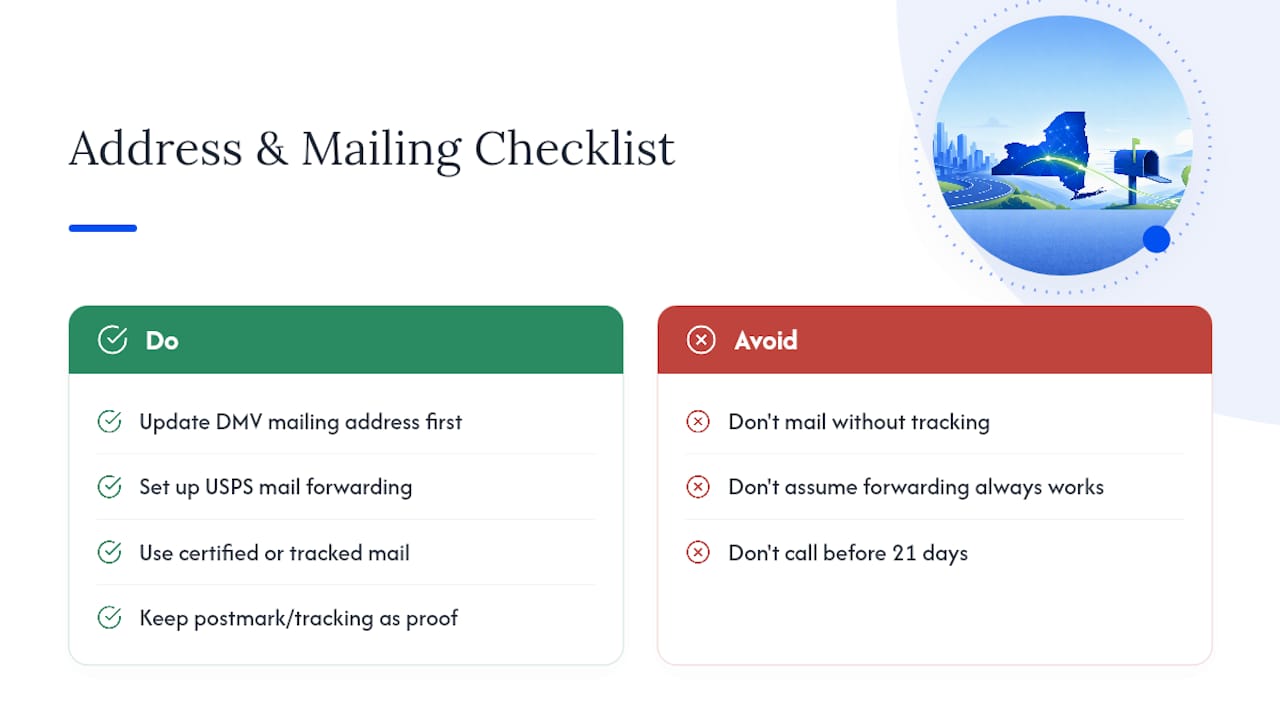
Update your DMV mailing address before you send anything, not after. If you’ve recently moved, set up USPS mail forwarding too, since a refund check or FS-6T sent to an old address doesn’t always forward automatically depending on how the DMV mailing system routes it.
Pro Tip: Use certified or tracked mail every time you mail plates, even if it costs a few extra dollars. The postmark is your legal surrender date, and without a tracking number, you have no way to prove what that date actually was.
Give it the full 21 days before assuming something went wrong. If the FS-6T still hasn’t shown up after that, call the DMV directly and have your tracking number or postmark date ready. That single piece of information usually resolves the call in minutes instead of escalating into a dispute.
Official DMV Forms and Pages to Consult Now
Every method of surrender runs through the same core paperwork. The PD-7 Plate Surrender Application is required for each set of plates, whether you’re mailing them, dropping them off, or handing them to a clerk. The DMV’s surrender instructions page covers FS-6T timing and the Albany mailing address in full. For money matters, the refunds and transfer credits page and the insurance lapse penalty page are worth bookmarking before you start.
If you’re moving out of state rather than getting rid of the car entirely, the process for registering an out-of-state vehicle in New York covers the flip side of this same paperwork.
A Simpler Path If You’re Selling the Vehicle Anyway
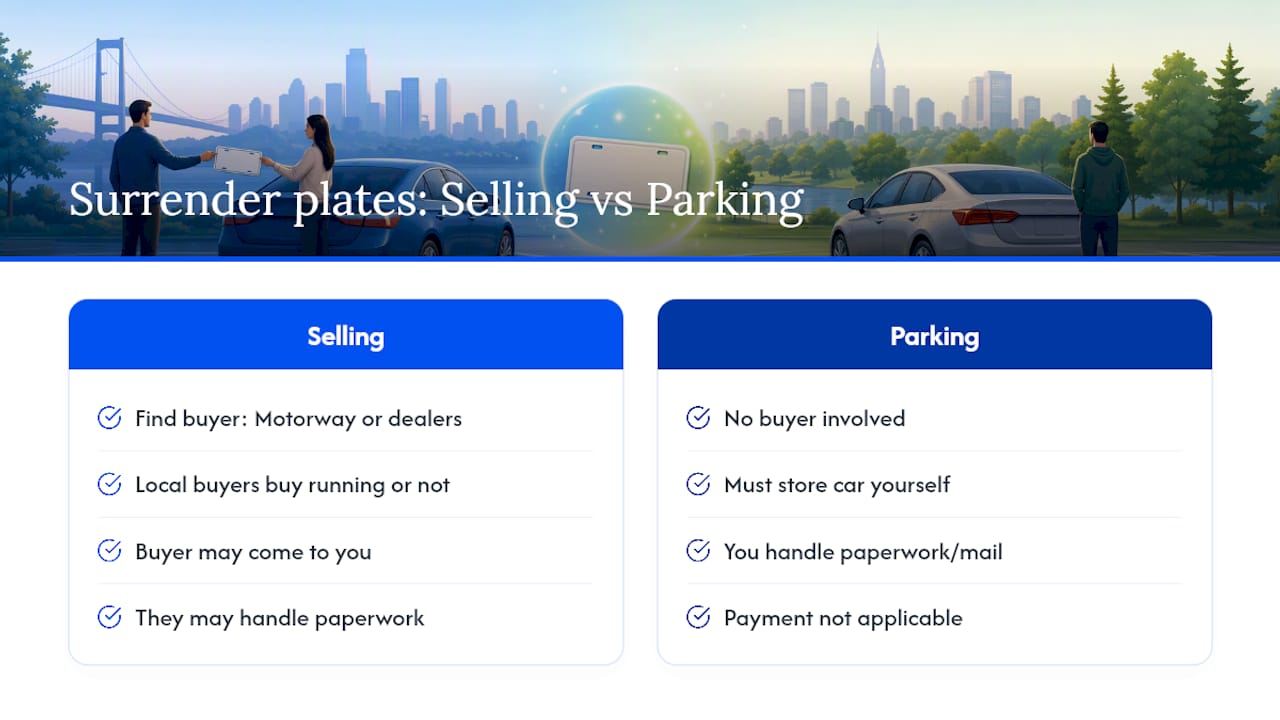
A lot of the hassle above disappears if you’re surrendering plates because you’re getting rid of the car, not just parking it; you can also consider how to sell your car via Motorway – find the dealer who’ll pay the most as part of this process. There are local services that buy vehicles running or not and offer to send someone to you rather than making you haul the car anywhere. Such buyers may handle the paperwork side of the sale and assist with plate and title questions, with payment delivered the same day. If canceling registration is really the first step toward selling, not just parking a car in the driveway, a same-day cash sale in NYC skips most of the mailing and waiting described above entirely.
FAQ
How Do I Cancel My Car Registration In New York?
Surrender your plates and registration to the NY DMV using form PD-7, either in person, by mail, or through a participating county clerk, and keep the FS-6T receipt as proof once it arrives.
What Happens If You Don’t Return Plates To DMV NY?
The DMV can suspend your registration and driver’s license and assess civil penalties if it detects an insurance lapse tied to unreturned plates.
How Much Does It Cost To Surrender Your Plates In NY?
Surrendering plates through a county clerk typically costs a $1 processing fee; mailing plates directly to the DMV in Albany carries no DMV fee beyond your own postage.
Do I Need An Appointment To Surrender Plates In NY?
Most DMV offices and county clerks accept plate surrenders without a scheduled appointment, though checking your local office’s current walk-in policy before you go is worth the extra minute.