Why Dealer Trade-In Offers Are So Low, and Why Inherited or No-Title Cars Are Hard to Sell
TL;DR
- Dealers pay wholesale value, not retail, so trade-in offers usually land 10 to 20 percent below private-party value.
- Selling privately nets about 46 percent more on average, since you keep value a dealer holds back for reconditioning and profit.
- The sales-tax trade-in credit in NY, NJ, and CT is real but small, usually a few hundred dollars, and only applies if you buy a new car.
- Inherited, lost-title, and during-a-move sales are slow and paperwork-heavy, which is why a same-day cash buyer that handles the DMV work is the easiest route.
Why is the dealer’s trade-in offer so much lower than my car’s value?
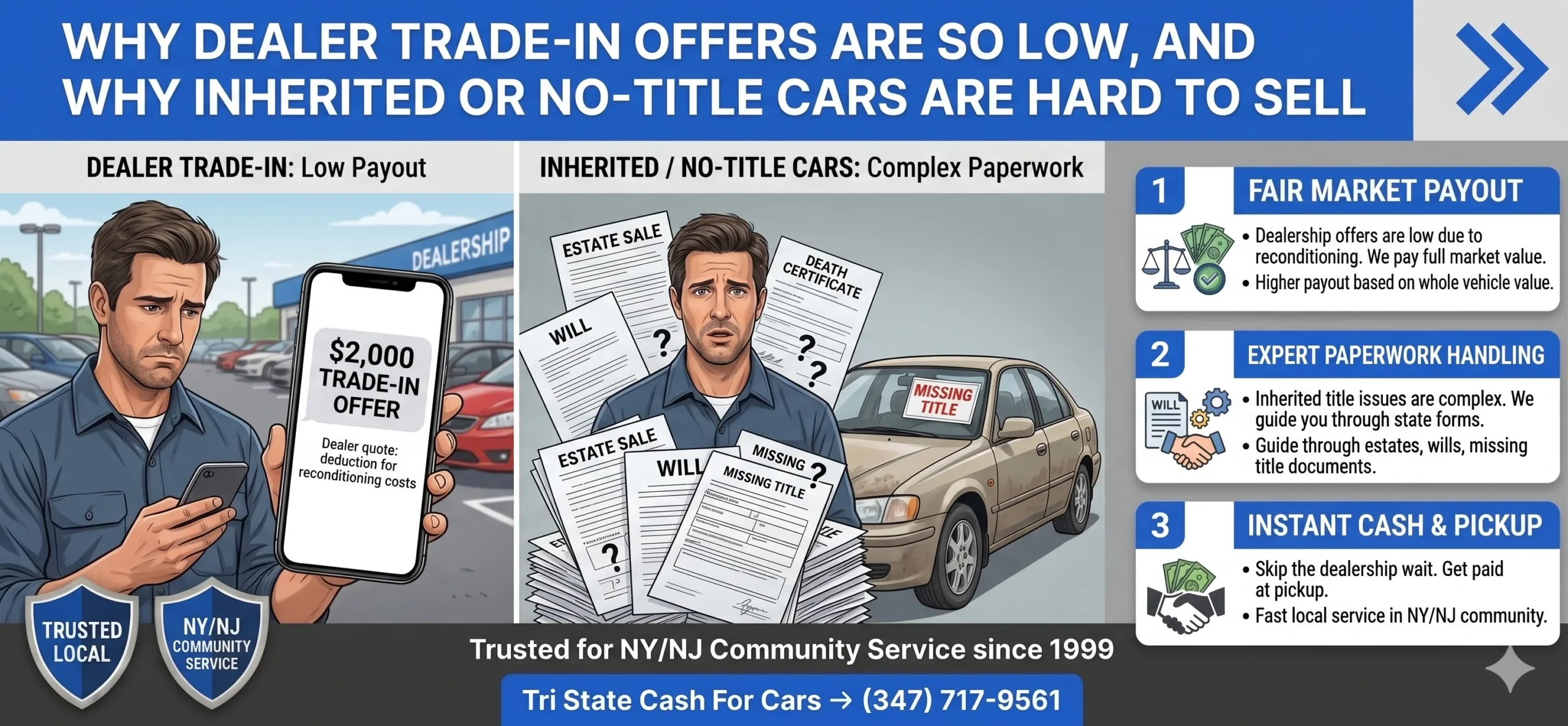
A dealer’s trade-in offer is lower because dealers pay wholesale value, not retail. Trade-in figures come from auction and wholesale data, then drop to cover reconditioning, inspections, financing, and profit. That puts most offers about 10 to 20 percent below private-party value, and a KeySavvy study found private sales netted roughly 46 percent more.
Why do dealerships always lowball trade-ins?
Dealers buy your car to resell at a profit, so the offer leaves room for their costs. Kelley Blue Book notes the trade-in value is less than private-party value because the reselling dealer pays for safety inspections, reconditioning, and other costs of doing business. Older or higher-mileage cars often can’t be retailed, so they head to a wholesale auction and the offer drops to cover that risk. Dealers also start low to leave room for negotiation.
Why do I have to buy a new car just to get a trade-in value?
Because the trade-in tax credit only works if you trade in and buy a car at the same time. New York, New Jersey, and Connecticut all subtract the trade-in amount before calculating sales tax, but that credit is usually worth only a few hundred dollars. It rarely covers the gap between wholesale and private-party value. If you don’t want a new car, the credit gives you nothing.
Why is it so hard to sell a car I inherited?
You can’t legally sell a car that isn’t in your name yet. The title must move from the deceased owner to you or the estate first. In New York, a single vehicle worth $25,000 or less can pass to a surviving spouse using Form MV-349.1. In New Jersey, a surviving spouse can transfer with Form BA-62 if the estate is $50,000 or less. In Connecticut, the executor assigns the title with a certified probate document.
Why does selling a deceased relative’s car require so much paperwork?
States require proof you have legal authority to transfer the vehicle, which guards against fraud and disputes. Depending on the value and whether there’s a will, you may need a small-estate affidavit, a Surrogate’s certificate, or full probate. New York uses a $25,000 threshold, New Jersey uses $20,000 to $50,000 depending on your relationship, and Connecticut covers estates up to $40,000. A buyer like Tri State Cash For Cars that handles the paperwork takes most of this off your plate.
Why can’t I sell my car if I lost the title?
The title is proof of ownership, so most buyers and the DMV require it. The fix is a duplicate. New York’s Form MV-902 costs $20, New Jersey’s Universal Title Application costs $60, and Connecticut’s Form H-6B costs about $45. Older cars may be exempt: New York doesn’t title vehicles from 1972 or earlier, and Connecticut skips titles for cars over 20 model years old.
Why is selling a car during a move so stressful?
A move already piles on packing, housing, and tight deadlines, and a car adds shipping costs, out-of-state re-registration, and insurance changes. Listing it privately means meeting strangers and waiting for a buyer you don’t have time for. A same-day cash sale with free pickup is the lowest-stress option when relocating, the model Tri State Cash For Cars runs across New York, New Jersey, and Connecticut.
Frequently Asked Questions
Why do I need cash fast but my car just won’t sell?
Private buyers move slowly and dealers lowball, so quick sales stall. A cash-for-cars service gives a firm offer and pays on the spot, often within 24 to 48 hours, in any condition.
Why does the DMV make transferring a car title so confusing?
Rules change by state and situation, whether the car is inherited, has a lost title, or carries a lien. A buyer that handles title transfers can work through the NY, NJ, and CT paperwork for you.
Why is my car worth more if I sell it myself instead of trading it in?
Because you capture retail-side value instead of wholesale, about 46 percent more on average, without the dealer’s reconditioning and profit taken out first.