Selling a Car in NY With Unpaid Tickets: What to Do
Yes, you can sell a car in New York while tickets are unpaid, but the type of ticket decides how easy it is. Parking and camera tickets are tied to the vehicle’s registration and can end up in judgment. Moving violations are tied to you and your license. Before you sell, find out which kind you have, what stage each is in, and whether the car is already at risk of a boot or tow. This guide walks through each case and shows how to sell without the debt wrecking the deal.
TL;DR
- Parking and camera tickets that reach judgment can get your registration suspended and your car booted or towed. Moving violations can suspend your license.
- In NYC, unpaid parking tickets pick up penalties at 30, 60 and 90 days and go into judgment at 100 days.
- Paying online sends the registration clearance to DMV within 72 hours. Paying in person at a Finance Business Center can give you a clearance notice the same day.
- If your car has already been towed, you have 10 business days before it can go to auction, and you can request a Sale Hold within 72 hours.
- Tell any buyer about open tickets up front, and settle the paperwork (title, plates) in the same visit as the sale.
Table of Contents
- Which tickets follow the car, and which follow you
- How unpaid NYC parking tickets escalate
- The registration trap
- Moving violations: what an unanswered ticket does
- Three situations, three plans
- Can you sell with the tickets still open?
- What to compare before you sell
- Our perspective
- Step-by-step: selling a car when tickets are open
- Selling your car with us
- FAQ
- Sources
Which tickets follow the car, and which follow you
Most confusion starts here. New York treats two families of tickets very differently.
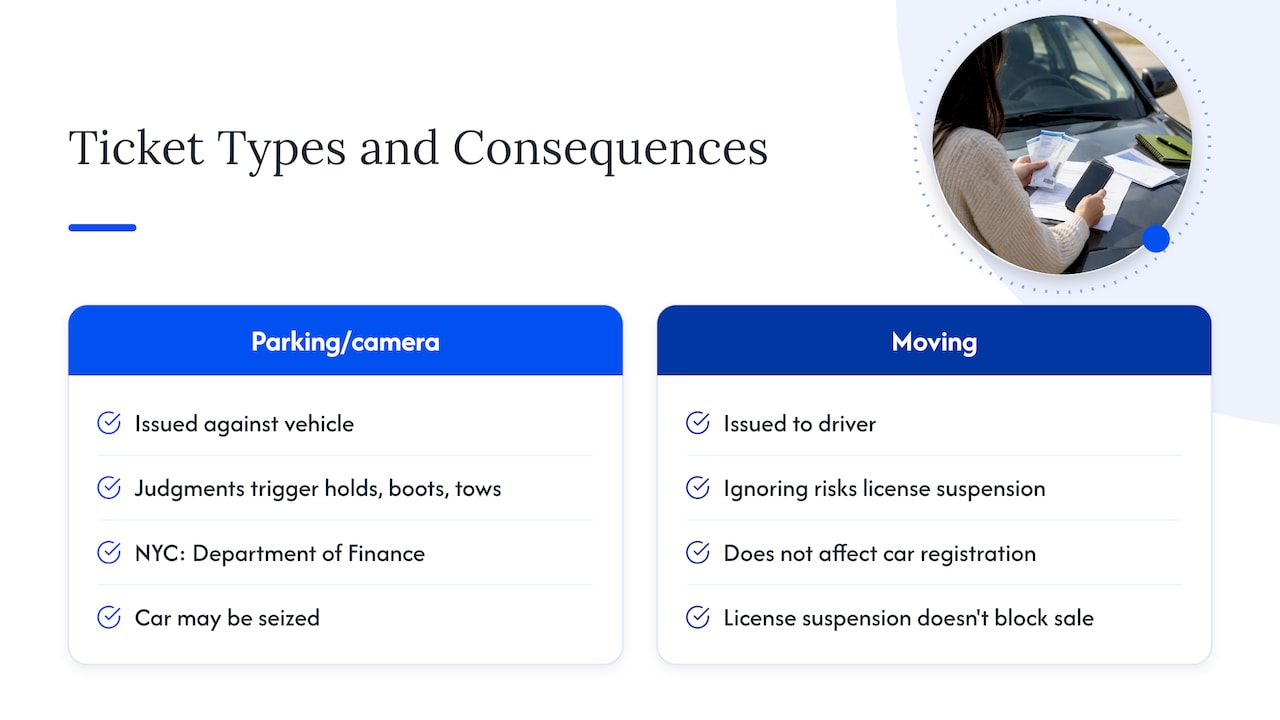
Parking and camera violations are issued against the vehicle. In New York City they are handled by the Department of Finance. If they go unpaid long enough, they become judgments, and judgments are what trigger registration holds, boots and tows.
Moving violations (speeding, running a light with an officer present, and similar) are issued to the driver. Ignoring them puts your license at risk, not the car’s registration. According to DMV guidance on payment plans, a registration suspension for unpaid parking tickets stops you from renewing the registration but does not by itself suspend your right to drive. Ignoring a moving violation is different, and driving on a suspended license is a crime.
Why this matters when you sell: a license suspension does not stop you from handing over a car. A registration suspension and a pile of judgments do complicate things, because the car itself can be seized.
How unpaid NYC parking tickets escalate
NYC publishes the schedule. If you do not pay or dispute within 30 days, late penalties start:
| Time since the ticket was issued | Penalty |
|---|---|
| Under 30 days | None |
| 30 days | $10 |
| 60 days | $20, on top of the earlier penalty |
| 90 days | $30, on top of earlier penalties |
| 100 days | Ticket enters judgment |
Once a ticket is in judgment, interest is added and the vehicle may be booted or towed. Camera violations follow their own penalty table on the same page.
The small numbers are deceptive. A $65 ticket that sits for three months picks up penalties, and then interest. A few of them together can push a car past the towing threshold. The city’s towing page says a vehicle can be towed when it has more than $350 in parking ticket or camera violations in judgment.
The registration trap
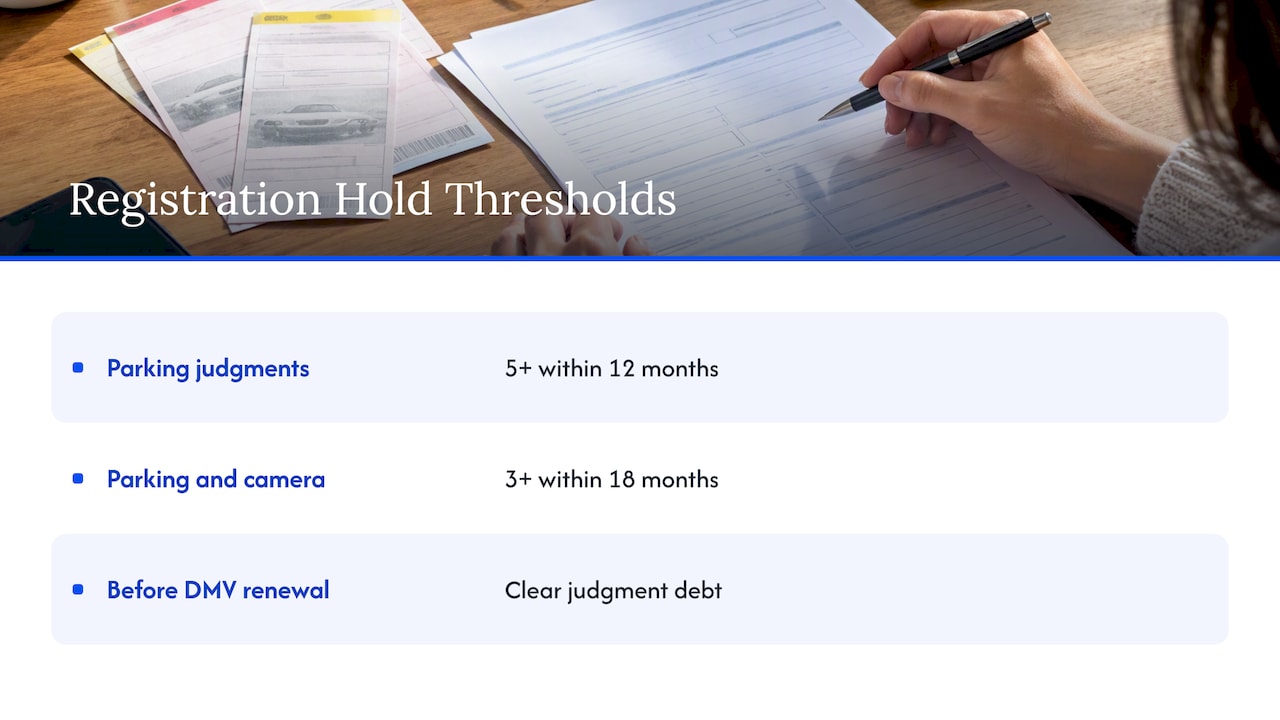
There is a second way tickets hurt a sale. New York can suspend a registration, or block its renewal, when you have 5 or more outstanding parking ticket judgments within 12 months, or 3 or more outstanding parking and camera judgments within 18 months. Before you can register or renew with DMV, you have to clear that judgment debt.
If your registration is already expired or suspended, you are not stuck. We cover that situation in detail in our guide to selling a car in NY with an expired registration. The short version: a car that cannot legally be driven can still be sold, as long as the buyer can pick it up on a tow rather than driving it away.
Moving violations: what an unanswered ticket does
If you ignored a traffic ticket, DMV says failing to answer leads to an indefinite license suspension that lasts until the ticket is satisfied, paid or answered. Clearing a suspension from failing to answer or appear also requires a $70 suspension termination fee on non-NYC tickets. For NYC tickets processed by the Traffic Violations Bureau, you also have to pay what you owe or enter a payment plan. DMV explains the options on its page for pleading to or paying TVB tickets.
Tickets issued outside the five boroughs go through the local court of the town, village or county where you got them, so contact that court, not DMV.
For a seller, the practical point is simple. Selling the car does not make a moving violation go away, and it does not make it worse. The ticket stays with you. What it can change is your ability to deal with DMV on other matters, so clear it if you plan to buy another car soon.
Three situations, three plans
Your tickets are recent and not in judgment
This is the easy case. Pay them or dispute them within the 30-day window and they never become a sale problem. If you are selling quickly, pay first. It is a few minutes online and removes any doubt about the car.
Your tickets are in judgment but the car is still with you
You have leverage here, because the car is still yours to sell. Your steps:
- Look up every open ticket and judgment for the plate on the city’s payment site, so you know the exact total.
- Decide how to pay. Online is convenient, but the registration clearance goes to DMV electronically and takes up to 72 hours. If you want paper proof the same day, pay at a Department of Finance Business Center.
- Ask for a satisfaction of judgment notice if you need a record of payment. The city says it can document that you have paid your parking judgments.
- Then sell, with the debt already behind you.
A word of caution on payment plans. The city’s guidance is that having one does not always stop enforcement if your total debt is above the thresholds. If the car is at risk of a tow, settle the judgment debt rather than relying on an installment arrangement.
Your car has already been booted or towed
Time now matters more than anything else. If the city or a marshal towed your car over judgment debt, you generally have to pay all outstanding judgment debt plus boot and tow fees to get it released. The city’s page on retrieving a towed vehicle says that if you also owe $101 or more in judgment debt, you must pay it all, along with the tow fees, to get the vehicle back. The fastest way to stop an active tow in progress is to call the boot release line and pay by phone.
If a marshal or the Sheriff towed the car, the clock is stricter. Reclaim it within 10 business days or request a Sale Hold at a Finance Business Center within 72 hours. Otherwise the Sheriff’s Office may auction it.
Why not just let it go to auction? Because an auction does not necessarily close the account. If the sale price falls short of the judgment debt, penalties and towing fees, the former owner stays responsible for the rest, and collection can continue. You lose the car and keep the bill.
Can you sell with the tickets still open?
Sometimes, but think it through before you try.
The tickets are not the buyer’s problem in the legal sense: new owners are not responsible for a previous owner’s parking tickets. But the city can still boot and tow a vehicle with outstanding judgment debt no matter who is driving or registered. A buyer who ends up with the car and its plates is exposed in practice, so a careful buyer will ask about tickets. An honest seller will say so before the price is agreed.
Two habits keep a sale clean:
- Disclose everything. If you are not sure what is owed, look it up before you list or call anyone.
- Do not hand over plates you are still responsible for without a plan. Sorting out plates and the title in the same visit prevents tickets from landing on you after the car has gone. We explain the document side in our walkthrough of New York title transfer forms and notarization.
If the title is also an issue, for example it is lost, see selling a car without a title in NY, which covers the $20 duplicate versus the MV-35 route.
What to compare before you sell
Unpaid tickets shrink your options, so compare them on what you actually need.
| Option | Handles open tickets? | Speed | Main risk |
|---|---|---|---|
| Private sale | You must clear them first or disclose | Days to weeks | Buyers walk when they see judgments or a suspended registration |
| Dealer trade-in | Usually wants a clean slate | Same day | Lower offer, and the dealer may deduct for problems |
| Auction after a tow | No, balance can remain | Fixed by the city’s deadlines | You keep the debt even if the car sells |
| Direct cash buyer | Depends on the buyer, so ask | Often same day | Make sure the quoted price is guaranteed in writing |
We cover the wider choice in our guide to the options for selling your car, including how a cash sale compares with a private listing.
Our perspective
We buy cars from owners across New York and New Jersey every week, and unpaid tickets come up more often than people expect. They are rarely the deal-breaker sellers fear. What hurts is not knowing the number.
Here is what we tell sellers. Find out the total before you call anyone. Decide whether to pay it from the sale proceeds or before. Then pick a buyer who gives you a price that will not change at your door. Our offers are guaranteed: we commit to paying the stated price at pickup, so there are no surprises when we arrive. That matters most for someone who has already had one nasty surprise from the city.
We send a team to your location, make the cash offer, handle the paperwork, and aim to have cash in your hand within an hour. We also buy cars that do not run, are damaged or are old, and we can buy with or without a title. That helps when a tow, a suspended registration or a stalled car has made a driveway sale impossible.
One piece of advice we repeat: do not wait on the tickets. Every month they sit costs you more, and a tow turns a manageable bill into a crisis. If you are weighing it up, talk to us before the 100-day mark, not after the tow truck.
— Eric
Step-by-step: selling a car when tickets are open
- Pull the numbers. List every parking, camera and moving violation, and note which are in judgment.
- Check the car’s status. Is the registration valid, suspended or expired? Has it been booted or towed?
- Choose your payoff route. Online for convenience (allow up to 72 hours for DMV clearance), in person at a Business Center for same-day paper proof.
- Collect your documents. Title, ID, and lien information if you still owe a loan. Our six-step car buying process explains how a sale works even with a loan.
- Get a firm offer. Ask whether the quoted price is the price paid at pickup.
- Close the sale in one visit. Sign the paperwork, take payment, and keep copies of the bill of sale and your proof of payment.
- Protect yourself afterward. Keep the satisfaction notice and the sale records in case a ticket is later attributed to you in error.
Selling your car with us
If you want a straight answer on what your car is worth and a pickup that does not depend on a clean registration, get your offer from Tri State Cash For Cars. Tell us about any tickets or title problems when you contact us, and we will explain how the sale would work. You can also read how to prepare your car for a better offer.
FAQ
Can I sell my car in New York if I have unpaid parking tickets?
Yes, the car is still yours to sell. But tickets in judgment can lead to a boot, a tow or a registration suspension, so clearing or at least knowing the total before the sale is the safer route. Disclose the situation to any buyer.
What happens if I don’t pay a traffic ticket in NY?
DMV says failing to answer leads to an indefinite license suspension until the ticket is paid or answered. A $70 suspension termination fee applies to non-NYC tickets. NYC TVB tickets also require paying or entering a payment plan.
Does selling the car cancel my unpaid tickets?
No. Moving violations stay with you, and judgment debt stays with the account. Even an auction sale after a tow may leave a balance if the price does not cover the debt, penalties and fees.
How long do I have to get a towed car back before it is auctioned?
For a car towed by a marshal or the Sheriff, you have 10 business days to reclaim it. You can request a Sale Hold within 72 hours at any Finance Business Center. Act as early as you can, because the deadlines are short.
Sources
- NYC parking or camera tickets: penalty schedule
- NYC Finance: Towed vehicles
- NYC Finance: Retrieve a towed vehicle
- NYC Finance: Proof of satisfaction
- NYC311: Parking ticket or camera violation clearance
- NYC311: Towed vehicle reclaim from Marshal or Sheriff
- NY DMV: Tickets received outside New York City
- NY DMV: Plead to or pay NYC TVB tickets
- NY DMV: Payment plans