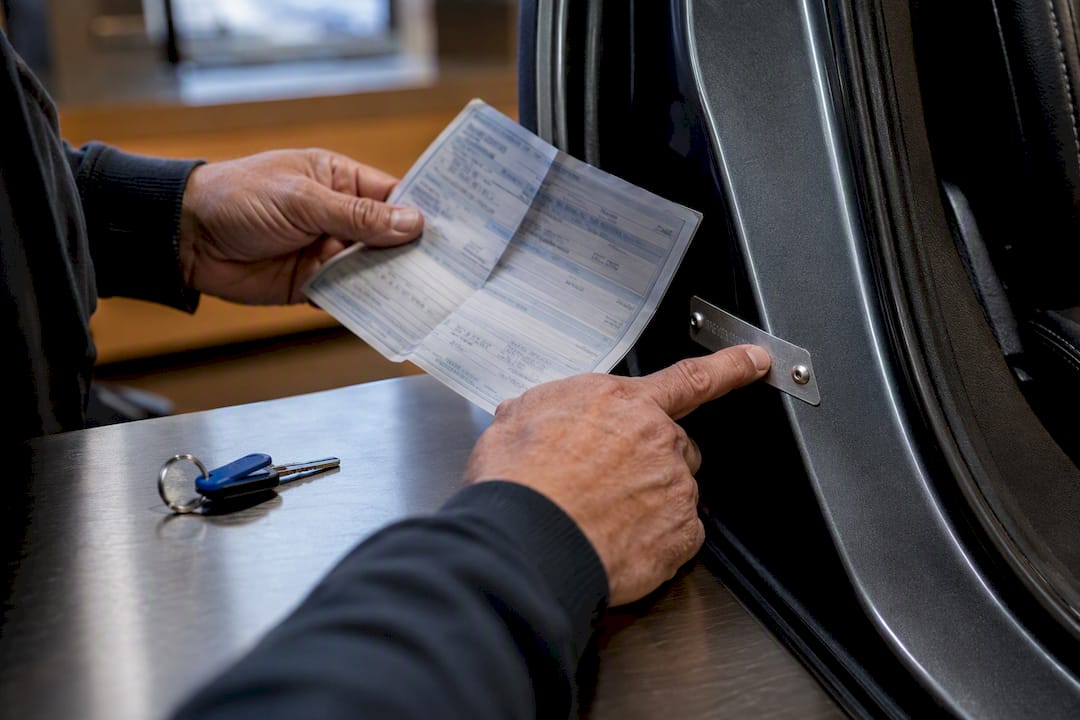
$20 Duplicate or MV-35? Sell a Car Without a Title in NY
You generally cannot sell a 1973-or-newer car to a private buyer in New York without a title, and you need to fix that before listing it. If the original is lost, get a duplicate title through the NYS DMV for $20. A narrow exception, Form MV-35, lets owners transfer a vehicle worth $1,250 or less and that is at least 8 model years old to a registered dismantler, scrap processor, or itinerant vehicle collector. Cars from 1972 or earlier skip titles entirely and transfer through registration or Form MV-353.
TL;DR:
- Vehicles from 1973 or newer must have a title to be legally sold in New York, and obtaining a duplicate title costs $20 with no liens or mismatches.
- Cars built in 1972 or earlier rely on transferable registration or Form MV-353, which recreates ownership proof if the original document is lost.
- The MV-35 form is a strict, one-way transfer option for vehicles worth $1,250 or less and at least 8 model years old, applicable only to dismantlers or scrap processors.
- A private sale without a proper title or acceptable proof of ownership often causes DMV delays, making cash buyers a faster alternative in urgent situations.
- Confirm vehicle age first, then secure the correct paperwork before lining up a buyer to avoid lengthy delays or legal issues.
Table of Contents
- Titled vs Non-Titled Vehicles in NY: Which Rule Applies to Your Car
- How to Sell a 1973-or-Newer Vehicle When the Title Is Missing
- How to Transfer a Pre-1973 Vehicle Using MV-353
- The MV-35 Scrap and Dismantler Exception, and Its Permanent Cost
- Documents Buyers and the DMV Will Insist On
- When a Cash Buyer Makes More Sense Than the DMV Route
- What Sellers Get Wrong About “No Title” Sales
- Need This Handled Fast? Here’s a Faster Path
- Official NY DMV Resources for These Forms
- Sources
- FAQ
Titled vs Non-Titled Vehicles in NY: Which Rule Applies to Your Car
New York draws a hard line at model year 1973. Anything built in 1973 or later falls under the state’s titling system, meaning ownership lives on a title certificate and that document has to change hands (or get replaced) before a sale is legal. Anything 1972 or older was never issued a title in the first place, so New York uses a different proof of ownership entirely.
This distinction decides your entire paperwork path, not just a technicality:
- 1973+ vehicles (a 2019 Civic, a 1995 Camry, a 1974 pickup) need a title or a properly obtained duplicate.
- 1972-and-older vehicles (a 1968 Mustang, a 1955 Bel Air) rely on transferable registration or Form MV-353.
- Age alone doesn’t override the rule. A 30-year-old sedan built in 1996 still needs a title. Only the 1973 cutoff matters.
Figure out which bucket your car falls into first. Everything else in this guide branches from that one answer.
How to Sell a 1973-or-Newer Vehicle When the Title Is Missing
If your car is titled and you’ve lost the paperwork, a duplicate title is the standard fix, and it’s the route the DMV expects you to take. The fee is $20, and eligibility depends on a few things: you can’t have an active lien complicating the record, and your name and address on file need to match your current ID. Mismatches or liens push you into a slower, more manual process.
Here’s the practical sequence:
- Check your eligibility online first. If your record is clean (no lien, matching name and address), the DMV’s duplicate title portal is the fastest option (fee $20).
- Gather your documents. You’ll need proof of identity, your vehicle’s plate or VIN, and payment for the $20 fee.
- Choose your filing method. Apply online for speed, mail your application to the Title Bureau if you prefer paper, or visit a DMV office in person if you need help sorting out a lien or address issue on the spot.
- Wait for processing. Straightforward requests move quickly; anything involving a lien release or a name discrepancy can stretch into weeks while the Title Services Bureau reviews the file.
- Only then move to sale. Don’t advance a private sale until the duplicate is actually in hand.
Our step-by-step duplicate title guide walks through each filing method in more detail if your situation isn’t clean-cut.
Pro Tip: Never hand over keys, sign a bill of sale, or accept a deposit before your duplicate title physically arrives. A buyer who agrees to “figure out the title later” is the same buyer who disappears when the DMV flags a mismatch.
How to Transfer a Pre-1973 Vehicle Using MV-353
Cars from 1972 and earlier never got a title in New York, so the DMV treats a transferable registration as your legal proof of ownership instead. If you still have that document, it moves with the sale much like a title would.
Lost your transferable registration and can’t get a replacement issued? That’s where Form MV-353, the Certification of NY State Registration for Transfer of Non-Titled Vehicle, comes in:
- There is a fee for this form.
- It essentially recreates your proof of ownership using DMV records when the physical document is gone.
- If the DMV can’t issue MV-353 either, you may need to submit other acceptable proofs of ownership, such as prior registration history or supporting DMV correspondence, on a case-by-case basis.
For classic car owners, this is often simpler than the duplicate title process for newer vehicles, since there’s no title record to reconcile.
The MV-35 Scrap and Dismantler Exception, and Its Permanent Cost
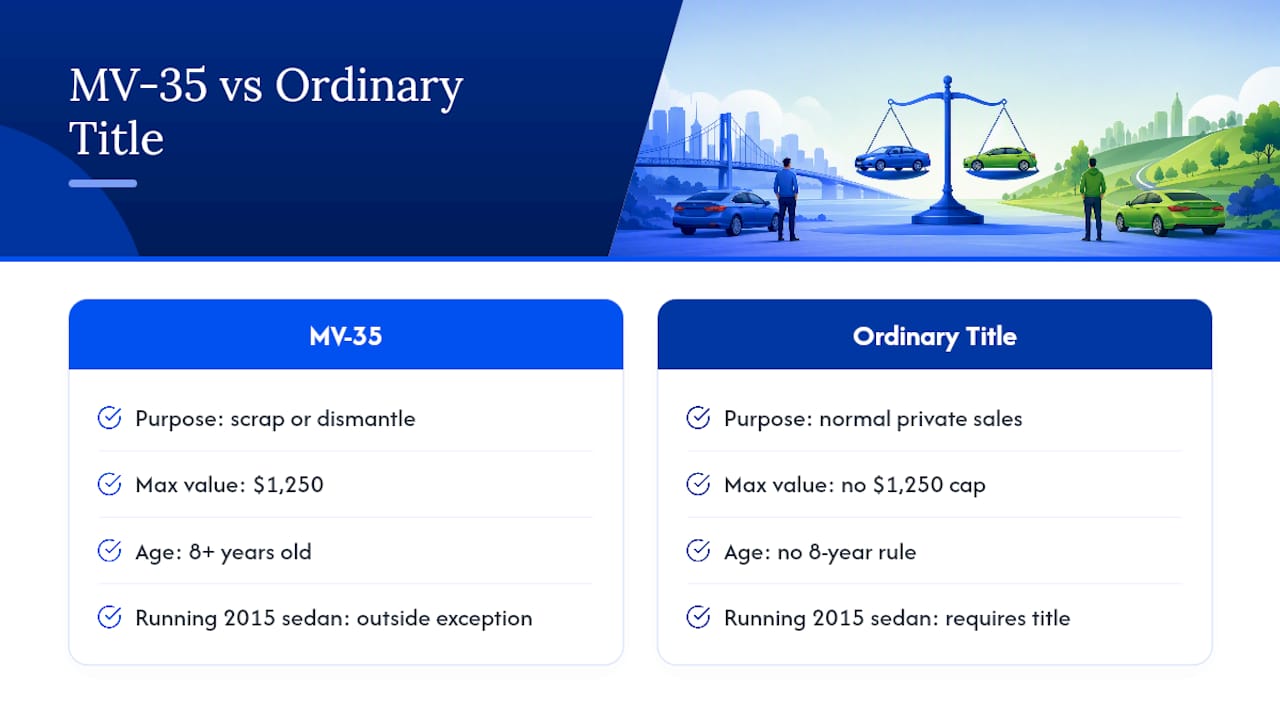
Form MV-35 gets misunderstood constantly, so here’s the precise rule: it applies only to a vehicle that is at least 8 model years old and worth $1,250 or less, according to the DMV’s own MV-35 form. That’s a narrow, specific threshold, not a general workaround for any car missing paperwork.
MV-35 also restricts who can receive the vehicle:
- A DMV-registered vehicle dismantler
- An itinerant vehicle collector (IVC)
- A certified scrap processor
Private-party buyers don’t qualify, period. If you’re thinking about using MV-35 to unload a car to a friend or a stranger off Facebook, that’s not what the form is for.
The consequence is permanent: once a vehicle transfers under MV-35, it can never be titled again. That’s not a temporary hold, it’s the end of the road for that vehicle’s titling history. The form also carries explicit legal warnings, and submitting false information on it can constitute a misdemeanor under state law.
If the vehicle also needs a salvage certificate (Form MV-907A), that filing has its own clock: dismantlers and scrap processors generally must submit it within 15 business days of acquiring the vehicle. Treat MV-35 as a one-way door, not a shortcut.
Documents Buyers and the DMV Will Insist On
Whether you’re dealing with a title or a non-titled vehicle, incomplete paperwork is the single most common reason a sale gets held up at the DMV counter. Here’s what actually needs to be in hand before you close the deal:
- For titled vehicles (1973+): the signed original title, or your duplicate if the original was lost, plus a completed MV-912 bill of sale.
- For non-titled vehicles (1972 and older): transferable registration or Form MV-353, along with a bill of sale.
- Identification and signatures: valid photo ID, lien release paperwork if applicable, and signatures from every listed co-owner.
- Special cases: estates need court-issued documentation showing legal authority to sell, and any name or address mismatch on file needs to be resolved before the sale, not after.
A bill of sale alone never transfers ownership of a titled vehicle on its own. Buyers who register the car later will get bounced by the DMV without the underlying title or acceptable proof of ownership. Our guide on title transfer forms and notarization covers the notarization details some counties still require.
When a Cash Buyer Makes More Sense Than the DMV Route
Sometimes the paperwork math doesn’t work in your favor. If you’re facing a lien complication, an estate sale, a non-running vehicle, or you simply need cash faster than DMV processing allows, a professional buyer can solve the problem differently than a private sale ever could.
Some cash buyers handle vehicles with title complications directly, sending someone to inspect the car, making a cash offer, and managing the DMV paperwork on the seller’s behalf. The tradeoff is straightforward: you likely won’t net what a patient private-party sale might bring, but you avoid weeks of DMV back-and-forth entirely. For sellers buried in lost-title logistics, that trade is often worth it. Our guide to selling a tricky car with a lost title or estate situation breaks down more scenarios where this route fits.
What Sellers Get Wrong About “No Title” Sales
Most confusion about selling a car without a title in New York comes from treating MV-35 as a universal loophole instead of what it actually is: a narrow provision for low-value, older vehicles headed to scrap or dismantling. Sellers hear “you can sell without a title” secondhand, skip the fine print on the $1,250 and 8-year thresholds, and try to hand a running 2015 sedan to a private buyer using paperwork meant for a vehicle worth less than a used refrigerator.
The DMV’s own rules are actually more forgiving than that myth suggests, provided you follow the right lane. Getting a duplicate title is a $20 fee and a form, not a legal ordeal, as long as your name and address match DMV records and there’s no lien fight to resolve. The real friction shows up in estate sales and lien disputes, not in the basic title-replacement process most sellers face.
If there’s one thing worth prioritizing above all else here, it’s sequencing: confirm your model year, then chase the correct document, then find your buyer. Sellers who reverse that order, lining up a buyer before sorting the paperwork, are the ones who end up stuck explaining to a stranger why the sale is delayed another three weeks.
— Eric
Need This Handled Fast? Here’s a Faster Path
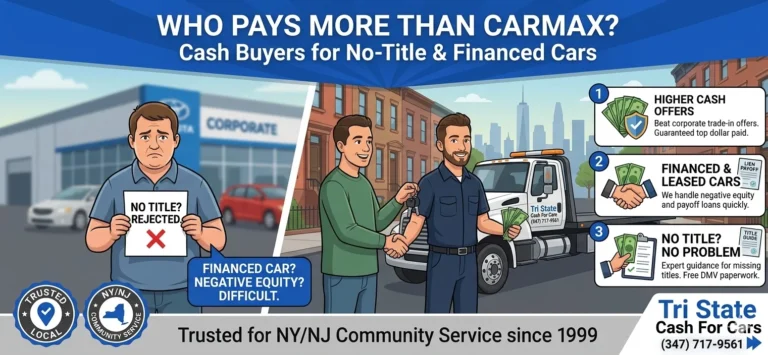
Chasing a duplicate title, tracking down MV-353, or figuring out whether your car even qualifies for MV-35 takes time you might not have, especially if you need cash now rather than in three weeks. Some services offer guaranteed cash offers, on-site pickup, and handle DMV paperwork to simplify the sale process.

This works best for sellers dealing with a lost title, an estate vehicle, a non-running car, or just a hard deadline for cash in hand. Before the inspection, pull together whatever you have: your ID, any registration or title paperwork on file, and your keys. If your paperwork is genuinely missing, tell the team upfront, since lost-title situations are something they navigate regularly rather than something that stalls the offer. Head to Tri State Cash For Cars to get a quote started and see what a same-day sale actually looks like.
Official NY DMV Resources for These Forms
For the current fees and any procedural updates, go straight to the source: the DMV’s title and registration hub, the MV-35 statement form (PDF), and the acceptable proofs of ownership page covering MV-353. Rules and fees can shift, so confirm details before filing.
FAQ
What happens if I sell a car without a title in NY?
For a 1973-or-newer vehicle, the sale generally can’t be legally completed and registered without a title or duplicate title. The buyer will be unable to register the car, and you may still be liable for the vehicle if it’s never properly transferred.
Can you register a car with a bill of sale and no title in NY?
No. A bill of sale alone doesn’t transfer ownership of a titled vehicle, and the DMV requires a valid title or another acceptable proof of ownership to complete registration.
How do I get rid of a car with no title in New York?
If it’s 1973 or newer, apply for a duplicate title for $20 first. If it’s at least 8 model years old and worth $1,250 or less, you may qualify for the MV-35 scrap/dismantler transfer instead. For urgent situations, a cash buyer like Tri State Cash For Cars can also purchase the vehicle and manage the paperwork directly.
How do I register a car without a title in NY?
You can’t register a titled-era (1973+) vehicle without a title or duplicate title. Pre-1973 vehicles use transferable registration or Form MV-353 as their proof of ownership instead of a title.
Does Tri State Cash For Cars buy vehicles without a title?
Yes, Tri State Cash For Cars works with sellers facing lost-title and other paperwork complications, and helps manage the required DMV documentation as part of the sale.