Fix a Jumped Title in New York With On Site Buyer Help
Yes, title jumping is illegal in New York and creates serious registration, tax, and criminal risks for everyone in the chain. If you suspect you’re holding a jumped title, stop before you try to register the vehicle. Preserve every document and text message related to the sale, then contact the NYS DMV and, if you suspect fraud, your local police precinct. A local paperwork-handling buyer can also help you avoid creating this mess in the first place.
TL;DR:
- Failing to transfer the vehicle’s title properly can lead to criminal charges and hefty fines around $1,000, especially if fraud is involved.
- Buyers must apply for a new title within 30 days of purchase to avoid registration issues and suspicion of a jumped title.
- Signs of a jumped title include multiple signings on the same document, erased markings, or mismatched VINs, which should be checked before buying.
- Handling the transaction in person with a reputable buyer who completes the transfer at pickup minimizes the risk of open-title problems.
- Legal remedies like bonded titles or filing proper forms at the DMV can resolve issues if a title jump is discovered after purchase.
Table of Contents
- What Title Jumping in New York Actually Means
- New York Legal Consequences and DMV Timing Rules You Must Know
- How to Spot a Jumped Title Before You Buy
- Already Bought a Car With a Jumped Title? Do This First
- How Sellers Avoid Creating a Jumped Title in the First Place
- NYS DMV Remedies: Which Form Do You Actually Need?
- Why Working With a Reputable Buyer Reduces Your Title Risk
- What I See Over and Over in New York Title Cases
- Sell Your Car in New York Without the Title Paperwork Risk
- Where to Go Next for Official Guidance
- Sources
- FAQ
What Title Jumping in New York Actually Means
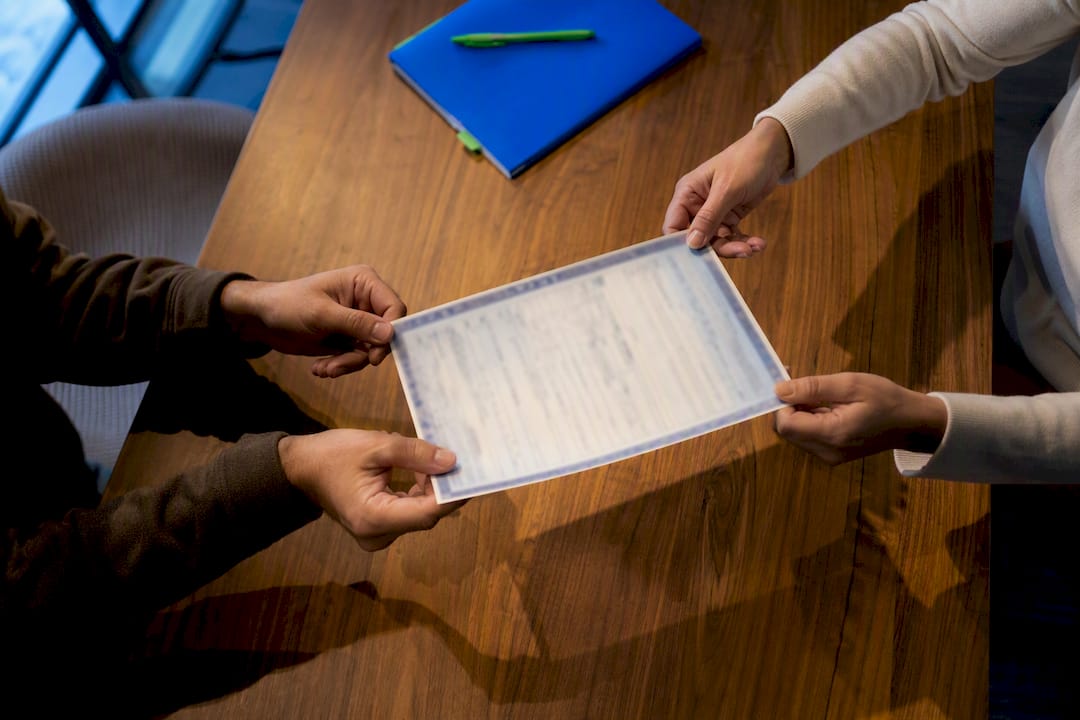
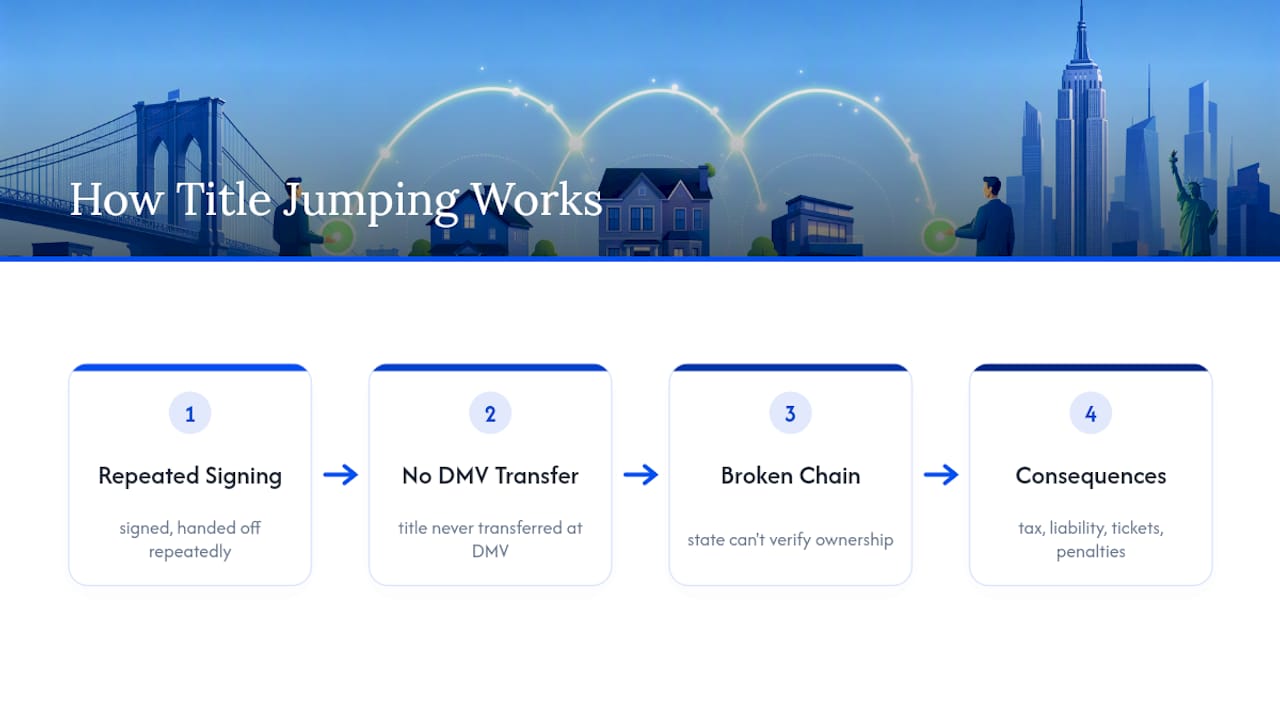
Title jumping happens when a vehicle changes hands without the title ever getting formally transferred into the new owner’s name. Instead of going seller to DMV to buyer, the title just floats. It gets signed over, handed off, signed over again, sometimes three or four times, with no one ever showing up at a DMV counter to make it official. Dealers and flippers call this an “open title.” The DMV calls it a broken chain of ownership.
Most people who do this aren’t trying to commit grand fraud. They’re trying to avoid sales tax on the transfer, skip a DMV visit, or flip a car fast without the paperwork hassle. A used car dealer might buy ten cars a month and jump titles to avoid registering each one individually. A private seller might just not want to deal with lines at the DMV.
The problem is that New York’s title system depends on an unbroken chain. Every name on that title has to connect logically to the next. When a link goes missing, the state can’t verify who legally owned the car at any given point, which means it can’t verify who owes sales tax, who’s liable for outstanding tickets or tolls, and who actually has the right to sell the vehicle to you. The short-term convenience of skipping a DMV trip almost always costs more than the trip would have, once penalties and unwound sales enter the picture.
New York Legal Consequences and DMV Timing Rules You Must Know
New York treats title jumping as a form of documentation fraud, and the consequences scale with intent. If someone alters a title, forges a signature, or knowingly sells a vehicle using fraudulent ownership documents, that can trigger criminal charges on top of administrative penalties from the DMV. Civil exposure often follows too, especially around unpaid sales tax.
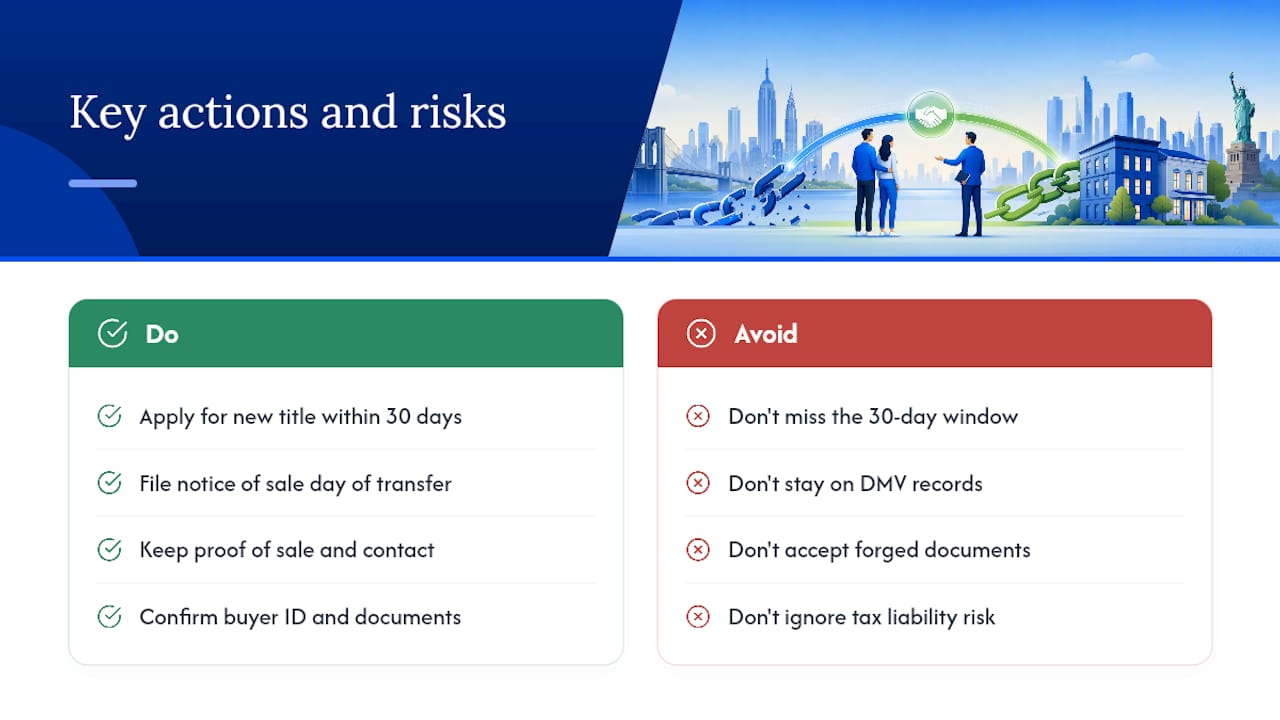
Timing matters more than most sellers realize. Under New York’s registration rules, a buyer normally has to apply for a new title within 30 days of the transfer. Miss that window, and you’re already building the kind of gap that makes a title look jumped even if nobody meant to break any rules. It’s one of the most common ways an innocent, disorganized sale turns into a legal headache months later.
Statistic Callout: Title fraud-related misdemeanors in New York can carry fines commonly cited around $1,000, along with possible vehicle impoundment depending on the specific circumstances of the case.
Beyond fines, the DMV can flag the vehicle’s registration, which stops you from driving it legally until the chain gets fixed. Sales tax assessments can also land on whoever the state considers the “last legitimate owner,” even if that person sold the car months ago and thought the deal was done. If you remain the registered owner in DMV records after a sale, you can end up on the hook for tolls, parking tickets, or worse if the buyer commits a crime with the car. That’s why filing a formal notice of sale the day you hand over the keys isn’t optional paperwork. It’s the only thing that legally separates you from what happens to that vehicle next.
How to Spot a Jumped Title Before You Buy
A jumped title usually leaves fingerprints. Before you hand over cash for any used vehicle in New York, run through this checklist.
- Compare the name on the title to the seller’s photo ID. If they don’t match and the seller can’t explain why with a clean assignment, walk away.
- Look for more than one assignment section filled out on the same title. A title with two or three names scrawled into the transfer boxes is a textbook open title.
- Check for erasures, cross-outs, or white-out anywhere on the document. The DMV won’t accept an altered title, and neither should you.
- Ask to see the original title, not a photocopy. Photocopies are a common way sellers hide a broken chain.
- Verify the VIN on the title matches the VIN on the dashboard and door jamb, and confirm the odometer reading lines up with the title’s mileage disclosure.
Pro Tip: Meet at a bank or a DMV office for the actual exchange of money and paperwork. It costs you nothing extra, and it puts a neutral witness and a paper trail between you and any dispute that comes up later.
Pay with a traceable method (certified check or verified electronic transfer) and get a fully completed bill of sale, even if the title looks perfect. NYC’s consumer protection office recommends exactly this kind of paper trail, and it’s the single easiest habit that protects you if a title problem surfaces down the road.
Already Bought a Car With a Jumped Title? Do This First
If you’ve already handed over money and discovered the title doesn’t add up, don’t panic, but move quickly and in order.
- Stop and gather everything. Pull together the bill of sale, texts, emails, photos of the title, and any receipts tied to the purchase. Do not attempt to register the vehicle with a broken chain. The DMV will reject it, and you’ll waste a trip.
- Report it to the NYS DMV. File a report through the DMV’s fraud-reporting channels, describing exactly what you found and when. This creates an official record that matters if the case escalates.
- Call local police if you suspect fraud. Forged signatures or knowingly falsified documents cross into criminal territory, and a police report strengthens any later legal claim you might need to make.
- Track down the last legitimate owner. The most efficient fix is often getting a fresh, clean assignment directly from whoever’s name legally matches earlier paperwork. This single signature can solve a problem that otherwise takes months.
- Apply for a bonded title or title-only procedure if the legitimate owner can’t be found. This administrative route lets the DMV issue you a valid title without a complete ownership trail, though it takes documentation and time.
- Consult an attorney for a quiet title action if the DMV route stalls. This is a court process that legally settles ownership when other administrative paths fail, and it’s worth the legal fee if you’ve got real money tied up in the vehicle.
How Sellers Avoid Creating a Jumped Title in the First Place
Most jumped titles start with a seller trying to save time, not commit fraud. Avoiding the problem is simpler than fixing it.
- Never sell a vehicle using someone else’s name still on the title. If you bought the car and haven’t transferred it into your own name yet, do that first, even if it feels like an extra step.
- Fill out every form in ink, and never cross anything out. A single strike-through can force a duplicate-title process that delays your sale by weeks.
- Keep copies of the MV-82 registration/title application and MV-912 bill of sale before you hand the originals to the buyer.
- Confirm any lien on the vehicle is fully released and documented before listing it for sale.
- Complete the transfer somewhere neutral, like a bank or DMV office, or work with a vetted buying service that handles the paperwork directly at pickup.
Sellers who skip these steps because “it’s just a used car” are usually the ones who get a certified letter from the DMV eight months later asking why the vehicle they sold is still registered in their name.
NYS DMV Remedies: Which Form Do You Actually Need?
The DMV has a specific administrative path for almost every version of this problem, and knowing which form applies saves you a wasted trip.
| Situation | Form or Pathway | What It Does |
|---|---|---|
| Title is lost, stolen, or damaged but ownership is clear | MV-82 (Duplicate Title Application) | Issues a replacement title in the current owner’s name |
| Vehicle has no transferable title but you can prove ownership another way | MV-51B | Establishes proof of ownership when the original title is unavailable |
| You need a title issued for a vehicle you’re bringing into New York or one that never had a clean title in the state | Application for Title Only | Gets a title on record without full registration |
| You suspect the title was altered or the sale involved fraud | DMV fraud report | Opens an official investigation; does not itself issue a new title |
The DMV’s proof-of-ownership process typically requires supporting documents like a canceled check, a notarized bill of sale, or insurance records showing you as the policyholder. There’s often a modest fee, around $10 for certain certification requests, on top of standard title fees.
One thing worth knowing upfront: the DMV can issue you a valid title through these administrative routes, but it can’t force a missing prior owner to cooperate, and it can’t resolve a dispute where two people both claim ownership. Those situations move into civil court, not a DMV counter.
Why Working With a Reputable Buyer Reduces Your Title Risk
The safest sales are the ones where the paperwork gets handled on the spot, by someone who’s done it correctly hundreds of times. A trustworthy buyer completes the title transfer at pickup, matches your photo ID against the title, hands over guaranteed payment before driving away, and keeps a copy of every document exchanged.
That combination matters because it closes the exact gap that creates a jumped title. There’s no delay between handshake and paperwork, no “I’ll mail it in later,” no photocopy standing in for the original. Buying services that handle title transfer at the point of sale materially cut the odds that a sale turns into an open-title problem down the line, because the transfer happens while both parties are still standing there.
Before you sell to anyone, ask for a written offer, confirm the buyer’s ID matches their business name, ask exactly how payment will be delivered, and insist the transaction, cash and title, is completed fully at pickup, not partway now and partway later. If a buyer hesitates on any of those four points, that hesitation is the warning sign.
What I See Over and Over in New York Title Cases
Most of the jumped titles I hear about in New York didn’t start with anyone trying to scam anyone. They started with a private seller who didn’t want to sit at a DMV counter, or a buyer who figured they’d “get to the paperwork later.” Later turns into never, and never turns into a registration nightmare six months down the road.
The pattern that actually prevents this is boring: complete the transfer the same day, in person, with both signatures and both IDs on the table. I’ve seen sellers avoid months of DMV back-and-forth simply because the buyer’s team filled out every form on-site and handed over a copy before leaving the driveway. That’s not a legal trick. It’s just doing the paperwork when it’s supposed to be done.
If you’re weighing whether to sell privately or work with a service that closes everything at pickup, that single detail, whether the transfer happens now or “later,” is the one that decides whether you’re dealing with this problem again in a year.
— Eric
Sell Your Car in New York Without the Title Paperwork Risk
If you’d rather skip the DMV counter, the open-title risk, and the wait for a buyer to “mail it in later,” A reputable buyer pays for your vehicle and handles the title transfer on the spot, the same visit, before leaving your driveway.
That’s the practical difference for a New York seller weighing this decision: no gap between handshake and paperwork, no photocopy standing in for a signature, no waiting to see if a buyer follows through. A buyer can send a team to your location, make a cash offer, and pay at pickup once the paperwork is signed, whether the car runs or not, and whether or not you still have the physical title in hand.
This route makes the most sense if you need cash fast, if your title situation is already complicated, or if you simply don’t have the time for multiple DMV trips. Before reaching out, gather what you have: the title if it’s available, a photo ID, and any prior bill of sale. Ready to start? Get your offer through Tristatecashforcars and see what your vehicle is worth with the paperwork handled for you.
Where to Go Next for Official Guidance
For direct action on a title problem, start with the NYS DMV’s titles and vehicle ownership page, which covers required forms and how to change information on an existing title. If your title is missing or unusable, the DMV’s proof-of-ownership guidance walks through acceptable alternative documentation. For buyer-side safety tips before you purchase, NYC’s consumer protection tips for buying a used car cover identity verification and safe payment practices in more detail.
This article is general information, not a substitute for advice from a qualified lawyer. Consult a qualified legal professional about your own circumstances before acting on anything here.
Sources
FAQ
Is title jumping illegal in New York?
Yes. Selling or transferring a vehicle without properly recording ownership at each step violates New York’s title and registration rules, and it can bring both administrative penalties and criminal charges when fraud is involved.
What is title jumping and why is it illegal?
Title jumping is when a vehicle changes owners multiple times without any of those transfers getting recorded with the NYS DMV, which breaks the chain of ownership the state relies on to track taxes, liability, and legal title.
What states allow title jumping?
No state legally permits title jumping. Every state requires some form of documented ownership transfer, though enforcement and penalty structures vary, and New York’s rules are among the more strictly enforced when fraud is suspected.
How long do I have to title a vehicle after buying it in New York?
Buyers typically must apply for a new title within 30 days of the transfer. Waiting longer increases the risk of registration problems and makes an innocent sale look like a jumped title.
What should I do if I bought a car and the title doesn’t match the seller?
Stop before attempting to register it, gather your paperwork, and contact the NYS DMV to report the discrepancy. If getting a clean assignment from the prior owner isn’t possible, a bonded title or title-only application through the DMV is the next step.
Can a paperwork-handling car buying service prevent title jumping?
Yes. A buyer that completes the title transfer and payment at pickup across the local region closes the gap that typically leads to an open or jumped title.