NJ Car Sale Notary Rules: Meet the MVC Deadline in 10 Working Days
Most private car sales in New Jersey do not require notarization of the title or bill of sale. You will need a notary only in specific situations: when someone signs using a power of attorney, when the vehicle came from a state that does not issue titles, or when a lienholder requires it. Outside those cases, focus on accurate paperwork and the 10-working-day MVC transfer window instead of hunting for a notary.
TL;DR:
- For a power of attorney, name both parties, spell out signing authority, and include the vehicle’s year, make, and VIN for a limited sale authorization.
- For vehicles from states without titles, submit a notarized statement listing the VIN, sale date, and price, plus tracing or a photo, registration proof, and Form OS/SS-UTA.
- Buyers must transfer New Jersey or dealer reassigned titles through MVC within 10 working days; missing that deadline carries a $25 penalty.
- Leave notarized signature lines blank until the signer meets the notary, and verify the VIN, sale date, price, and mileage against the title first.
- Remote notarization is legally permitted under New Jersey rules, but MVC or a lienholder may reject it for particular forms, so confirm acceptance first.
Table of Contents
- When notarization is required: POA, non-title states, and special cases
- Documents to prepare and what to leave unsigned until the notary appears
- How to notarize in New Jersey: in-person, mobile, or remote
- Power of attorney: what the MVC requires
- Timeline and MVC steps to avoid the 10-working-day penalty
- Steps to void or correct a notarized document if errors occur
- Differences in notarization requirements between private sales and dealer sales in NJ
- Common mistakes sellers make when notarizing car sale documents and how to avoid them
- Practical seller priorities: what I focus on when notarization is involved
- Tri State Cash For Cars: paperwork and same-day pickup across New Jersey
- FAQ
- Sources
- Official NJ links and forms to download
When notarization is required: POA, non-title states, and special cases
Ordinary New Jersey title transfers between a private seller and buyer do not call for a notarized signature. The NJ MVC’s transfer instructions describe signing the seller section of the title, completing a bill of sale, and having the buyer bring the paperwork to an MVC agency. Notarization enters the picture when someone signs on behalf of another person.
If a seller or buyer cannot appear in person, a General, Durable, or Limited Power of Attorney lets someone else sign at MVC. Each POA type must name the parties clearly and spell out the powers granted; a limited POA used for a vehicle sale must also reference the vehicle’s year, make, and VIN.
A second trigger involves vehicles previously titled in a state that does not issue titles. The NJ MVC’s pre-owned vehicle title guidance requires a notarized seller statement listing the year, make, VIN, sale date, and price, along with VIN tracing or a photo and the last registration card. Form OS/SS-UTA and proof of prior registration round out that packet.
A lienholder or cautious buyer may also ask for notarization even when state rules do not require it, so confirm expectations before the signing happens.
Documents to prepare and what to leave unsigned until the notary appears
Arriving prepared saves a second trip to the notary or MVC. Gather these items before you schedule anything:
- The original title, not a photocopy.
- A government-issued photo ID for every signer.
- A completed bill of sale with blank signature lines.
- A current odometer reading written exactly as it appears on the dashboard.
- A lien release letter if the vehicle had a loan against it.
- The buyer’s full legal name and address, spelled correctly.
Double-check the VIN, sale date, and sale price against the title and bill of sale before anyone signs. A mismatch between these fields is one of the fastest ways to get bounced back from MVC. If the buyer is a business, confirm whether MVC needs an EIN rather than a personal driver’s license.
Leave any line requiring notarization blank until the signer is physically in front of the notary. A notary cannot witness a signature that already happened, and NJ MVC guidance notes that correcting an already-signed title is difficult. Keep blank copies of Form BA-49 (the application buyers file at MVC), and when a non-title-state vehicle is involved, download Form OS/SS-UTA in advance so you are not searching for it at the appointment.
How to notarize in New Jersey: in-person, mobile, or remote
New Jersey sellers have three practical paths to a notarized signature, and each comes with its own tradeoffs.
- In-person notarization: the signer appears with valid photo ID, and the notary verifies identity before witnessing the signature. County notary guidance lists $2.50 per notarial act as the statutory baseline fee.
- Mobile notary: a notary travels to your home or the sale location, which is convenient for pickups, but county fee guidance notes that travel, evening appointments, and printing often carry separate charges on top of the base fee.
- Remote Online Notarization (RON): the New Jersey Notary Public Manual permits RON under secure identity-proofing and record-keeping rules, but MVC or a lienholder may not accept a remotely notarized document for every form.
Pro Tip: Before paying for any notarization, confirm with MVC or the receiving party that they will accept the method you plan to use, and get the notary’s total fee in writing.
Power of attorney: what the MVC requires
A power of attorney becomes necessary whenever someone other than the titled owner needs to sign ownership paperwork at MVC, whether because of travel, illness, or a business transaction. New Jersey recognizes General, Durable, and Limited POAs for this purpose, and each one must name the appointee and principal with full addresses and describe the powers granted in specific terms.
A limited POA used for a single vehicle sale should reference the year, make, and VIN along with the type of transaction being authorized. When a business grants the POA, it must appear on official company letterhead. Bring the original signed and notarized document, not a copy, along with photo ID for the person presenting it.
Notarization alone does not guarantee MVC will accept the document. Check the exact form language MVC requires and confirm acceptance before the appointment rather than after.
Timeline and MVC steps to avoid the 10-working-day penalty
New Jersey gives sellers and buyers a narrow window to complete a transfer correctly. Here is the sequence that keeps both sides protected:
- The seller removes the license plates (unless transferring them) and signs the seller section of the title with accurate buyer information, sale date, price, and odometer reading.
- The seller hands over the original title and a signed bill of sale, keeping copies of both for personal records.
- The buyer brings the title, ID or EIN, and payment to an MVC agency, along with Form BA-49 for the application.
- The buyer registers the vehicle and receives plates if needed.
For New Jersey titles and dealer-reassigned titles, MVC rules require the transfer to happen within 10 working days or a $25 penalty applies. Documenting the sale with dated copies of the bill of sale and the signed title protects both parties if a dispute comes up later. Forms and office locations are available directly through MVC’s website.
Steps to void or correct a notarized document if errors occur
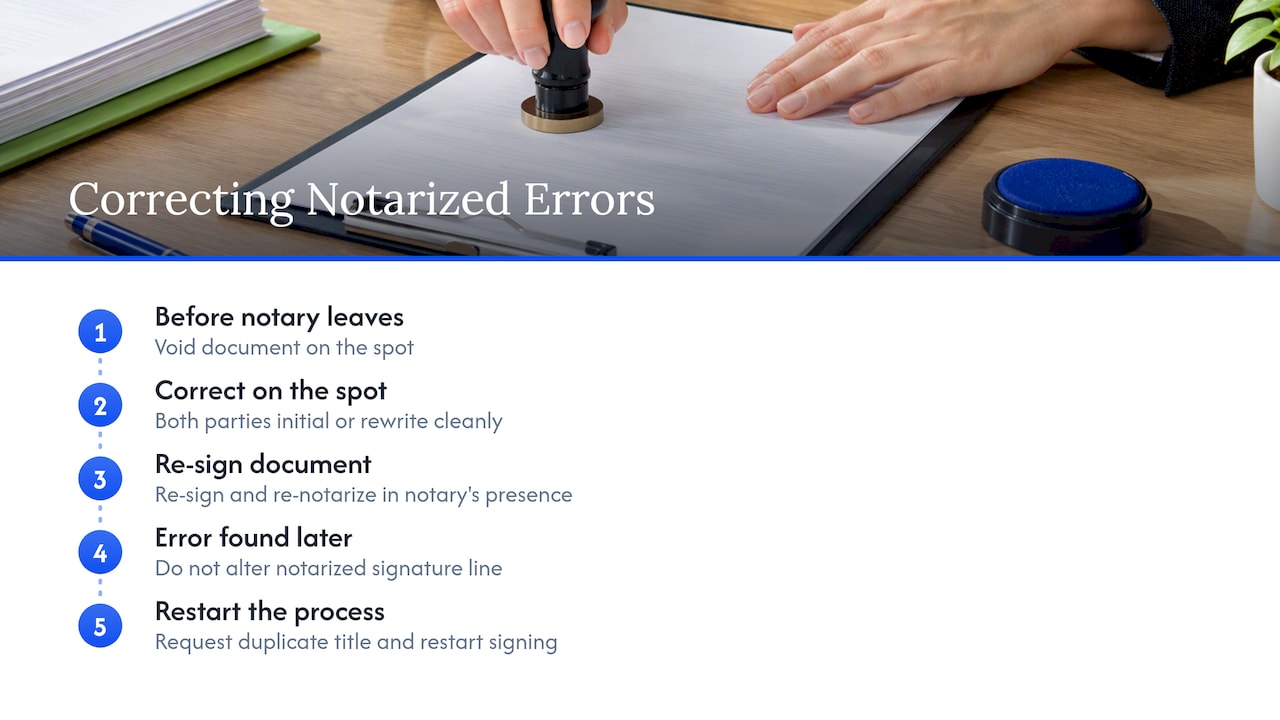
Mistakes on a notarized title or bill of sale are harder to fix after the fact than before, since a notary witnesses a signature rather than verifies the accuracy of the content written above it. If you catch an error before the notary leaves, the cleanest fix is to void the document on the spot: both parties initial the correction, or the form is destroyed and rewritten cleanly, then re-signed and re-notarized in the notary’s presence.
Once the notary has left and the error is discovered later, correcting the original document yourself is risky. Crossing out or altering a notarized signature line can make MVC reject the title outright, since any appearance of tampering raises red flags at the counter. In that situation, the safer route is usually to request a duplicate title from MVC and start the signature and notarization process again with the corrected information.
Small, consistent errors are the most common: a transposed VIN digit, a misspelled buyer name, or an odometer reading that does not match the dashboard at the moment of sale. Catching these before the notary witnesses anything avoids the whole correction process. If the vehicle involved a lien, a mistake on the release paperwork should be resolved directly with the lienholder before resubmitting anything to MVC, since DO-22 and related lien forms depend on accurate lien status information.
When in doubt, a second clean copy of the title application costs far less time than untangling a rejected transfer at the MVC counter.
Differences in notarization requirements between private sales and dealer sales in NJ
Dealer transactions in New Jersey route through a different paperwork system than private sales, which changes how notarization fits in. When a licensed dealer sells a vehicle, the dealer typically reassigns the title using their own dealer paperwork and handles the registration process on the buyer’s behalf, often electronically. That workflow rarely requires a notary because the dealer’s licensing and bonding already satisfy MVC’s verification needs.
Private sales put more of that responsibility directly on the seller and buyer. There is no dealer license standing behind the transaction, so MVC relies on the signed title, a bill of sale, and, in exception cases like POA signings or non-title-state vehicles, a notarized statement to confirm the transfer is legitimate. This is also why private sellers see the 10-working-day penalty rule applied directly to them if a dealer-reassigned or New Jersey title is not transferred promptly.
The practical takeaway for a private seller is that you are doing the verification work a dealer’s systems would normally handle. That means double-checking the VIN, sale price, and buyer information yourself, and understanding that notarization is the exception for private deals rather than a routine step. If your sale involves a lien, a POA, or an out-of-state title history, treat it more like the dealer side of this comparison and build in the extra paperwork and verification time those cases require.
Common mistakes sellers make when notarizing car sale documents and how to avoid them
The most frequent error is assuming notarization is required for every private sale and spending time locating a notary when the ordinary title assignment process would have been enough. Check whether your situation actually triggers the requirement before booking an appointment.
A second common mistake is signing a notarizable line before the notary is present. A notary can only witness a signature made in front of them, so a line signed in advance has to be redone, often meaning a new form and a repeat visit.
Sellers also frequently mismatch the odometer reading, sale price, or VIN between the title and the bill of sale. Even a small discrepancy can cause MVC to question the paperwork later. Read every field against the title itself rather than relying on memory.
For non-title-state vehicles, sellers sometimes forget the supporting documents that go alongside the notarized statement, such as VIN tracing or the last registration card. Missing one piece means a second trip. Finally, sellers using a mobile notary sometimes agree to a quoted fee without confirming travel or after-hours charges, then get a bill larger than expected. Ask for the full breakdown in writing before the notary arrives.
Practical seller priorities: what I focus on when notarization is involved
Accuracy beats speed here. A correct VIN, mileage, and buyer name matter more than finding the cheapest notary in town, because a paperwork error costs far more time than a slightly higher notary fee. Mobile notaries and RON make sense for pickups or sellers who cannot easily travel; face-to-face notarization is worth the extra step when a lien or a complicated title history is involved. Before any appointment, check the title, bill of sale, and ID against each other one last time.
— Eric
Tri State Cash For Cars: paperwork and same-day pickup across New Jersey
Selling a car with paperwork complications, a lien, or a tight timeline does not have to mean chasing down a notary and an MVC appointment on your own schedule. We send a team to your location in New Jersey, give you a cash offer, and handle the paperwork that comes with the sale, including vehicles with liens or title questions.
We quote a price at pickup, so there are no surprises once our team arrives. That matters most for sellers who want:
- A fast, same-day cash payout without listing the car themselves.
- Help managing title or lien paperwork instead of researching forms alone.
- An alternative to a dealership trade-in or an extended private sale process.
If your sale involves a power of attorney, a lien release, or a title from out of state, we work through that paperwork directly with you rather than leaving you to coordinate a notary and MVC visit on separate days. You can request an offer and schedule a pickup whenever your schedule allows, and payment happens at the time our team arrives.
FAQ
Do you need a bill of sale to sell a car in New Jersey?
Yes, a bill of sale is a standard part of a New Jersey private car sale even though it typically does not need to be notarized. It should include the VIN, sale date, sale price, and both parties’ names and addresses, matching the information on the signed title.
Is becoming a notary signing agent worth it?
Whether becoming a notary signing agent is worthwhile depends on local demand, fees you can charge, and how much time you want to commit, which varies by person and region. For a car seller rather than a notary, the more relevant question is simply whether your specific sale requires notarization at all.
What is the most common mistake made by a notary?
In vehicle sales, a frequent issue is a signer completing a notarizable line before the notary is present, which forces a redo of the entire form. Confirming identity and leaving signature lines blank until the notary witnesses them avoids this problem.
Do you need to notarize a car sale?
Most ordinary New Jersey private car sales do not require notarization of the title or bill of sale. Notarization becomes necessary for a power of attorney signing, a vehicle from a non-title state, or when a lienholder specifically requires it.
Sources
- NJ MVC | Transferring vehicle ownership
- New Jersey Notary Public Manual
- Middlesex County — Notary services FAQ
Official NJ links and forms to download
Save these before your sale: MVC’s transfer instructions, pre-owned title guidance, the OS/SS-UTA form, the DO-22 lien form, and the New Jersey Notary Public Manual. If your sale involves an out-of-state title history, this guide to buying a car out of state from FrenzyCars covers additional title nuances worth reviewing.