US Sellers: Get Cash at Pickup for Your Non Running Car in 24–72 Hours
Sell your non-running car to a cash buyer who handles pickup and paperwork, rather than trying to move it yourself. Start now by locating your title (or starting a duplicate-title request), photographing the VIN and odometer, and confirming how you’ll be paid. Never release the vehicle until payment clears and every document is signed.
TL;DR:
- Most reputable buyers for non-running cars handle pickup and paperwork, ensuring payment is verified before releasing the vehicle.
- Starting the duplicate-title or lien-release process early prevents delays that can extend the sale by days or weeks.
- Confirm bank transfer or cashier’s check authenticity directly with the bank before handing over the keys to avoid fraud.
- Using a bill of sale or bonded title can be valid alternatives if the original title is missing or the vehicle has a lien.
- Verify all fees upfront, including towing and paperwork costs, and always file the release of liability immediately after the sale to avoid future liabilities.
Table of Contents
- How Do You Prepare a Non-Running Car for a Fast Sale?
- What Paperwork Do You Need When the Title Is Missing or a Loan Exists?
- How Does Pickup Work and How Do You Verify Payment?
- What Mistakes Put Sellers at Risk?
- Payment Verification and Safe Receipt of Funds
- How Long Does a Replacement Title Actually Take?
- What Fees Should You Expect to Pay?
- Safety and Legal Steps Before the Tow Truck Arrives
- Getting the Vehicle Ready for the Tow Truck
- How Do You Find a Reputable Cash Buyer for a Non-Running Vehicle?
- How Do You Negotiate Price and Terms Before Pickup?
- What If the Buyer Is a Salvage Yard or Scrap Dealer?
- What Sellers Get Wrong About Timing and Risk
- Get a Guaranteed Cash Offer With Pickup and Paperwork Handled
- Where to Verify State-Specific Rules
- Sources
- FAQ
How Do You Prepare a Non-Running Car for a Fast Sale?
Getting the right paperwork together before a buyer shows up is what separates a same-day sale from a week of back-and-forth. Most delays trace back to one thing: the seller starts hunting for documents after the buyer has already agreed to a price.
Here’s the order that actually saves time:
- Find your title first. Check the glove box, a home file, or your bank if there’s a loan on the car. If you can’t find it, start a duplicate-title application with your state DMV immediately, since duplicate-title requests typically require your VIN, ID, and a filing fee, with processing that runs from days to a few weeks.
- Locate your registration and any lien paperwork. If a lender’s name is on the title, you’ll need their contact info to sort out a lien release before or at the sale.
- Photograph the VIN plate, the odometer reading, and the car’s overall condition, including any visible damage. A short set of clear photos speeds up buyer trust and cuts down on last-minute renegotiation over condition, according to documentation checklists for private sales.
- List what’s included. Extra keys, the owner’s manual, a spare fob. Buyers appreciate knowing upfront rather than discovering it at pickup.
- Decide how you’ll accept payment, and confirm the method with your bank if it involves a cashier’s check or wire.
- Clear out personal items and remove toll transponders like E-ZPass devices, since leaving connected accounts and toll tags active can create billing headaches after the sale.
- Print a bill of sale template in case your buyer wants one signed on the spot, and have a valid photo ID ready. Bringing a witness is optional but never hurts.
Pro Tip: Take your VIN and odometer photos with a timestamp visible, either through your phone’s metadata or a dated note in frame. If a payment dispute ever comes up, that timestamp is the first thing a buyer or bank will ask about.
What Paperwork Do You Need When the Title Is Missing or a Loan Exists?
The title is the single document that makes a sale legal in most states, but it isn’t the only path available when the original is lost, damaged, or was never transferred to you.
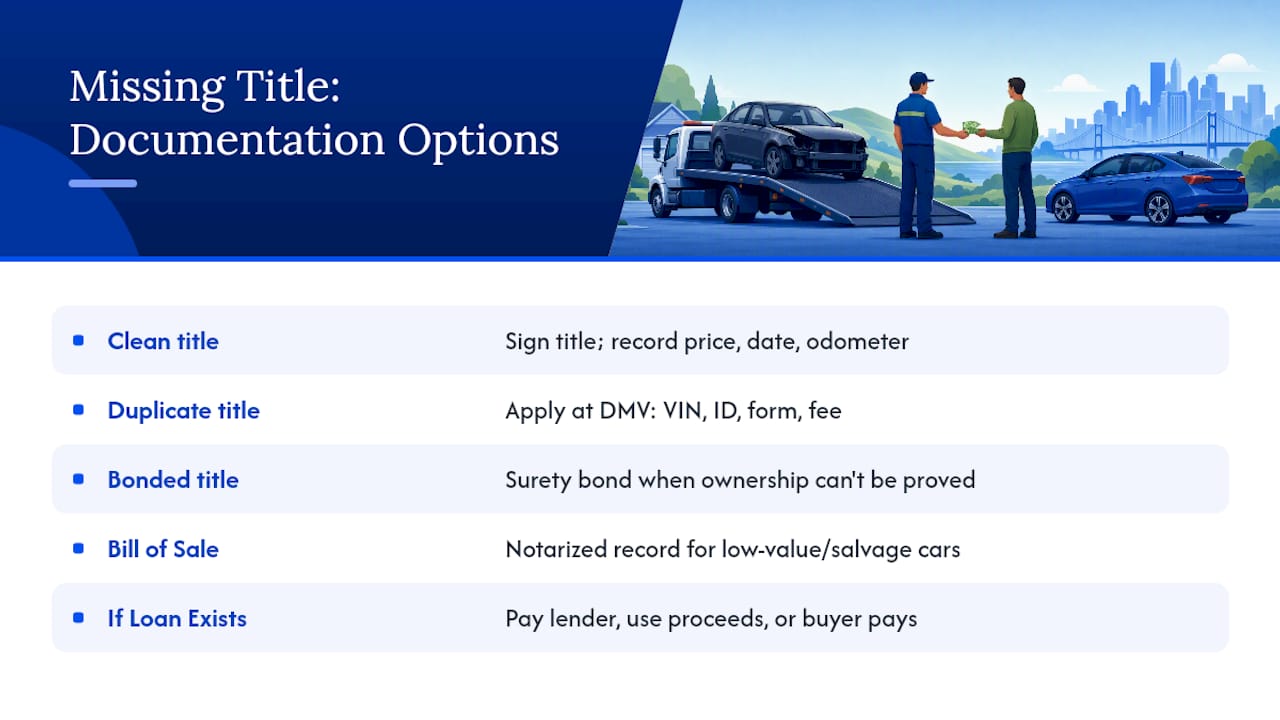
Clean title transfer is the simplest route. You sign the title over, fill in the sale price and date, and complete an odometer disclosure. That disclosure isn’t optional paperwork you can skip: federal rules require odometer disclosure on most vehicle transfers for cars under 10 years old, recorded either on the title itself or a separate form.
Duplicate title. If the original is gone, apply through your state DMV. Expect to submit your VIN, a government ID, an application form, and a fee. Turnaround varies by state, but the process is straightforward once the paperwork is filed correctly.
Bonded title. When you can’t prove clean ownership (a common issue with older vehicles or inherited cars with no paper trail), a surety bond can stand in for a missing title in many states. It costs more and takes longer than a duplicate title, so it’s a fallback, not a first choice.
Bill of sale or scrap sale. For low-value or very old vehicles, some states accept a notarized bill of sale in place of a title, particularly when the buyer plans to scrap or part out the car. A bill of sale should record the VIN, sale price, date, and both parties’ signatures at minimum, according to legalclarity.org. Some scrap and salvage buyers will accept a car without a title at all under the right circumstances, and many will arrange free towing as part of the deal.
If there’s a loan on the car, the lender holds the title until it’s paid off. You have three options: pay off the balance before selling, use the sale proceeds to pay the lender at closing, or have the buyer pay the lender directly if everyone agrees to that arrangement. Either way, getting the lien release sorted before pickup day avoids a stalled closing.
Once the sale is done, file your state’s seller-notice or release-of-liability form right away, and remove or transfer your plates according to your state’s rules. This step protects you from tickets, tolls, or liability tied to a car that’s no longer yours.
How Does Pickup Work and How Do You Verify Payment?
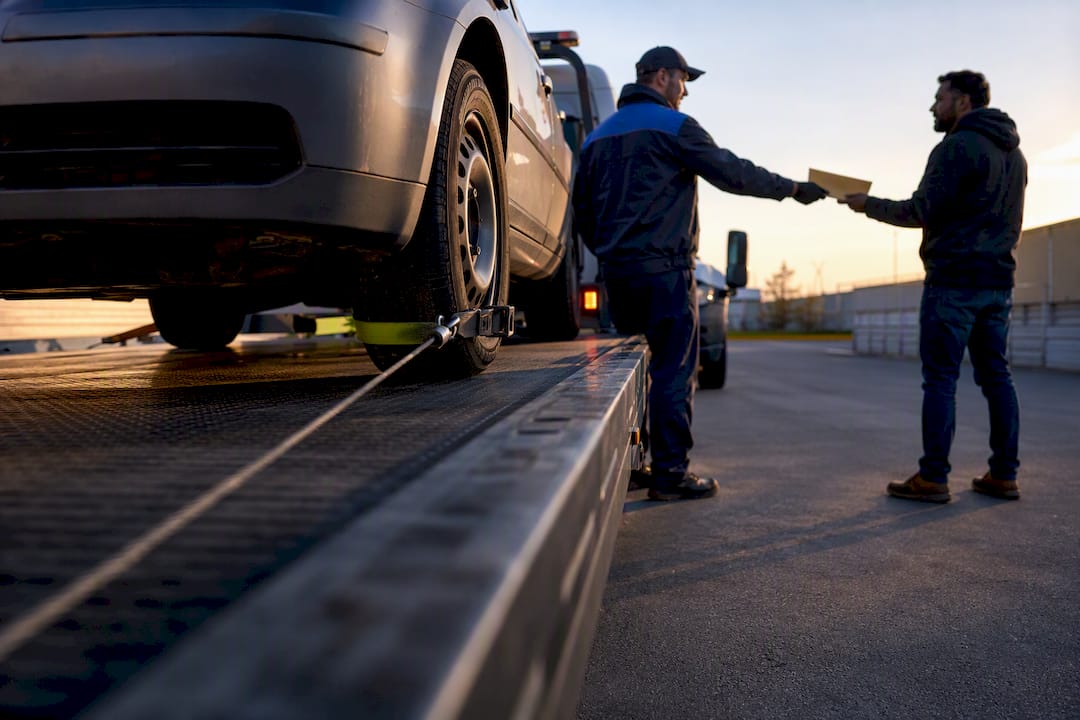
Buyer-arranged pickup usually comes in one of three forms: a flatbed tow truck, a local tow service, or a carrier the buyer contracts directly. Before pickup day, confirm which one is coming, what time window to expect, and whether the driveway or street access works for a flatbed.
Follow this sequence before you hand over the keys:
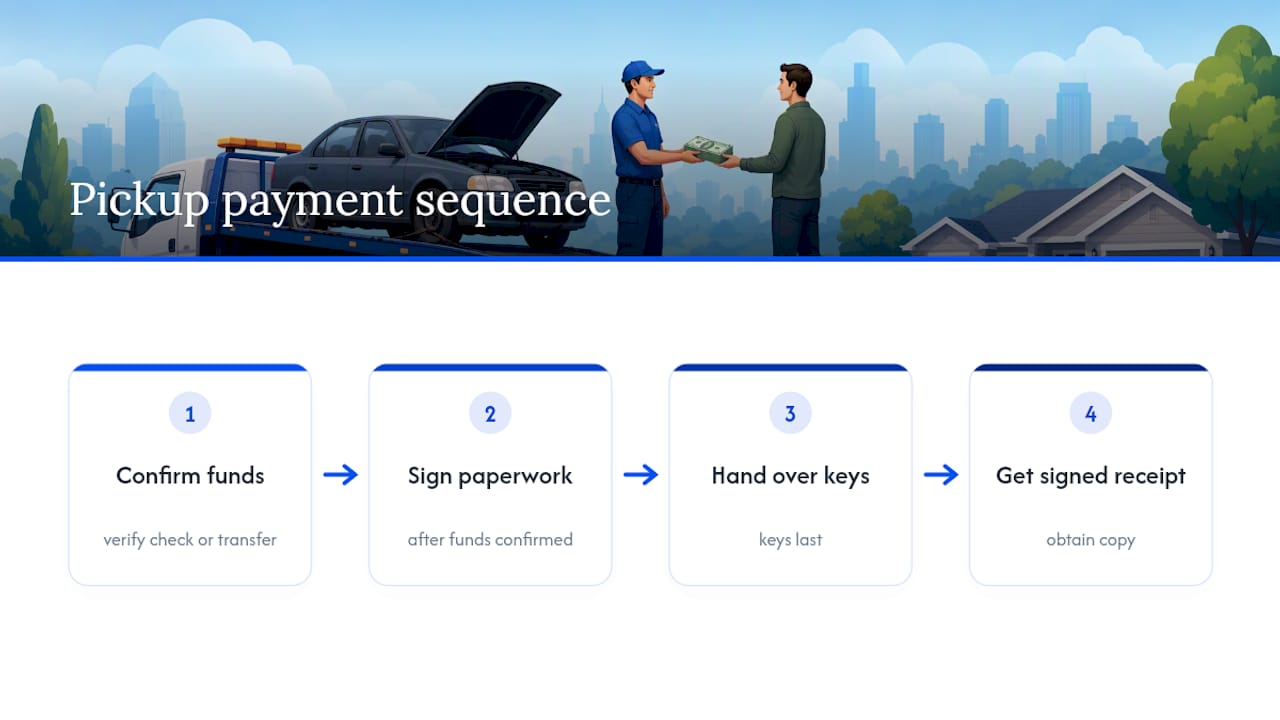
- Verify the payment first. If it’s a cashier’s check, call the issuing bank directly to confirm it’s real, rather than trusting the paper in your hand. For a bank transfer, confirm with your own bank that funds have actually landed, not just that a transfer was initiated.
- Sign and exchange documents. The title (or bill of sale), a completed odometer disclosure, and a bill of sale if your state doesn’t require the title alone.
- Collect the buyer’s ID and get a signed pickup receipt. This is your proof of who took the car and when.
- Photograph everything. The signed paperwork, the payment instrument or transfer confirmation, and the vehicle’s condition right before it leaves your property.
- Get towing terms in writing when you first schedule pickup, so there’s no confusion about whether it’s included in the offer.
A wire transfer or ACH payment being “sent” is not the same as it being cleared. Banks can confirm finality on their end, and that confirmation, not a screenshot of a pending transaction, is what tells you it’s safe to release the vehicle.
Quick fact check: most disputes in private car sales trace back to a seller releasing the vehicle before confirming payment actually cleared, which is exactly why private-sale guides consistently recommend verifying funds before handing over keys.
What Mistakes Put Sellers at Risk?
Most problems with non-running car sales come down to five avoidable habits.
- Releasing the vehicle based on a “pending” payment screenshot instead of a bank-confirmed transfer.
- Signing a title with blank fields, or missing a required co-owner signature your state demands.
- Agreeing to mail the title after pickup instead of closing the deal in person with verified payment.
- Waiting days or weeks to file the release-of-liability form with the state, leaving you exposed to tickets or tolls the new owner racks up.
- Accepting an unfamiliar payment method without checking it with your bank first.
Pro Tip: If a buyer pushes hard for you to sign now and “handle the title paperwork later,” treat that as a red flag rather than convenience. Legitimate buyers, including reputable cash-for-cars companies, expect to close paperwork and payment together, not in two separate steps days apart.
File your release-of-liability or seller-notice form with your state DMV the same day if possible, and keep copies of everything: the title, the bill of sale, the payment confirmation, and your photos. If something goes wrong later, a bank branch visit to verify a large payment in person costs you twenty minutes and removes almost all the risk of the transaction.
Payment Verification and Safe Receipt of Funds
Cash is the simplest payment to verify, but it’s also the least practical for larger amounts and carries its own safety considerations if a stranger is bringing physical cash to your home. Cashier’s checks and bank transfers are the more common methods for cash-for-cars transactions, and each has one verification step you should never skip.
For a cashier’s check, call the issuing bank’s official phone number (not one printed on the check itself) and confirm the check number, amount, and issuing account are legitimate. For a bank transfer, log into your own account and confirm the funds have actually posted, not just that a transfer notification arrived by text or email.
A buyer who resists a short delay for payment verification, or who insists you release the car before funds clear, is telling you something important about how the rest of the transaction will go. Reputable buyers build verification time into their pickup process because they expect it too.
Once funds are confirmed, sign the paperwork, hand over the keys, and get your signed receipt. That order matters. Payment first, signature second, keys last.
How Long Does a Replacement Title Actually Take?
Duplicate-title processing times vary by state, generally running from several days to a few weeks, depending on the method and state processing speed. States with online duplicate-title systems tend to move faster than those requiring an in-person appointment.
The single biggest lever you control is when you start the application. Requesting a duplicate title before you even start fielding offers means the paperwork is often ready by the time you’ve settled on a buyer and price, rather than adding weeks to the process after the deal is already agreed.
If your timeline is tight and the duplicate title won’t arrive in time, ask your buyer whether they accept a documented bill of sale as a bridge, particularly if the vehicle is headed to salvage or parts rather than back on the road. Some buyers, including scrap and salvage-focused ones, have processes built around exactly this situation and won’t need you to wait on the DMV at all.
What Fees Should You Expect to Pay?
Selling a non-running car involves a short list of possible costs, and knowing which ones apply to your situation avoids surprises at closing.
Duplicate-title fees are set by your state DMV and are typically a modest flat charge, though the exact amount varies by state. Notary fees apply if your state requires a notarized bill of sale, usually a small per-signature charge at a bank or notary office. Bonded-title costs run higher, since you’re paying for a surety bond rather than a flat filing fee, and they scale with the vehicle’s value.
Tow fees are the one cost that shouldn’t come out of your pocket in most cash-for-cars transactions. Buyers who specialize in non-running vehicles frequently include pickup in their offer. Some scrap and salvage buyers arrange towing at no charge to the seller as a standard part of the deal, according to marketwatch.com. If a buyer tries to deduct a tow fee from your agreed price at pickup, that’s a term you should have settled before the truck ever showed up.
Ask about every fee, who pays it, and when, before you agree on a final number.
Safety and Legal Steps Before the Tow Truck Arrives
A non-running car sitting in a driveway or on a curb carries risks beyond just paperwork. If it’s leaking fluid, disconnect the battery to reduce fire risk during loading, and place a container or absorbent material under any active leak until pickup.
Check your local rules on street parking for inoperable vehicles. Some municipalities issue citations for a car that appears abandoned or non-running if it sits too long in one spot, so scheduling pickup promptly matters for reasons beyond the sale itself.
Legally, the biggest exposure comes from an incomplete handoff. If you don’t file your state’s release-of-liability or seller-notice form, you can remain the vehicle’s registered owner in the state’s records even after it’s gone, which means tickets, tolls, or worse could still land on you. File that form the same day the car leaves, not “sometime this week.”
If a lien is still on the title, don’t let the buyer take possession until you’ve confirmed with your lender how the payoff or release will happen. A buyer paying you cash for a car you don’t yet own free and clear creates a mess for everyone involved.
Getting the Vehicle Ready for the Tow Truck
A non-running car still needs a few minutes of prep before a flatbed or tow truck arrives, even though you’re not driving it anywhere.
Disconnect the battery if you haven’t already, both for safety and because a dead battery can sometimes create electrical shorts during loading. Secure or remove any loose exterior parts, a hanging bumper, a loose mirror, a trunk that won’t latch, so nothing shifts or falls during transport. If the car has a shattered window or missing parts that could shed debris, mention it to the buyer ahead of time so their driver comes prepared.
Make sure the wheels turn freely and the parking brake is released, if possible, since a locked brake or seized wheel makes loading onto a flatbed considerably harder. If the car has flat tires or is missing wheels entirely, tell the buyer in advance. Most tow operators can still load it, but they’ll want to know before they arrive with the wrong equipment.
Clear a path from the car to the street if it’s tucked into a tight driveway or garage. A partner guide on preparing a vehicle for pickup notes that securing loose components and clearing the load path are two of the most overlooked steps that slow down transport day. Finally, do one last walk-through: check under seats, in the trunk, and the glove box for anything personal you don’t want going with the car.
How Do You Find a Reputable Cash Buyer for a Non-Running Vehicle?
Not every buyer who says they’ll pay cash for your car actually specializes in non-running vehicles, and that gap shows up fast once you start asking questions.
Look for buyers who state clearly, in writing, that they handle pickup and paperwork as part of the deal rather than as an upsell. A dedicated guide on selling a non-running car fast walks through exactly what documentation a legitimate buyer will ask for, which is a useful check against any buyer who seems vague about the process.
Ask direct questions before you agree to anything: Do they guarantee the quoted price at pickup, or is it subject to change once their driver sees the car? Do they cover towing, or is that a separate charge? How do they pay, and can you verify that payment method independently? A buyer who answers all three clearly and quickly is usually one who’s done this many times before.
Check for a real business address, a working phone number answered by a person, and reviews that mention actual pickups rather than just quotes. If you’re specifically dealing with a car that has no title, state-specific guidance on selling without a title can tell you whether your buyer’s process matches what your state actually allows.
How Do You Negotiate Price and Terms Before Pickup?
Get your offer in writing before a truck is scheduled, including the price, whether towing is included, and how payment will be delivered. Verbal agreements have a way of shifting once a driver shows up.
If a buyer’s initial offer seems low, ask what it’s based on. Condition, running status, and whether the car has usable parts all move the number, and a buyer who can explain their offer in those terms is more trustworthy than one who just names a figure with no reasoning behind it.
You have more leverage than you might think if the car runs at all, has a clean title in hand, or has low mileage for its age. Mention these details upfront rather than waiting for the buyer to discover them, since a documented clean title or an available duplicate can sometimes bump an offer because it removes friction from the buyer’s side too.
Settle towing costs before pickup day, not at the curb. If a buyer wants to deduct a fee for the tow truck after quoting you a price, that’s a term that should have been disclosed at the offer stage. A comparison of what different buyers pay and cover for towing is worth a quick read if you’re unsure whether a quote is competitive.
Finally, don’t be afraid to get a second quote. A five-minute call to a second buyer costs you nothing and gives you a real number to compare against.
What If the Buyer Is a Salvage Yard or Scrap Dealer?
Salvage and scrap buyers often have simpler paperwork requirements than a private buyer, but “simpler” doesn’t mean “unregulated.” Most legitimate scrap operations still need your ID, the vehicle’s VIN, and either a title or an accepted alternative like a bonded title or notarized bill of sale.
Ask the dealer directly what documentation they need before they arrive, since requirements can vary depending on whether the vehicle is going to be crushed, parted out, or resold whole. A reputable scrap buyer will tell you this upfront rather than improvising at pickup.
Get a receipt for the transaction regardless of how informal the exchange feels. This receipt, combined with your state’s release-of-liability filing, is your proof that you no longer own the vehicle if any registration or ticket issue surfaces later. Photograph the dealer’s ID or business license if they’re willing, and confirm the payment method the same way you would with any other buyer: verify a check with the issuing bank, or confirm a transfer has actually cleared before the tow truck leaves your property.
If the dealer seems reluctant to provide any documentation or a receipt at all, treat that as a signal to look elsewhere.
What Sellers Get Wrong About Timing and Risk
Most sellers assume the car itself is the hard part of this process. It isn’t. The paperwork is, and specifically, the delay caused by not starting the title process early enough.
In practice, a straightforward sale runs on a short timeline: inquiry, offer, payment verification, and a scheduled pickup within 24 to 72 hours when a title or duplicate title is already in hand. The sellers who get stuck for a week or more almost always hit the same wall, they wait to deal with a missing title until after they’ve already found a buyer, instead of starting that process the moment they decide to sell.
A guarantee at pickup matters more than it sounds like it should. Private buyers can back out, lowball you after seeing the car, or disappear entirely. A buyer that commits to the quoted price at pickup removes that risk almost entirely, which is the whole point of choosing a buyer built around this exact transaction.
— Eric
Get a Guaranteed Cash Offer With Pickup and Paperwork Handled
Tristatecashforcars removes the two biggest friction points in this whole process: chasing a buyer who might change their offer, and handling title paperwork on your own. The guarantee is straightforward: the price quoted is the price paid at pickup, with the team handling the paperwork onsite rather than leaving you to sort through DMV forms after the fact.
Getting started takes a few minutes. Have your VIN, general condition details, and title status (in hand, missing, or lien-encumbered) ready when you request a quote. Same-day or next-day pickup is available in many cases once a price is confirmed. When you schedule pickup, ask exactly three things: which payment method will be used, whether towing is included in the quoted price, and what documents you’ll need to have signed and ready. Start your quote through the guaranteed cash and fast pickup page to see what your non-running vehicle is worth today.
Where to Verify State-Specific Rules
Title, duplicate-title, and seller-notice requirements vary by state, so confirm the specifics with your local DMV before finalizing a sale. A checklist of documents needed for private car sales and a guide to selling without a title are both useful starting points for exact forms and timelines in your state.
Sources
- How to Sell a Car Without a Title: Steps and Options – LegalClarity
- Private-party vehicle sales guide
- Documents needed to sell a car privately in the US: Complete checklist | Car Spot
FAQ
Can You Sell a Non-Running Car Without a Title?
In many states, yes, through a bonded title, a notarized bill of sale, or by selling to a scrap or salvage buyer that accepts alternative documentation, though rules vary by state.
How Long Does a Duplicate Title Take to Arrive?
Processing time ranges from a few business days for in-person DMV requests to a few weeks for mail-in applications, depending on your state.
Who Pays for Towing a Non-Running Car?
Many cash buyers who specialize in non-running vehicles include pickup as part of their offer rather than charging a separate tow fee.
What Documents Do You Need to Sell a Non-Running Car?
You need the title (or an accepted alternative), a completed odometer disclosure, a bill of sale, and your photo ID at closing.
How Do You Know a Cashier’s Check Is Real?
Call the issuing bank directly using a number you look up independently, and confirm the check number and amount before releasing the vehicle.
Should You Sign the Title Before or After Payment Clears?
Sign and hand over documents only after payment is verified as cleared, not based on a screenshot or a “pending” transfer notice.