Get Cash for a Totaled Car in 24 to 48 Hours, Keep vs Surrender
The quickest reliable path to a totaled car sale is a guaranteed offer from a cash buyer who includes free pickup and handles the paperwork. That structure gets you paid at the moment the tow truck arrives, not weeks later. Tri State Cash For Cars is one direct option that works this way, and it removes the logistics headache that usually stalls a total loss sale.
TL;DR:
- Most cash buyers offering guaranteed on-site pickup and immediate payment can complete sales within 24 to 48 hours with no additional fees or surprises.
- Surrendering the vehicle to the insurer typically yields a higher payout unless a buyer’s salvage offer clearly exceeds the salvage deduction, which ranges from $300 to $1,500.
- Essential documents include the vehicle title, proof of a paid-off loan if applicable, previous settlement letter, registration, and ID, with duplicate titles improving offers.
- The strongest offers are from reputable buyers who confirm clear, same-day payment, free pickup, and handle all paperwork on-site to avoid delays or scams.
- Selling a totaled car rarely impacts insurance rates significantly unless the claim was at fault, and such sales are generally not taxable for private owners, provided there’s no profit.
Table of Contents
- Quick Steps to Sell Your Totaled Car in 24 to 48 Hours
- Should You Keep the Salvage or Let the Insurer Take It?
- What Documents Do You Need to Sell a Totaled Car?
- Where Do You Get the Best Instant Cash Offers?
- How Do You Lock in Payment and Pickup Without Getting Burned?
- What Actually Happens on Pickup Day?
- What Scams Should You Watch for When Selling a Totaled Car?
- Does a Totaled Car Raise Your Insurance Rates?
- Do You Owe Taxes on Money From a Totaled Car Sale?
- How Do You Negotiate a Better Offer on a Totaled Car?
- When Does an On-Site Cash Buyer Make the Most Sense?
- Sell Your Totaled Car to Tristatecashforcars for Guaranteed Cash at Pickup
- Sources
- FAQ
Quick Steps to Sell Your Totaled Car in 24 to 48 Hours
Most totaled car sales move fast once you have the right information ready. Buyers who advertise free pickup and same-day payment can typically close the deal within a day or two of your first call.
- Gather your VIN, current photos of the damage, and a short written summary of what happened.
- Confirm your title status and whether you still owe money on a loan.
- Request offers from at least two or three buyers who explicitly promise free pickup and payment at pickup.
- Compare the total payout each buyer offers after any salvage deductions or fees, not just the sticker number.
- Pick the strongest net offer, schedule pickup, and confirm exactly how and when you’ll be paid.
Pro Tip: Ask every buyer the same question in the same words: “What do I actually walk away with after fees?” Buyers who dodge that question are the ones who lowball at pickup.
Should You Keep the Salvage or Let the Insurer Take It?
This decision comes down to simple math, and most owners never run the numbers before signing off.
When your insurer declares a total loss, they calculate your payout using the vehicle’s actual cash value, or ACV, right before the crash. If you surrender the car, you get the full ACV. If you keep it, they subtract a salvage deduction, an estimate of what the wreck is worth in its damaged state.
- Surrender scenario: ACV of $9,000, no deductions, insurer takes the car and arranges transport.
- Keep scenario: ACV of $9,000, minus a salvage deduction of roughly $300 to $1,500 depending on the vehicle, leaving you $7,500 to $8,700 plus whatever a cash buyer pays you for the wreck itself.
The math only favors keeping the car if a buyer’s offer for the salvage clearly beats that deduction. Every day the car sits at a tow yard racking up storage fees, that math gets worse. If your insurer’s ACV feels low, pull three to five comparable listings for the same make, model, year, and mileage in your area and send them over before you sign anything. That comparable-sales evidence is the single most effective way to push back on a lowball number.
What Documents Do You Need to Sell a Totaled Car?
Paperwork is where most totaled car sales get stuck, and it’s almost always avoidable.
- Your vehicle title (or proof you’ve applied for a duplicate)
- Your insurer’s total loss settlement letter, if the claim already closed
- Loan payoff information, if you’re still financing the car
- Your registration and a valid photo ID
- A bill of sale, which most buyers will provide at pickup
If you can’t find your title, you’re not stuck. Selling without a title is possible in many states, though offers tend to run lower because the buyer takes on more paperwork risk. Requesting a duplicate title from your state DMV usually takes anywhere from a few days to a couple of weeks depending on the state, and it almost always bumps your offer back up. If you still owe a lender, that lender gets paid first out of any settlement or sale proceeds, so call them before pickup day to confirm your exact payoff amount.
Requirements vary by state, so confirm specifics with your own DMV before you assume a rule that applies elsewhere applies to you. Owners dealing with a missing title or an estate situation can find more detail in this guide to selling a tricky car for cash.
Pro Tip: Start the duplicate title request the same day you learn your car is totaled. It’s the one step with a real waiting period, so getting ahead of it keeps everything else on schedule.
Where Do You Get the Best Instant Cash Offers?
Not every buyer who says “we pay cash” actually delivers cash, so treat the first quote as a starting point, not a decision.
- Ask each buyer to confirm in writing that pickup is free and that payment happens at the moment of pickup, not after.
- Get the payment method spelled out: cash in hand, certified check, or instant transfer. Vague answers here are a warning sign.
- Compare net payout, not headline offers. A buyer quoting $500 more but charging a towing fee or docking money for “processing” at pickup can end up paying you less than a lower, cleaner offer.
- Request two or three quotes minimum, and time them against your insurer’s settlement timeline so you’re not doing the same paperwork twice.
If your car is still driveable but banged up, this guide to selling a damaged car fast walks through pricing it realistically before you start collecting offers. And if you’re weighing a salvage title sale specifically, this breakdown of buyer options covers what different buyer types will and won’t accept.
How Do You Lock in Payment and Pickup Without Getting Burned?
The gap between agreeing to a price and actually holding cash is where deals go sideways, so treat pickup day like a checklist, not a formality.
- Verify who’s showing up. A legitimate buyer sends a named tow crew tied to a real business, not a random driver in an unmarked truck.
- Confirm the payment method again the morning of pickup: cash in hand or certified check, never a personal check or a promise to “send it later.”
- Have your bill of sale, signed title, and odometer disclosure (where your state requires one) ready before the truck arrives.
- If you have an outstanding loan, confirm ahead of time whether the buyer’s payment goes to you or gets routed toward your lender payoff, since insurers and buyers generally pay the lender first when a loan is still open.
Pro Tip: Write yourself a one-line receipt template in advance: date, buyer name, amount paid, VIN, and both signatures. Handing it over for a signature at pickup takes ten seconds and gives you proof if anything gets disputed later.
What Actually Happens on Pickup Day?
Pickup day follows a predictable order, and knowing it ahead of time keeps you from feeling rushed into signing something you haven’t read.
- The buyer or tow crew arrives and inspects the car to confirm it matches what you described.
- You sign the title and bill of sale, and complete an odometer disclosure if your state requires one for this transaction.
- Payment happens next, in the method you agreed on, before the car gets loaded onto the tow truck.
- The car gets towed away, and the sale is done.
Never hand over your keys or signed title before payment clears in your hand. If you’re financing the vehicle, the insurance settlement or sale proceeds route through your lender first, so confirm that payoff number before pickup, not after. Keep copies of everything: the bill of sale, the signed title, your payment receipt, and the buyer’s contact information. If a dispute ever comes up about the car after it’s gone, that folder is your entire defense.
What Scams Should You Watch for When Selling a Totaled Car?
Most totaled car scams follow the same pattern: pressure to sign before money changes hands.
- A buyer who wants your signed title before paying, promising the check is “on its way.”
- Payment offered through an unfamiliar app, a wire transfer, or a check from someone other than the buyer’s own name.
- A price that suddenly drops once the tow truck is already on your property, banking on the fact that you don’t want to send them away.
- A “business” with no verifiable address, no reviews, and a phone number that goes to voicemail every time.
Before you agree to pickup, verify the buyer has a documented pickup guarantee in writing, a real business address or listing, and some kind of visible track record online. If someone shows up and starts pushing you to sign before you’ve seen payment, stop the handoff. Don’t feel obligated to finish a transaction just because a truck is in your driveway.
Pro Tip: If a deal feels off at any point, walk away and call the buyer’s office directly instead of dealing only with the driver. A legitimate company will back up its own driver’s word every time.
If something does go wrong, document it immediately: photos, texts, names, and license plate numbers. Contact your local police non-emergency line to file a report before contacting your insurer or bank.
Does a Totaled Car Raise Your Insurance Rates?
A total loss claim almost always pushes your premiums up at your next renewal, even when the accident wasn’t your fault. Insurers price risk based on claim history, and a total loss is the largest kind of claim there is. How much your rate rises depends on your insurer, your state, your driving record, and whether the crash was ruled your fault.
At-fault total losses tend to carry the steepest increases, sometimes lasting several years before your record “ages out” of the surcharge period. Not-at-fault total losses, like getting rear-ended, can still nudge your premium up in some states because insurers factor in claim frequency regardless of fault, though the increase is usually smaller.
Shopping around at renewal is worth the hour it takes. Rates vary enormously between insurers for the exact same driving history, and a company that penalizes total loss claims heavily isn’t necessarily the same company charging you now. If you’re financing a replacement vehicle, ask your new insurer directly how a recent total loss on your record factors into their quote before you commit. Some insurers weigh it more heavily than others, and that difference can run into hundreds of dollars a year.
None of this changes the math on selling your current wreck quickly. Whether you surrender it to the insurer or sell the salvage yourself, the claim is already on your record either way, so delaying the sale doesn’t protect your premium.
Do You Owe Taxes on Money From a Totaled Car Sale?
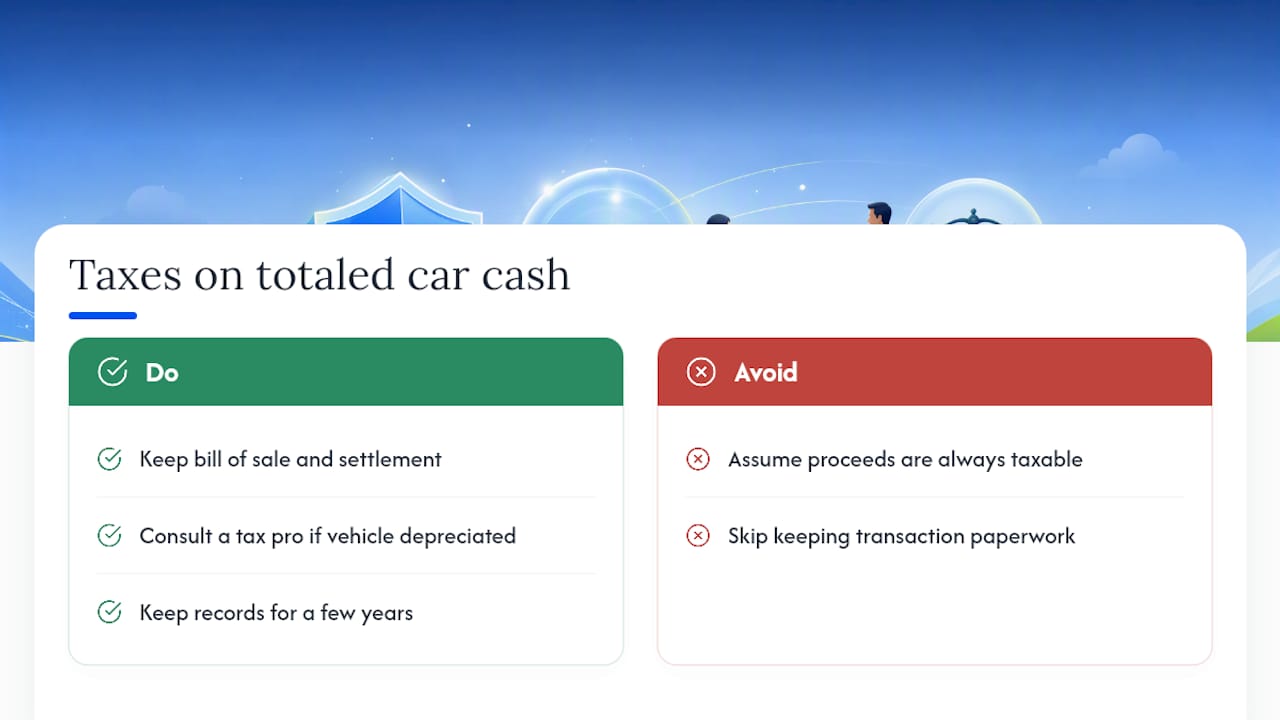
Selling your own totaled car for cash generally isn’t a taxable event, because you’re not making a profit, you’re getting paid for a personal-use vehicle that lost most of its value in a crash. The IRS treats personal vehicles differently from investment property: a loss on a personal car isn’t deductible, but the cash you receive for a wrecked one isn’t income either in the vast majority of individual sales.
Where it gets more complicated is your insurance settlement. That payout is compensation for a loss, not income, so it’s typically not taxable at the federal level. The exception worth knowing: if you ever claimed depreciation on the vehicle for business use, like a car used partly for freelance delivery work, part of your settlement or sale proceeds could factor into your taxes differently. That’s a narrow case, but if it applies to you, a tax professional familiar with vehicle-related deductions can walk you through it in ten minutes.
For the overwhelming majority of private sellers just trying to convert a wrecked personal vehicle into cash, there’s no 1099 to file and no line on your return to worry about. Keep your bill of sale and settlement paperwork anyway. It’s good proof of the transaction if any question ever comes up, and it costs nothing to hold onto a folder for a few years.
How Do You Negotiate a Better Offer on a Totaled Car?
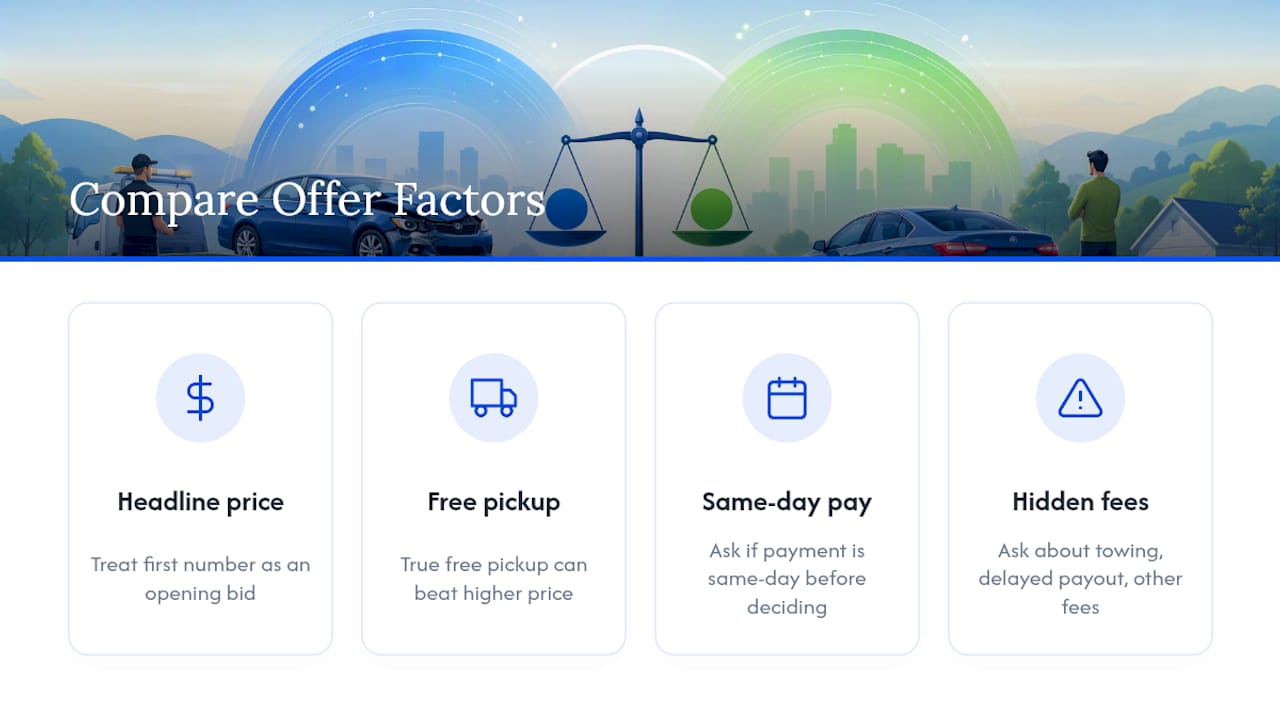
The biggest mistake sellers make is accepting the first number a buyer says out loud. Treat that number as an opening bid, not a final offer.
Start by getting your insurer’s ACV or a set of comparable sales numbers in hand before you call any buyer. Having a real figure to reference changes the entire conversation, because it signals you know what the car is actually worth instead of guessing. When a buyer quotes a price, ask directly what it’s based on: mileage, damage severity, or current scrap and parts demand. Vague answers are your cue to push back.
Get every offer in writing, even a text message, and use competing quotes as leverage. Telling a buyer “another offer came in at this number, can you match or beat it” is a completely normal part of this process, and reputable buyers expect it. Don’t let anyone rush you into a decision the same hour you get the first quote. Pressure tactics are a sign of a weak offer, not a good one.
Factor in the full picture, not just the headline price. A slightly lower offer with truly free pickup, same-day payment, and no hidden fees can beat a higher number that comes with towing charges or a delayed payout. Ask about all three explicitly before you compare numbers side by side, and don’t be afraid to walk away from a buyer who won’t answer clearly.
When Does an On-Site Cash Buyer Make the Most Sense?
Selling a totaled car isn’t really a pricing problem. It’s a logistics problem wearing a pricing costume. Most owners lose money not because they picked the wrong buyer, but because they spent two extra weeks juggling tow yards, title paperwork, and phone tag while storage fees quietly ate into their payout.
An on-site guaranteed cash buyer solves the actual problem: someone shows up, verifies the car, pays the number they promised, and handles the title work on the spot. Some cash buyers operate on that model, with pickup and paperwork bundled into one visit and payment guaranteed at the door, not promised for later. That structure suits sellers who need liquidity now more than those with time to shop a private sale for weeks.
Surrendering to your insurer still makes sense when your ACV is fair and you’d rather skip the extra step entirely. A private sale can occasionally beat a cash buyer’s offer, but only if you have the patience for it and a title in hand. For everyone else, before you commit to any buyer, ask three questions: Is the pickup actually free? Is payment guaranteed at the moment of pickup? And will you handle the title paperwork on-site? A trustworthy buyer answers all three without hesitation.
— Eric
Sell Your Totaled Car to Tristatecashforcars for Guaranteed Cash at Pickup
Some buyers provide a direct route to cash with guaranteed offers upfront and commitment to paying that amount at pickup, with no renegotiations or surprise deductions.
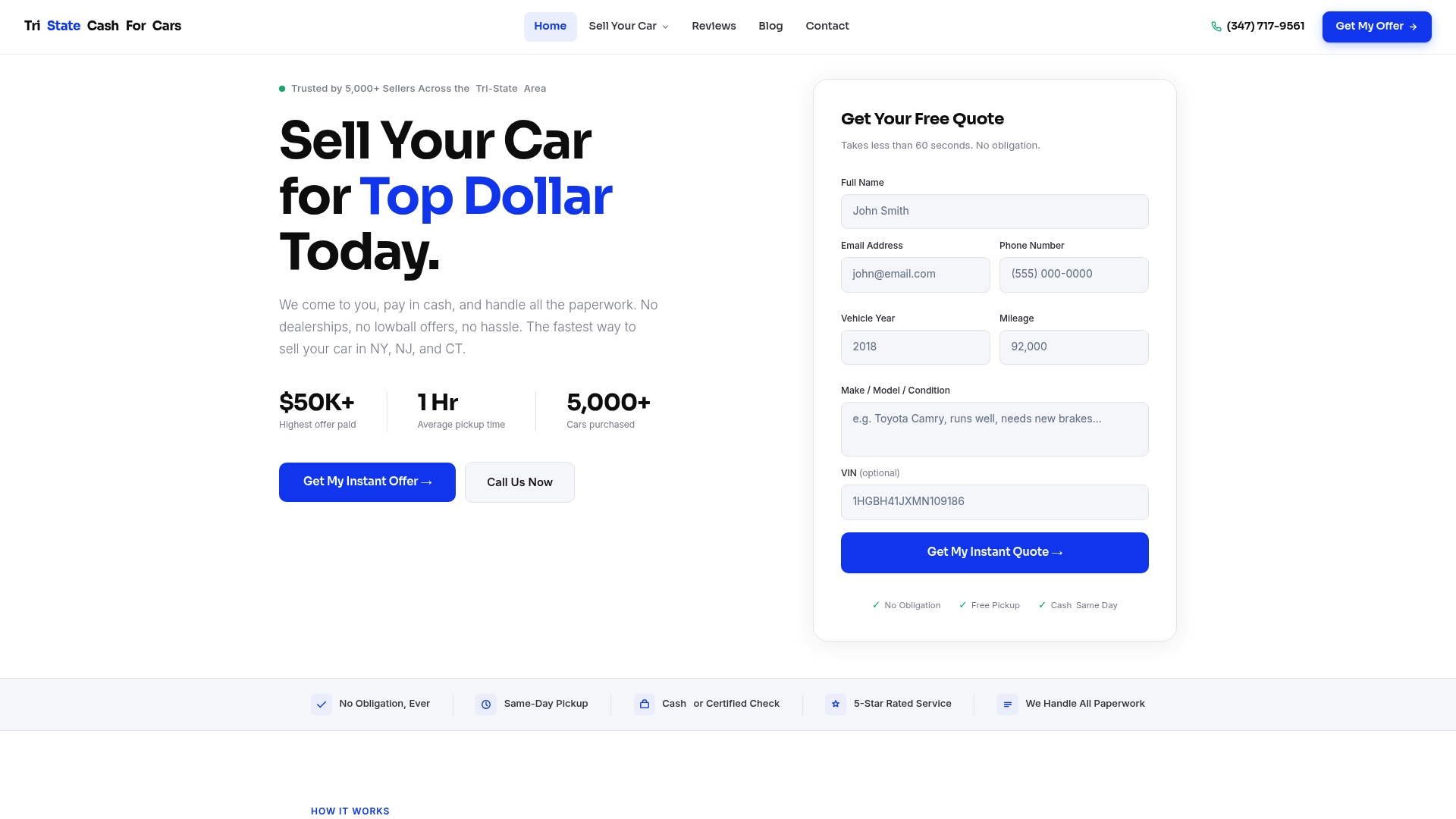
Some services offer pickup across New York, New Jersey, and Connecticut for cars that run or not, with or without a title in hand. These buyers handle paperwork on-site, including title transfer and bills of sale, so sellers avoid DMV trips or waiting for a check in the mail. If you’ve read through the checklist above and you’re ready to skip straight to a real number, get a guaranteed cash offer and free pickup today and see exactly what your totaled car is worth before the tow truck ever leaves the lot.
Sources
- What to do after a total loss – Salvage, payout & towing
- How to sell a totaled car? (You owe money or without title) – Sell Car Advisor
FAQ
Can You Sell a Totaled Car Without a Title?
Yes, in many states you can sell a totaled car without a title, though offers are typically lower because the buyer takes on more paperwork risk. Requesting a duplicate title from your DMV usually raises your offer.
How Fast Can I Get Paid for a Totaled Car?
Most cash buyers who offer free pickup can complete the transaction and pay you within a couple of days of your first call, with payment happening at the moment of pickup.
Should I Keep My Totaled Car or Let the Insurer Take It?
Keep it only if a salvage buyer’s offer clearly beats your insurer’s salvage deduction, which typically runs $300 to $1,500. Otherwise, surrendering the car to the insurer usually nets more with less hassle.
Who Buys Totaled Cars for Cash?
Cash-buying services that specialize in damaged and non-running vehicles purchase totaled cars directly, often offering free pickup and same-day payment.
Will Selling a Totaled Car Raise My Insurance Rates?
The total loss claim itself, not the sale of the car afterward, is what affects your premium. Selling the wreck quickly doesn’t change your claim history either way.
Do I Have to Pay Taxes on a Totaled Car Sale?
Generally no. Selling your own totaled personal vehicle for cash isn’t a taxable event for most private sellers, since you’re not realizing a profit on personal-use property.