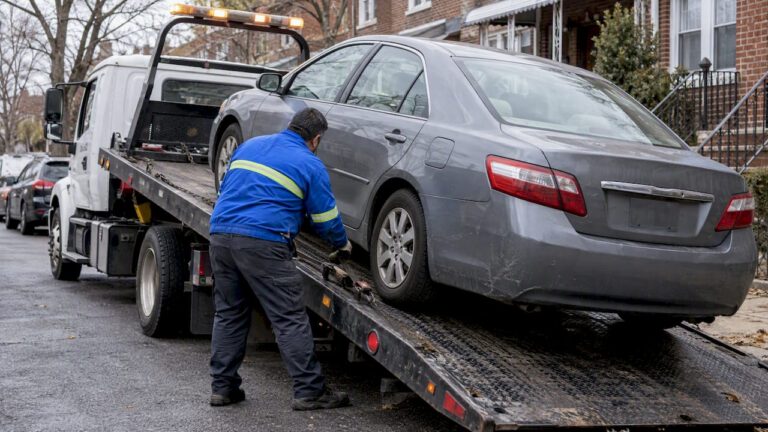
Sell Your Car From Home: How Pickup Sales Work
You can sell a car without leaving your driveway. You submit the car’s details online or by phone, get an offer, confirm a time, and a buyer comes to you, checks the car, handles the paperwork and pays you. No listing, no strangers test-driving it, no trip to a dealership. The steps below show how it works, what to have ready, and how to keep the price you were quoted.
TL;DR
- Start with your VIN or license plate, the car’s condition and any damage. Honest details get you an offer that holds at pickup.
- Have your title (or loan details), photo ID and keys ready. Paperwork differs by state, so check your DMV’s rules first.
- If you still owe money, the lender holds the title. The payoff has to be settled before ownership can move to the buyer.
- Non-running and damaged cars can be sold from home too. Disclose the problems up front so the offer matches what the buyer sees.
- Sign the title and a bill of sale, keep copies, remove your plates if your state requires it, and cancel insurance only after the car is gone.
Table of Contents
- How selling from home works, start to finish
- Get the offer right before you accept it
- What to have ready before the buyer arrives
- Payment, title and paperwork at pickup
- If you still owe money on the car
- Selling a car that does not run
- How to avoid price changes at pickup
- Perspective: why home pickup suits most sellers
- Sell your car from home with Tri State Cash For Cars
- A simple timeline for a same-day sale
- FAQ
- Sources
How selling from home works, start to finish
Most home-pickup sales follow the same five steps, whether the buyer is an online retailer or a local cash buyer.
- You submit the car’s details. This is a short form: VIN or plate, mileage, condition, and photos or answers about damage.
- You receive an offer. Consumer Reports found that most online retailers it tested returned offers within minutes. It also notes that, depending on the company, you may have several days to accept or decline.
- You schedule pickup. You choose a time and place: your driveway, your office, a garage.
- The buyer verifies the car. They compare it with what you described, check the title and your ID, and confirm the odometer.
- You sign and get paid. Title and bill of sale are signed, payment is made, and the car leaves with the buyer.
The difference between a smooth sale and a frustrating one is almost always step 4. If the car matches the description, nothing changes. If it does not, the price does. That is why the next sections focus on accuracy and paperwork.
Get the offer right before you accept it
An offer is only as good as the information behind it. Online forms typically ask for your VIN or license plate, the color and the options, both factory and dealer-installed. According to Consumer Reports, they may also ask whether the car was smoked in, has been in a crash, has other damage such as flooding, and whether you have two keys.
Answer each of those as you would if the buyer were standing next to the car. Every mismatch between the form and the car is a reason for an offer to move at pickup.
What a fair remote offer looks like
You cannot judge a number without context, so use a few simple habits:
- Compare offers of the same type. An offer you can accept today and an estimate that depends on inspection are different things. Ask which one you have.
- Ask what the price is based on. It should reflect your car’s year, mileage, condition and local demand, not a generic figure.
- Ask whether the quote is guaranteed at pickup. This is the single most important question. A quote with no commitment behind it is a starting bid.
- Ask about fees. Towing, pickup and paperwork should not appear as deductions at the end.
At Tri State Cash For Cars, our offers come with a guarantee: we commit to paying the stated price at pickup. If you want to understand why instant quotes sometimes drift from the final number, our guide on closing the gap in instant offer accuracy walks through it, and avoiding odometer and title surprises covers the two most common causes.
What to have ready before the buyer arrives
Preparing the paperwork before pickup is what makes a one-visit sale possible. A short checklist:
| Item | Why it matters |
|---|---|
| Title in your name | Proof you own the car and the document that transfers ownership |
| Photo ID | The buyer matches it to the name on the title |
| Loan details (if any) | Lender name, account number and payoff amount |
| All keys and remotes | Missing keys can change the price |
| Service records (optional) | Supports the condition you described |
| Odometer reading | Required in writing on transfer (see below) |
Consumer Reports states that if you accept an online offer, you generally must show proof of ownership and some form of identification.
Requirements vary by state. AAA points out that different states require different paperwork and tells sellers to check their DMV’s requirements beforehand. In some states the title alone is enough, while others also require specific information to be recorded and signed on it.
If you are in New York or New Jersey, we keep state-specific guides: NY car sale paperwork, NY title transfer forms and notarization and NJ car sale paperwork. For a quick tidy-up before the buyer comes, see how to prepare your car for sale.
Payment, title and paperwork at pickup
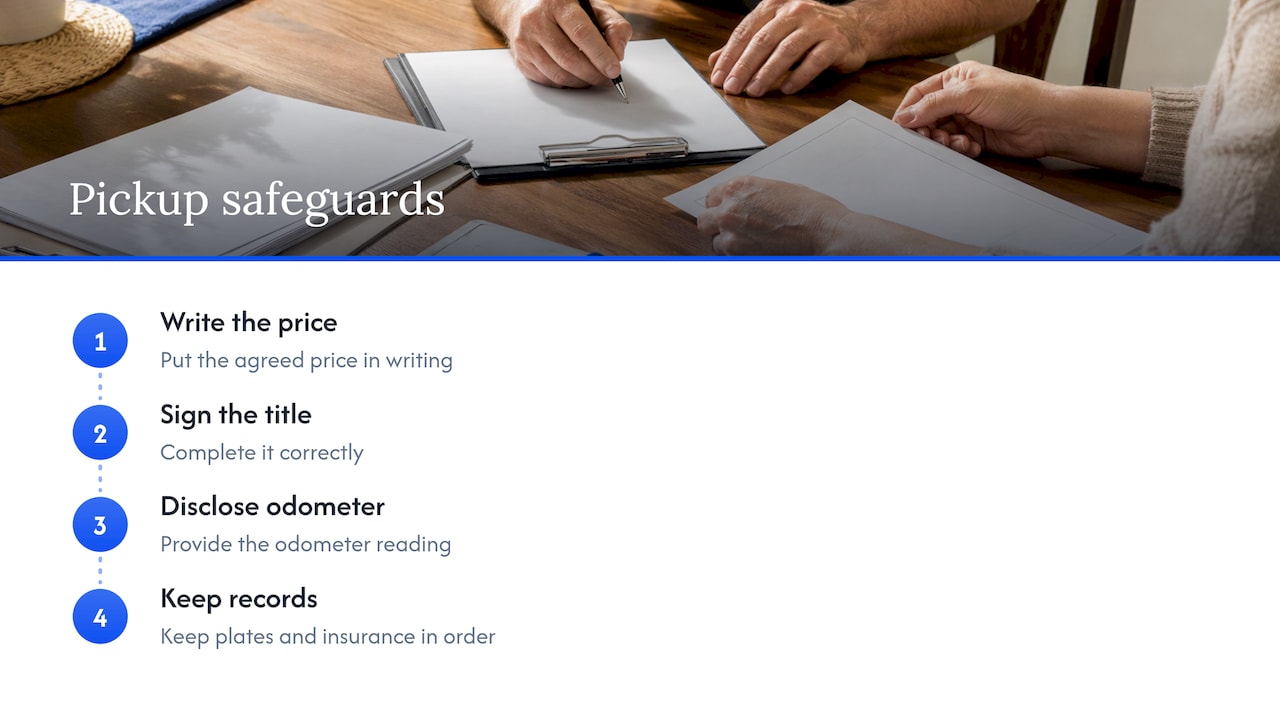
This is the moment where careful sellers protect themselves. Four things should happen before the car drives away.
1. Put the price in writing
The Better Business Bureau advises finalizing the sale with paperwork, not on a handshake. Once you agree on the price, get it in writing, sign over the title and complete a bill of sale.
2. Sign the title correctly
The exact fields depend on your state. As an example, the Maryland MVA tells sellers to fill in the buyer’s name and address, the sale price, the odometer reading, the date of sale and the signature of every owner, unless the title shows “OR” between names. Your own state’s motor vehicle agency will have the equivalent list. Our page on what to sign before the buyer drives away covers the usual documents in plain terms.
3. Disclose the odometer reading
Federal law requires the person transferring a vehicle to give the buyer a written disclosure of the mileage. 49 U.S.C. 32705 sets that rule, with certain exemptions. NHTSA explains that since January 1, 2021, disclosure is required on every transfer for the first 20 years, beginning with model year 2011 vehicles. Model year 2010 and older remain exempt from the extended requirement.
4. Keep your records, plates and insurance in order
The Maryland MVA advises that license plates stay with the seller and that you keep proof of the sale, including copies of the completed title (front and back) and the bill of sale. The BBB adds that you should cancel insurance only after the buyer has signed the bill of sale and driven away. It also says to transfer registration and file a release of liability if your state requires it. In New York, see our guide to reporting a car sale.
If you still owe money on the car
A loan does not stop you from selling at home, but it changes the order of events. Consumer Reports explains that when you are still making payments, the lender holds the title and the loan must be paid off before you get it. Some buyers handle the payoff part for you.
The principle is the same across states. The Maryland MVA says a lien must be released before the sale. Arizona’s transportation department says liens must be paid off, or the buyer needs written permission from the lienholder, before the title can go into the buyer’s name.
In practice:
- Call your lender and ask for a payoff amount valid through a specific date.
- Compare it with your offer. If the offer is higher, the difference is yours. If it is lower, you will need to cover the gap.
- Ask the buyer how the payoff is handled and when the lien release reaches you.
We have walkthroughs for selling a financed car in New York and selling a car with a lien in New York, and an overview of our six-step process, even with a loan.
Selling a car that does not run
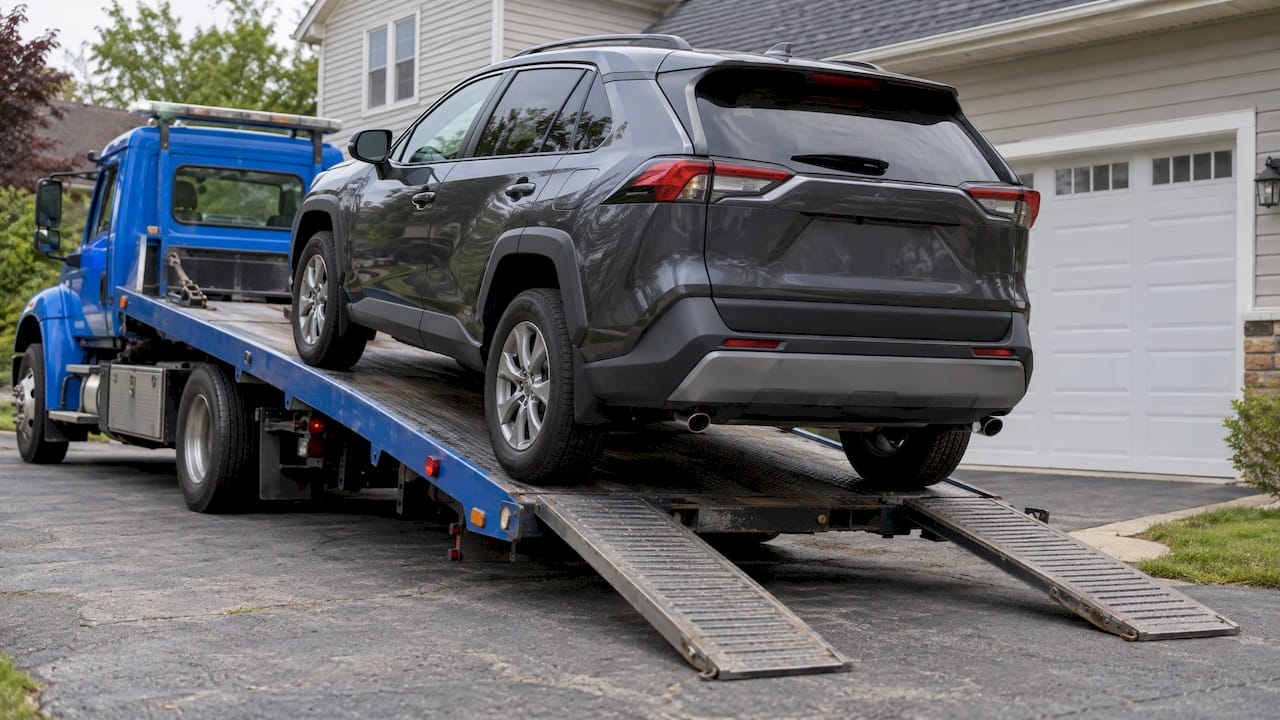
A car that will not start can still be sold from home. Buyers who collect vehicles bring a tow or flatbed, so you do not need to move it. What matters is that you describe it accurately.
Before you accept an offer, be ready to say:
- Whether the car starts, drives or needs towing
- Any crash history or body damage
- Flood, fire or smoke exposure, which forms commonly ask about
- Missing parts, such as a catalytic converter, wheels or a second key
- Warning lights, transmission or engine problems
- Whether you have the title, and if not, what documents you do have
The reason is simple. The buyer prices the car from your description and then verifies it at your door. If what they find matches, the quoted price stands. If you left out a major problem, the number will change and you will have lost time.
We buy running and non-running vehicles, including damaged and older ones, and we work with sellers with or without a title. Tell us your situation when you request an offer and we will tell you what is needed.
How to avoid price changes at pickup
Most last-minute changes come from a few causes. All of them are avoidable.
- Vague answers on the form. Say “rear bumper dented, passenger door scratched” rather than “minor cosmetic.”
- Wrong mileage. Read the odometer on the day you request the offer, and again at pickup.
- Title problems. A lien you forgot about, or a name that does not match your ID, can stop a sale.
- Missing keys. Mention it at the start.
- Photos that flatter. If photos are requested, take them in daylight and show the damage, not just the good side.
And the single protective step: before you schedule, ask whether the quoted price is the price you will be paid at pickup. Ours is.
Perspective: why home pickup suits most sellers
We started Tri State Cash For Cars because selling a car is harder than it should be. Dealerships often lowball. Private listings mean weeks of messages, no-shows and strangers in your driveway. Neither fits a busy person who needs the car gone and the money in hand.
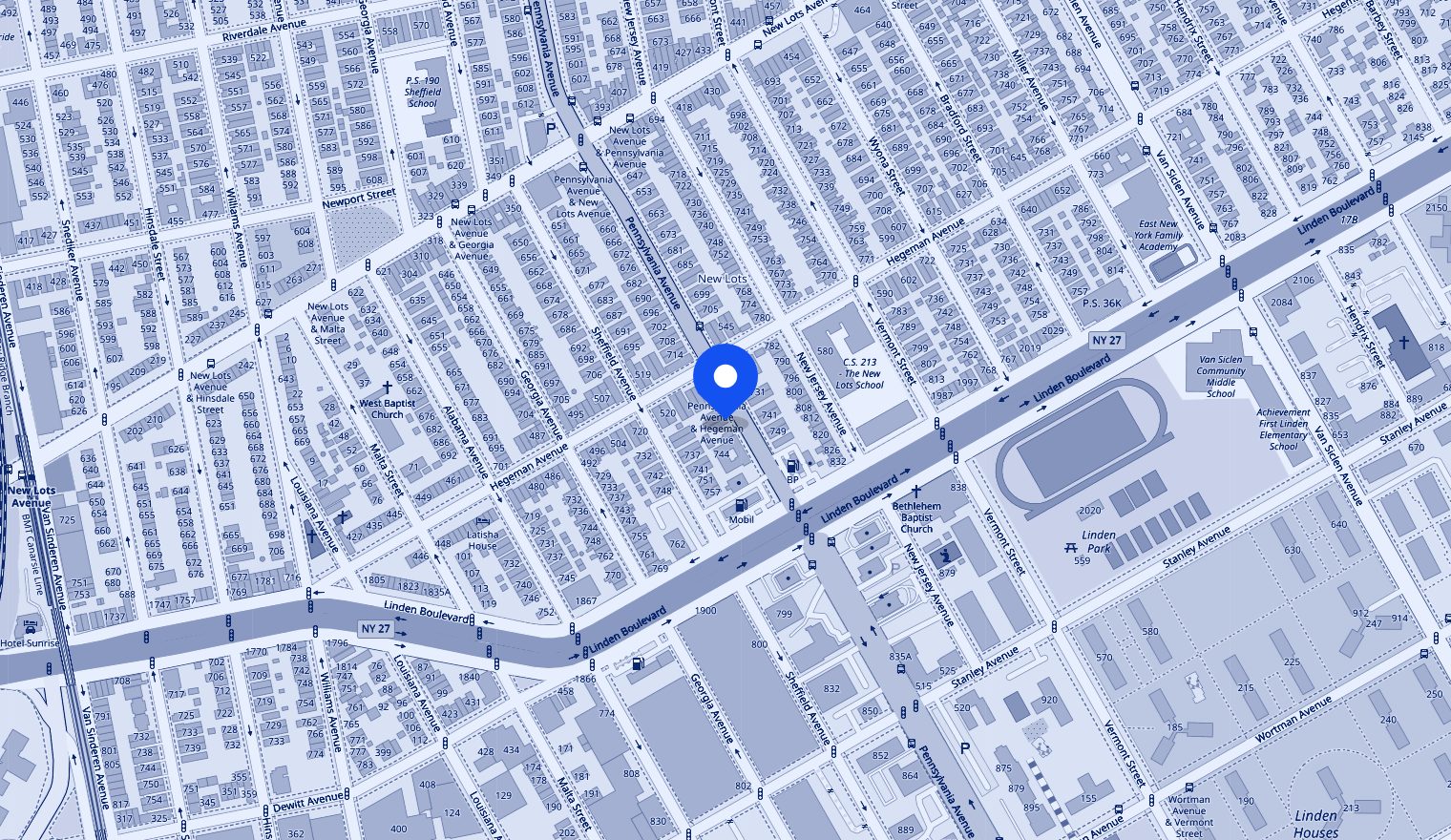
Our approach is built around one promise: the price we quote is the price we pay at pickup. We come to you in New York, New Jersey or Connecticut, handle the paperwork, and aim to have cash in your hand within an hour. We buy cars that run and cars that do not, with or without a title.
We believe that is how a car sale should feel: one conversation, one visit, no surprises. Our own view is that this approach beats waiting on a dealership trade-in or a listing, and we built our process to prove it every time we pull into a driveway.
Eric
Sell your car from home with Tri State Cash For Cars
If you are in New York, New Jersey or Connecticut and want to skip the listing, the haggling and the dealership visit, we can help. Tell us about your car, get an offer, choose a pickup time, and we come to you. We handle the paperwork, and the offer we quote is the one we commit to paying at pickup.
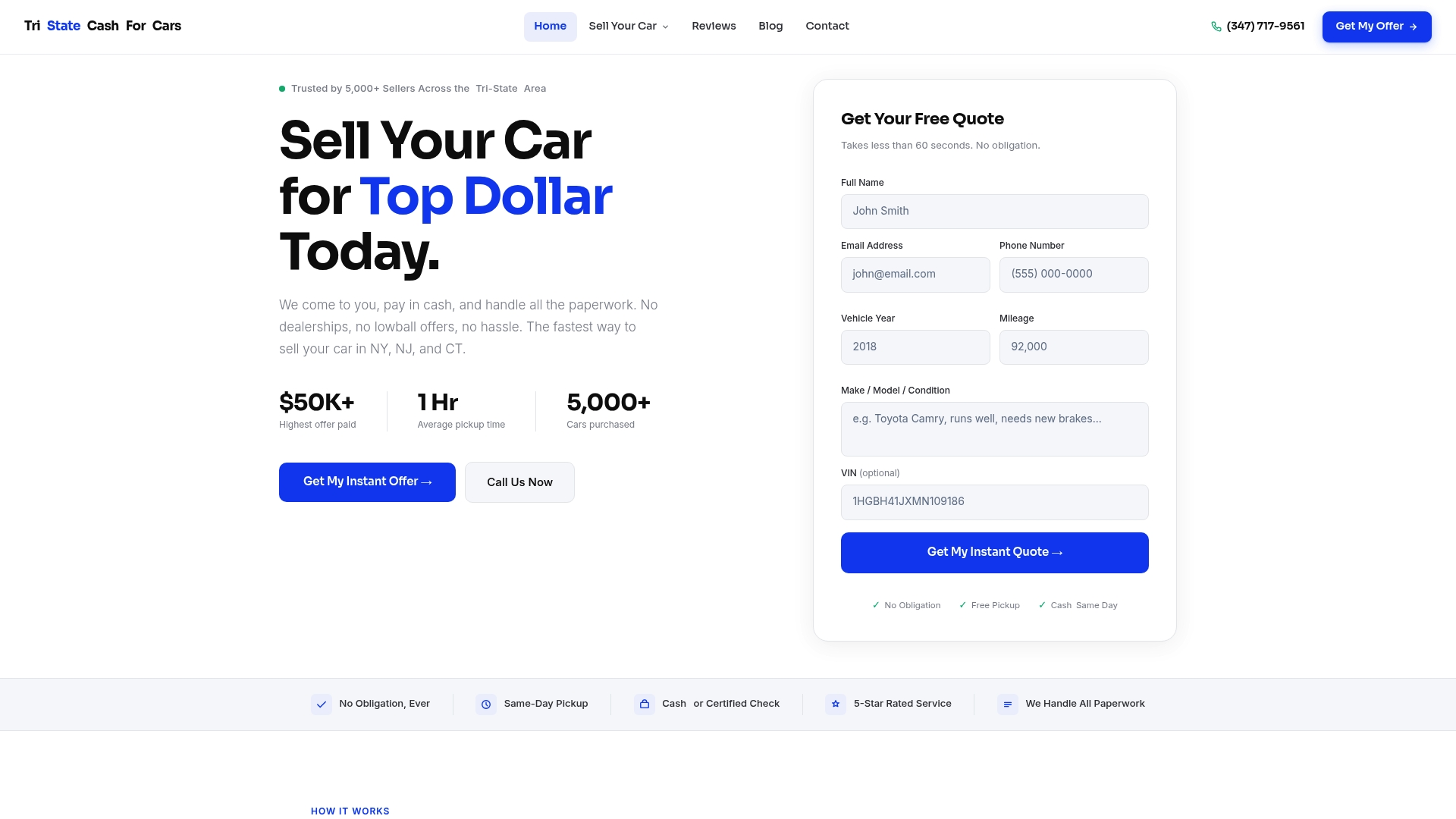
Request your offer at Tri State Cash For Cars and see how quickly your car can be sold from your own driveway.
A simple timeline for a same-day sale
If you want the car gone today, work backward from pickup.
| Time | What to do |
|---|---|
| Morning | Locate title, ID and keys. Read the odometer. Call your lender if there is a loan. |
| Before requesting an offer | Walk around the car and note every dent, light and issue. |
| Offer received | Confirm it is guaranteed at pickup and that no fees will be deducted. |
| Pickup | Verify the buyer’s details, sign the title and bill of sale, take payment, keep copies. |
| After pickup | Remove or return plates as your state requires, notify your DMV, then cancel insurance. |
The steps are routine once you have done them. The preparation is what gives you speed.
FAQ
Can I really sell my car without listing it?
Yes. You can request an offer from a buyer who purchases cars directly, then arrange pickup. There are no ads, no calls from strangers and no test drives. You only deal with the buyer’s representative at the time of pickup.
Do I need to be home for the pickup?
You, or the person named on the title, should be there to sign the paperwork and confirm the details. As the BBB advises, the sale should be completed in writing, and the title needs the owner’s signature. Pickup can happen at your home, workplace or wherever the car is parked.
What if I do not have the title?
Tell the buyer when you ask for an offer. Rules on titles depend on the state, and AAA notes that required paperwork differs from one state to another. We buy vehicles with or without a title, and we will explain what is needed in your case.
Can I sell a car with a loan from home?
Yes, but the lender holds the title until the loan is paid, as Consumer Reports explains. Get a payoff amount from your lender and share it with the buyer, who can coordinate the payoff. We cover the details for New York in our guide to selling a car with a lien.
When should I cancel my insurance?
Only after the buyer has signed the bill of sale and driven away, according to the BBB. Cancelling earlier leaves you exposed if something happens before the car leaves your hands.
Sources
- Consumer Reports: How to Sell Your Car to an Online Dealer
- AAA: How to Sell or Buy a Used Car Privately
- BBB: How to sell a car to a trustworthy, honest buyer
- Maryland MVA: Selling a Vehicle
- NHTSA: Changes to Odometer Disclosure Requirements
- 49 U.S.C. 32705 on govinfo.gov
- Arizona DOT: Vehicle Liens