Private Sale Risks: 6 Traps and Official Steps to Avoid Them
Selling your car to a private buyer carries real risks, but most of them are avoidable. The main dangers are payment fraud (fake checks and overpayment scams), buyer identity scams, odometer tampering, undisclosed liens, and personal-safety exposure during in-person meetups. The FTC and NHTSA publish specific guidance on these exact problems, and sellers who want to skip them entirely can request a guaranteed offer from us at Tri State Cash For Cars instead.
TL;DR:
- Never refund an overpayment or trust an available balance; confirm checks directly with the issuing bank and release the car only after funds clear.
- Compare the odometer with service records, resolve liens, and complete mileage disclosures; federal rules cover Model Year 2011 and newer vehicles for 20 years.
- Sign a bill of sale listing both parties, the VIN, price, payment method, mileage, and as is terms; keep a copy.
- Meet in a busy public place, bring someone with you, check the buyer’s license and insurance, and keep your keys until payment is verified.
- After payment clears, transfer the title, remove your plates unless state rules say otherwise, and check your DMV’s sale reporting requirements.
Table of Contents
- Top risks private sellers face
- How common scams work
- Legal and paperwork risks: title, liens, and odometer disclosure
- Payment and buyer-verification best practices
- Safe meetup and test-drive practices
- If something goes wrong: immediate steps and who to contact
- Steps to verify a buyer’s legitimacy beyond identity
- Common contract pitfalls and how to draft a secure sales agreement
- Tips to ensure proper transfer of ownership and avoid future claims
- Timeline overview of the private sale process, including title transfer
- Why a vetted cash buyer removes most of this risk
- A safer way to sell: on-site offer, cash at pickup
- FAQ
- Sources
Top risks private sellers face
Private car sales put you in direct contact with strangers, which opens the door to several distinct hazards. Knowing the list before you post your listing helps you spot trouble before it costs you money or worse.
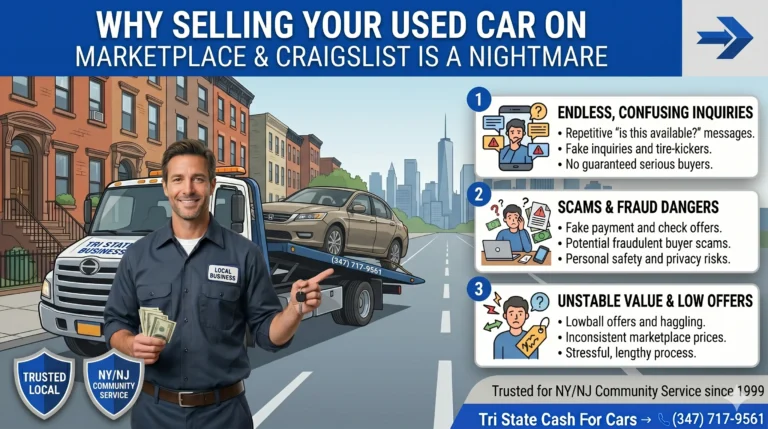
- Fake-payment and overpayment scams: a buyer sends a check for more than the asking price and asks you to refund the difference, then the original check bounces after your bank already showed the funds as available.
- Identity and pretexting risks: buyers who refuse to meet, insist on sight-unseen deals, or ask for personal documents under the guise of “processing” the sale.
- Odometer fraud: rolled-back mileage misleads buyers and exposes sellers to liability if they sign a disclosure without checking the number first.
- Title problems and undisclosed liens: a lender’s lien that was never released can block transfer and leave you on the hook after the sale.
- Physical-safety risks: meeting an unknown buyer alone, at an unfamiliar location, or letting someone test-drive the car without verifying who they are.
- Fake history-report and escrow sites: links that mimic legitimate vehicle-history or escrow services but exist only to collect payment details or personal information.
Each of these risks has a documented pattern. Scammers tend to reuse the same scripts because they work often enough to keep running them, which means a seller who recognizes the pattern early has a real advantage.
How common scams work
Most private-sale scams follow a predictable sequence, and recognizing the steps makes them much easier to shut down before any money moves.
- A buyer offers to pay more than your asking price and sends a check or money order for the higher amount, then asks you to wire back the difference before the bank has fully cleared the original payment.
- A buyer sends a screenshot of a mobile payment confirmation (Zelle, Cash App, or similar), claims they sent too much by mistake, and asks for a partial refund, even though no real transfer happened.
- A “buyer” who claims to be out of town or overseas offers to purchase the car sight unseen, then directs you to a fake escrow website to “hold” the funds until the car ships.
The FTC’s advisory on fake checks targeting car sellers warns that these schemes specifically target vehicle listings because the dollar amounts are large enough to make the “overpayment” request look plausible.
Pro Tip: Treat any bank balance showing “available funds” as provisional until you confirm with the issuing bank that the check has actually cleared, or simply insist on cash in person.
Legal and paperwork risks: title, liens, and odometer disclosure
Paperwork mistakes create legal exposure that can follow you long after the sale closes. A lien that was never released stays attached to the title, and if you sign over a car without resolving it, the buyer can come back to you, or the lender can pursue you, when the debt surfaces later.
Mileage disclosure carries its own federal rules. The NHTSA explains that federal odometer-disclosure requirements now extend to 20 years for Model Year 2011 and newer vehicles, and the agency estimates more than 450,000 vehicles are sold each year with false odometer readings. Signing a disclosure without checking the actual mileage against your records and past inspection reports puts you at risk if a discrepancy turns up later.
Common title mistakes to avoid:
- Signing the title before the buyer’s payment has fully cleared.
- Leaving the odometer section blank or estimating the mileage instead of using the exact reading.
- Failing to obtain a lien release letter before transferring ownership.
- Forgetting to remove your license plates and notify your state DMV of the sale.
A buyer in your area may have state-specific disclosure forms; our guide to odometer disclosure paperwork walks through one state’s version as an example of what to expect.
Payment and buyer-verification best practices
The safest payment is cash handed over in person, counted at a bank branch if the amount makes you uneasy carrying it. A bank-verified cashier’s check, confirmed directly with the issuing bank before you hand over keys, is the next safest option. Wire transfers work too, but only after your own bank confirms the funds have actually settled into your account, not just that a transfer was initiated.
- Never accept a payment for more than your asking price, under any explanation.
- Never wire money back to a buyer for any reason, even if their check appears to have cleared.
- Call the bank branch listed on a cashier’s check to confirm it is genuine before releasing the car.
- Be wary of any site that asks you to use its own “escrow” service rather than a bank you can verify independently; legitimate vehicle escrow services are tied to known providers, not a link a buyer sends you out of nowhere.
The CFPB warns that bank-reported “availability” does not mean a check has finally cleared, which is exactly the gap scammers rely on when asking sellers to refund an overpayment quickly.
Safe meetup and test-drive practices
Where and how you meet a buyer matters as much as the paperwork. Public, well-lit, busy locations cut down on physical risk, and a bank parking lot does double duty since it lets you verify payment on the spot.
- Meet in a public place such as a shopping center or police department parking lot, and bring a friend or family member along.
- Ask for a driver’s license and proof of insurance before handing over the keys for a test drive.
- Keep the car keys in your possession until payment is confirmed, and ride along on any test drive longer than a quick loop around the block.
- Avoid sharing your home address; suggest a neutral meeting point instead.
If something goes wrong: immediate steps and who to contact
Acting fast limits the damage if a deal turns out to be fraudulent or a payment gets reversed after the fact.
- Contact your bank immediately to flag the suspicious transaction and ask whether the check or transfer can be stopped or reversed on your side.
- Report the incident to the FTC and the CFPB, and file a police report if you suspect identity theft or theft of the vehicle.
- Contact your state DMV if the issue involves a title discrepancy or odometer reading, and preserve every message, photo, receipt, and document tied to the sale as evidence.
Keeping a simple folder, digital or paper, with screenshots of every message and a copy of every document you sign makes all three steps faster if you ever need them.
Steps to verify a buyer’s legitimacy beyond identity
Checking a name and face against a license is a start, not a finish line. A buyer can hand you a real ID and still be running a scam with someone else’s money.
Ask the buyer to meet in person before any payment discussion goes further; a buyer who repeatedly avoids this is a strong signal to walk away. Confirm the funding source directly: if they claim a cashier’s check from a specific bank, call that branch yourself using a number you look up independently, not one the buyer provides. Watch for mismatches between the story and the details, such as a buyer who claims to be purchasing for a relative but wants the title put in a third name you never discussed.
A buyer who pushes for a rushed close, who offers more than your price without negotiating, or who insists on an unfamiliar payment app is behaving exactly like the patterns the CFPB flags as classic fraud warning signs: urgency, unusual payment requests, and pressure to skip normal verification steps. Trust your own pace over the buyer’s timeline, and treat any resistance to a simple phone call or in-person meeting as a reason to slow down rather than speed up.
Common contract pitfalls and how to draft a secure sales agreement
A bill of sale protects both parties, but only if it is filled out completely and signed before the keys change hands. Leaving the sale price blank, skipping the odometer reading, or failing to note “sold as is” when that is the actual deal are the most frequent mistakes that come back to cause disputes later.
A secure private-sale agreement should include the full names and addresses of both parties, the vehicle identification number, the exact sale price and payment method, the odometer reading at the time of sale, and a clear “as is” or warranty statement so there is no ambiguity about what happens if something breaks down after the sale. Both parties should sign and date the document, and each should keep a copy.
Skipping a written agreement entirely, relying on a verbal deal or a text-message exchange, is one of the most common contract pitfalls sellers run into. Without a signed bill of sale, it becomes your word against the buyer’s if a dispute surfaces over the price, the condition disclosed, or whether the sale was final.
Tips to ensure proper transfer of ownership and avoid future claims
The sale is not finished when the money changes hands. Ownership transfer has to be completed correctly or you remain legally tied to a car you no longer drive.
Sign the title over to the buyer only after payment is fully verified, never before. Remove your license plates unless your state requires them to stay with the vehicle, and check with your state DMV about whether and when to report the sale, and how to handle any later tickets, tolls, or accident inquiries. Keep a signed copy of the bill of sale and a copy of the signed title transfer for your records.
If your state issues a release-of-liability form, check with your DMV about whether and how to file it. Keeping the DMV informed can help avoid confusion about a vehicle you no longer own.
Timeline overview of the private sale process, including title transfer
A typical private sale moves through a few clear stages, though the pace depends on how quickly a buyer and payment can be verified.
Listing and buyer screening usually take the longest, anywhere from a few days to a few weeks, since this is where scam attempts show up most often. Once a serious buyer is identified, the in-person meeting, test drive, and payment verification can happen in a single visit if the buyer brings cash or a cashier’s check you can confirm on the spot. Title signing and the bill of sale happen at that same meeting, immediately after funds are confirmed, never before.
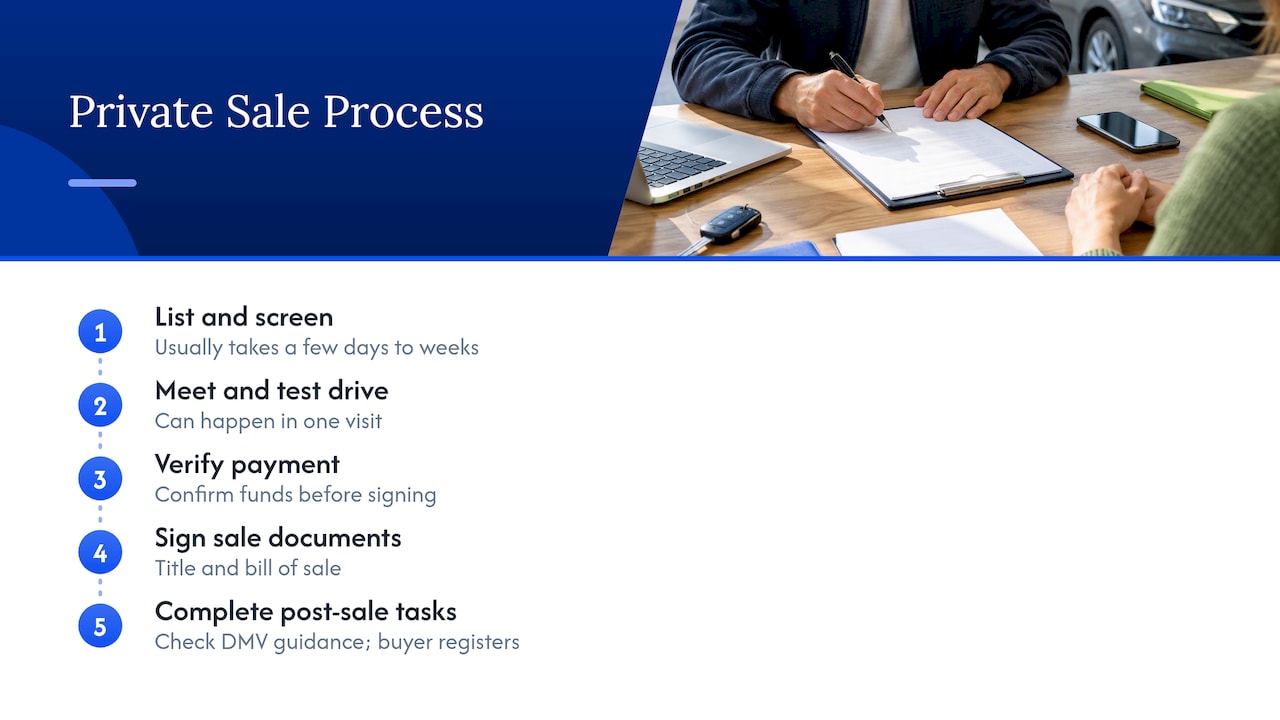
After the sale, check your state’s DMV guidance about when to report the sale and what to do with your plates. The buyer then has their own deadline to register the car in their name. The entire process, from a serious buyer’s first message to a completed title transfer, can move quickly when everything goes smoothly, but may take longer when payment verification or lien resolution gets complicated.
Why a vetted cash buyer removes most of this risk
Having watched how many of these deals fall apart over fake checks, stalled title transfers, and buyers who vanish after a test drive, I think the paperwork and payment risks are the part sellers underestimate most. A professional buyer who inspects the car on-site, pays at pickup, and handles the title directly sidesteps nearly every scam pattern described above. That route makes the most sense when you need cash fast, you are unsure how to resolve a lien, or you would rather not manage buyer verification yourself.
— Eric
A safer way to sell: on-site offer, cash at pickup
We built our process around removing the exact friction points that cause most private-sale problems. Our team comes to you and gives you a guaranteed offer backed by our guaranteed offer commitment, meaning the number we quote is the number you get paid at pickup, with no last-minute renegotiation.
- Request a quote online or by phone and get an offer without listing your car or screening strangers.
- We handle the paperwork, including title transfer, so you skip the DMV trip and the lien-release confirmation steps on your own.
- Payment happens at pickup, in person, so there is no check to verify and no wire to chase.
If you want to see the full process before you commit, our car buying service walkthrough covers what happens from quote to payout. When you are ready, start with Sell Your Car and get an offer today.
FAQ
Is it safe to accept a check from a private car buyer?
A check can be safe only after you confirm with the issuing bank that it is genuine and has actually cleared, not just that your bank shows the funds as available. The CFPB warns that bank availability does not mean final clearance, which is exactly how overpayment scams succeed.
What should I do if a buyer offers more than my asking price?
Treat this as a warning sign and refuse to refund any difference, since this pattern matches the fake-check and overpayment scams the FTC specifically warns car sellers about. Legitimate buyers negotiate down or pay the listed price, not above it.
How do I know if a car’s mileage has been tampered with?
Compare the odometer reading against past service records, inspection reports, or a vehicle history report, since inconsistencies are the clearest sign of tampering. The NHTSA notes that federal disclosure rules now cover vehicles up to 20 years old for Model Year 2011 and newer, specifically because mileage fraud remains widespread.
What’s the safest way to meet a private buyer?
Meet in a public, busy location such as a bank parking lot or shopping center, and bring another person with you. Keep your keys until payment is fully verified, and avoid sharing your home address with someone you have not met in person.
Can I sell a car privately if there is still a lien on the title?
A lien may affect how the title can be transferred and whether the buyer can register the car. Check with your lender and state DMV about the steps required before completing the sale.