Selling a Car With an Oil Leak: What It’s Worth and How
Yes, you can sell a car with an oil leak, whether it still runs or not. You do not have to fix it first, and in many cases you should not. The leak lowers what buyers will pay, but the size of that drop depends mostly on who you sell to. A buyer who prices the car as it sits, with the leak already counted, gives you a real number up front. We buy cars in New York, New Jersey and Connecticut, we come to you, we state the offer, and we pay that amount at pickup. Below you will find what a leak does to value, what you must tell a buyer, when a repair makes sense, and how to close the sale without surprises.
TL;DR
- An oil leak is sellable. Buyers discount for the uncertainty as much as for the repair, so the cleanest path is a buyer who prices the car as-is.
- Disclose the leak in writing. Selling “as is” limits warranty claims, but it does not protect a seller who hid a known defect.
- Fix it first only if the quote is small compared with the car’s value. Get a diagnosis before deciding, because leaks range from a cheap gasket to a major job.
- Our offer is guaranteed: we commit to paying the stated price at pickup, we handle the paperwork, and payment can be in your hand within an hour.
- Never accept a check you have not verified, and never leave the plates or title paperwork loose after the sale.
Table of Contents
- Can you sell a car with an oil leak?
- What an oil leak does to your car’s price
- What you have to tell the buyer
- Should you fix the leak before selling?
- Why selling it as-is for cash often works out better
- Get the car ready for the sale
- Paperwork: what to sign and what to do after
- Getting paid safely
- Our view: price the leak once, then move on
- Ready to sell your car with the leak?
- FAQ
- Sources
Can you sell a car with an oil leak?
Yes. A leak is a mechanical fault, not a legal barrier. No state stops you from selling a car because it drips oil. What the law cares about is whether you were honest about it, which we cover below.
The practical question is who will take the car and at what price. Three routes exist by type: a dealer trade-in, a private buyer from an online listing, and a direct cash buyer. Each handles an oil leak differently.
- Dealer trade-in. A dealer will inspect the car, find the leak, and subtract the repair plus a margin for risk. If your main goal was a better price, this is often where the leak hurts most.
- Private listing. Buyers who see a leak in a listing tend to assume the worst. You also take on the work: photos, messages, test drives with strangers, and the risk of a buyer who comes back later claiming you misled them.
- A direct cash buyer who comes to you. The car is looked at where it sits, running or not, and the price reflects its condition on the day. That is what we do.
If the car no longer starts, the same logic applies. A non-running car with a leak is still a car with parts, metal and resale value to a buyer set up for it. Our page on moving a non-running car explains how pickup works when the car cannot be driven.
What an oil leak does to your car’s price
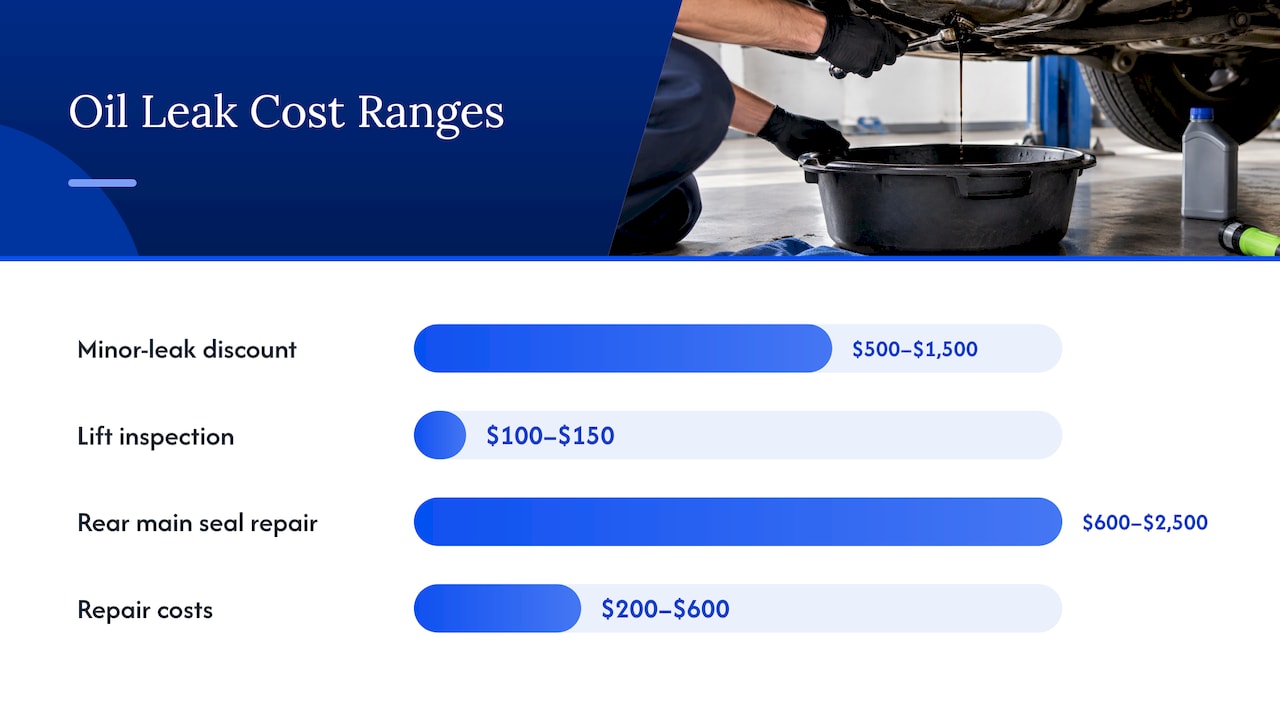
One pricing guide puts the buyer discount for a known minor oil leak at $500 to $1,500, against $200 to $600 in repair costs. Treat those as rough, since your car’s age and value change them. But the pattern is worth understanding: the discount is usually bigger than the repair itself.
That gap comes from uncertainty. The same guide argues that mechanical defects are discounted harder than cosmetic ones because buyers cannot tell what is behind a “minor leak” and price in the worst case. A seeping valve cover gasket and a failing rear main seal look the same on a driveway stain.
The cost range is wide. A mechanic’s lift inspection, which one guide prices at $100 to $150, can show whether the oil comes from the valve cover gasket, the rear main seal, the oil pan gasket or the front crankshaft seal. Each has a different repair bill. On some vehicles a rear main seal job means removing the transmission, which the same source puts at $1,000 to $2,500. A repair shop article gives a similar spread of $600 to $2,500 for a rear main seal, with parts often only $20 to $100 and the rest being labor of roughly 6 to 14 hours.
Those numbers explain why a buyer who cannot see the cause offers low. They also explain why a diagnosis, or a buyer who prices on the spot, takes the guesswork out.
What else moves the offer
The leak is one factor among several. Expect the offer to reflect:
- Age and mileage. On an older car with high miles, a leak is a smaller share of the value, so it changes the offer less.
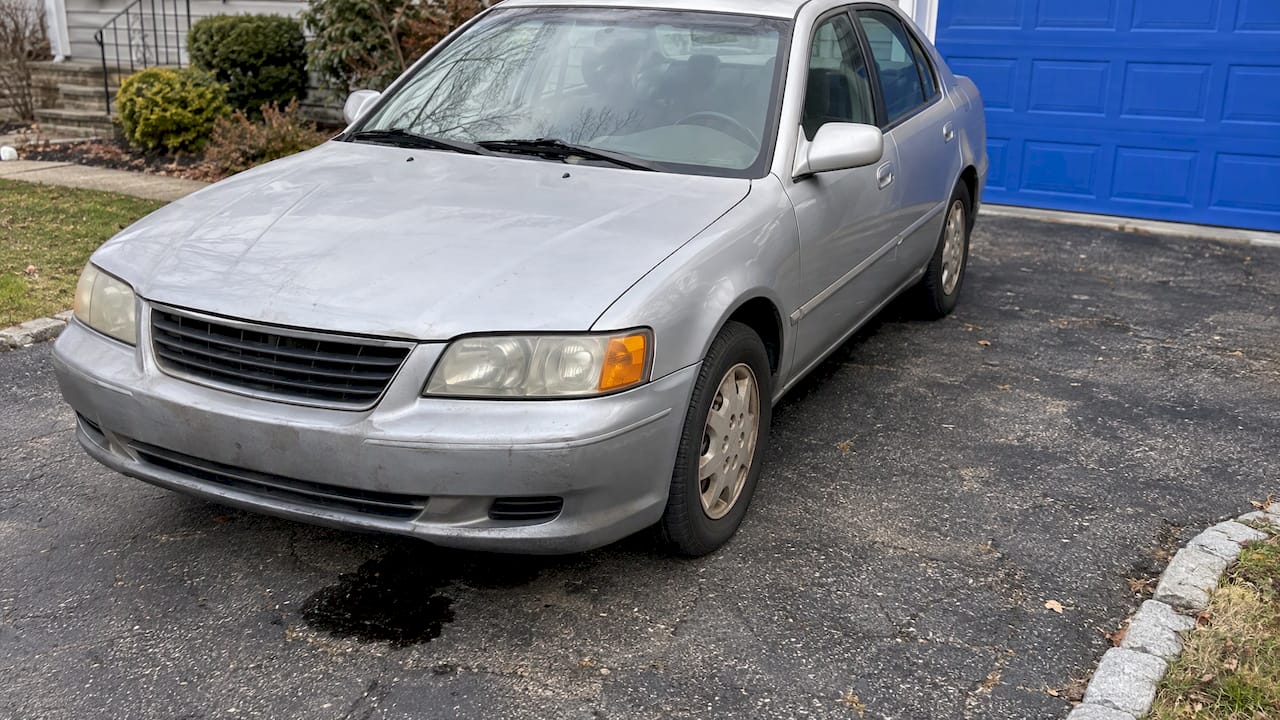
- Severity. A slow seep that leaves a spot overnight is different from a car that needs a quart every few hundred miles.
- Whether it runs. Low oil on a car that has been driven can mean engine damage, which a buyer will check for.
- Title and paperwork. A clean title in your name makes the sale simple. We also buy cars without a title, which matters if the paperwork went missing.
- Other faults. A warning light on top of the leak changes the picture; see our guide to selling with the check engine light on.

What you have to tell the buyer
Tell the buyer about the leak, in writing, in plain words. This protects you more than it costs you.
What “as is” means
In an as-is sale the buyer accepts the car with all its known and unknown problems. A state consumer office explains that repair costs after the sale are almost always the buyer’s, there is no cooling-off period, and verbal promises usually do not count. That is why “as is” is common on cars with known faults.
Two limits matter:
- As-is disclaims warranties. It does not cancel honesty. Deliberately hiding a known defect to make a sale can be treated as fraud, and as-is wording does not shield a seller who concealed a defect they knew about.
- State rules differ. The same source notes that New York requires damage disclosure under General Business Law 396-p, and that the trend in recent years has been toward more required disclosure.
The federal Buyers Guide that says “as is” applies to licensed dealers, not individuals. The updated rule, which took effect July 30, 2025, covers dealers, so as a private seller your protection comes from your state’s law and your own paperwork.
How to describe the leak
Keep it concrete. A good description says what the car does and when, for example that it leaves a spot on the ground overnight, and includes any shop diagnosis or estimate you have. A seller guide recommends recording each disclosed fault in the sale agreement and bill of sale, and notes that a default “as is” tick box does not take back what you already said in a listing or message.
A short line in the bill of sale does the job, for instance: “Buyer acknowledges the vehicle has a known engine oil leak and accepts it as is.” If you sell to us, we handle the paperwork at pickup, so the condition and price are written down before the car leaves.
Should you fix the leak before selling?
Sometimes, but less often than owners expect. Run the numbers first.
- Get a diagnosis. A lift inspection tells you where the oil comes from. Without it you are guessing at a cost range that runs from small to over $2,000.
- Get two quotes. One pricing guide suggests quotes from two shops, then subtracting the realistic cost from the car’s clean private-party value.
- Compare net proceeds. A dealership blog advises comparing the expected repaired price minus repair cost against the realistic as-is value. Small, visible, safety-related repairs can pay off. Major work usually needs the as-is value established first.
- Weigh the car’s value. A repair shop’s view is that a rear main seal is worth fixing only when the car’s overall value and condition justify it. On a low-value car, selling as-is is the better call.
A worked example
Say your 12-year-old sedan would sell for about $6,000 with no leak. A shop quotes $1,800 to replace the rear main seal, because the transmission has to come out. You would spend $1,800 and weeks of shop time to recover a value that a buyer may not credit in full, since many buyers still discount cars with any repair history. If a buyer pricing the car as-is offers a figure close to $6,000 minus the repair, you keep your money, your time and your driveway. The math favors selling as-is whenever the repair quote is a large share of the car’s value.
If instead the quote is $250 for a valve cover gasket on a car worth $9,000, a repair may be worth it. That is a judgment about your own car, and a diagnosis is the only way to know which case you are in.
Why selling it as-is for cash often works out better
The usual case against selling a car with a leak is that you will be lowballed. That happens when the buyer has to price in everything they cannot see. A buyer who sees the car in person, checks the leak, and commits to a number removes that risk.
Here is what that looks like with us:
- You get an offer based on the car as it is. Running or not, with or without a title.
- The offer is guaranteed. We commit to paying the stated price at pickup, so the number does not shrink in your driveway.
- We come to you. A team arrives at your location, in New York, New Jersey or Connecticut.
- Paperwork is ours to handle. You are not chasing forms.
- Payment is fast. Cash in hand can happen within an hour of the visit.
Compare that with listing a leaking car privately. Every message is a negotiation about the leak. Every test drive invites a story about it later. If you do go that way, our guides on private sale risks and car selling scams show what to watch for, and our car buying service process walks through how a sale with us goes, even if you still owe money on the car.
Get the car ready for the sale
You do not need a detailing. A few steps make the offer cleaner and the handover faster:
- Gather the paperwork. Title, registration, ID and, if you have a loan, the lender’s details. A trade group for businesses recommends gathering maintenance records, title and loan information, registration and warranty documents in one folder.
- Note the leak. Where you see it, how often, and whether you have topped up oil. Honest notes speed up the conversation.
- Keep service receipts. Records show you maintained the car, and they back up your description of the leak.
- Clear out your belongings and the toll tag if you have one.
- Check the oil level before anyone moves the car, and do not drive a leaking car with low oil, since running an engine low on oil can turn a cheap leak into engine damage.
Our page on preparing a car for sale covers what actually changes the offer and what does not.
Paperwork: what to sign and what to do after
Paperwork differs by state, and the three states we serve each have their own rules. In New York, a private sale involves signing the title’s transfer section and using a Vehicle Bill of Sale (MV-912) that lists the year, make, VIN, sale date, price, and both parties’ names and signatures. The buyer is responsible for titling and registering the vehicle. Our state guides go further: New York sale paperwork, New Jersey sale paperwork and Connecticut sale paperwork.
Whatever the state, these basics apply:
- Sign the title exactly as your name appears on it. Do not leave fields blank for the buyer to fill in.
- State the mileage. Federal law requires an odometer statement at transfer, and falsifying it is a federal offense.
- Write a bill of sale with both parties’ names, the VIN, price, date and the condition, including the oil leak.
- Handle the plates and insurance in the right order. Our pickup paperwork guide explains what to sign before the buyer drives away.
When we buy your car, we handle the paperwork at pickup, so you are not left guessing which form comes next.
Getting paid safely
If you sell to someone you do not know, payment is where sellers lose money. The rules from one bank’s seller guide are simple: never wire money to a buyer, accept only the exact sale amount, and for a check, confirm it with the issuing bank using contact details you look up yourself and wait until it clears before handing over ownership. For cash, both parties should sign a receipt such as a bill of sale.
An insurer’s guide adds that you should screen buyers by phone, meet in a well-lit public place, verify the buyer’s license, and be wary of overpayment-and-refund offers. Meeting at your own bank to complete a cash deal is the safest version of that advice.
With us, you are paid at pickup at the price we stated. There is no overpayment trick, no waiting on a check to clear and no stranger from an ad coming to your home with a story.
Our view: price the leak once, then move on
We talk to owners with oil leaks all the time, and the same worry comes up: that the leak will wreck the deal. It does not have to.
The leak costs you most when a buyer cannot tell how bad it is. A guess becomes a low offer, and then a lower one at the driveway. That is the experience people describe when they come to us after a dealer trade-in.
Our approach is built to remove that. We send a team to where the car is, we give a cash offer, and we commit to paying the stated price at pickup. We handle the paperwork. For an owner with a leaking or non-running car, that means a number you can trust and a sale that finishes the same day.
If a repair is small and obvious, do it. If the quote is large next to what the car is worth, do not spend the money. Tell us about the leak plainly and we will price the car as it is.
Eric
Ready to sell your car with the leak?
We buy cars, SUVs, trucks, vans and commercial vehicles in New York, New Jersey and Connecticut, running or not, with or without a title. Tell us about the car and the leak, get a guaranteed offer, and we pick it up and pay at pickup. Start at Sell Your Car, or see how a pickup sale from home works.
If you are comparing us with a dealer’s number, our guide on what to do when a dealer trade-in offer is too low shows how to use an offer like ours.
FAQ
Do I have to disclose an oil leak when I sell my car?
Yes. If you know about a defect that affects safety, value or usability, you should disclose it, and hiding it can be treated as fraud even in an as-is sale. Put the leak in writing in the listing and in the bill of sale. New York, for example, has its own damage-disclosure rule.
Can I sell a car with an oil leak that won’t start?
Yes. A non-running car still has value to a buyer equipped to move it. We buy running and non-running vehicles, and a team comes to your location to collect the car and pay at pickup.
How much does an oil leak lower the price?
It depends on the cause, the car and the buyer. One pricing guide cites buyer discounts of $500 to $1,500 for a known minor leak, while repair costs can range from a few hundred dollars to over $2,000 for jobs like a rear main seal. A diagnosis tells you which end of the range your car is on.
Should I top up the oil before a buyer sees the car?
Yes, keep the level safe, but do not hide the leak. Topping up is sensible if you must move the car. Then tell the buyer the leak exists and how often you need to add oil.
What if I owe money on the car?
You can still sell it. The lender has to be paid off as part of the transfer, and our step-by-step sale process explains how a sale works with a loan.
Sources
- Problems with Used Car Discovered after Purchase, Georgia Consumer Protection
- Buy, Sell, or Transfer Vehicle Ownership, NY DMV
- Is It Illegal to Sell a Car Without Disclosing Problems?
- Selling a car with problems: what to disclose
- How to Price Your Used Car: Condition-Based Guide
- The Pre-Purchase Inspection guide, Bumper
- Is it worth fixing the rear main seal?, Ryan’s Auto Care
- Should You Repair Your Car Before Selling It?, Silko Honda
- BBB Tip: How to sell a car to a trustworthy, honest buyer
- Georgia As Is Bill of Sale: Requirements and Legal Rules
- Sell It Yourself, Capital One seller’s guide
- How to Sell a Car Privately, Progressive