Selling a Car With a Missing Catalytic Converter: What to Do
Yes, you can sell a car with a missing or failing catalytic converter, as long as you disclose it in writing and sell to a buyer who is allowed to take it in that condition. The fastest, lowest-risk route is a buyer that comes to you, prices the whole car as it sits and handles the paperwork. That is what we do for owners in New York, New Jersey and Connecticut: we send a team to your location, give you a cash offer, pay the stated price at pickup and take care of the paperwork.
A missing converter makes a car harder to sell to the average private buyer, because the car may not pass an emissions inspection and may not be legal to drive until it is replaced. It does not make the car worthless. This guide explains the rules that matter, how to price the car, what to put in writing and how to get paid.
TL;DR
- A missing converter does not stop you from selling, but you must disclose it in writing, and some states bar selling a car without working emissions equipment for road use.
- Price the whole car, not the part: get one written repair quote and compare it with what the car would be worth in passing condition.
- If the repair costs a large share of the car’s value, selling as-is usually pays more than fixing it first.
- Do not sell the detached converter on the side without checking your state’s rules. Rules aimed at theft can require proof of ownership.
- A cash buyer that picks up the car, pays at pickup and handles the title work saves you the listing, the no-shows and the haggling.
Table of Contents
- What a missing converter does to a sale
- The rules you need to know before you sell
- Why the buyer matters more than the part
- How to price a car with a missing or bad converter
- Do not sell the converter by itself without checking the law
- What to put in writing
- Your three options compared
- Selling to us: how it works
- Get your offer
- FAQ
- Sources
What a missing converter does to a sale
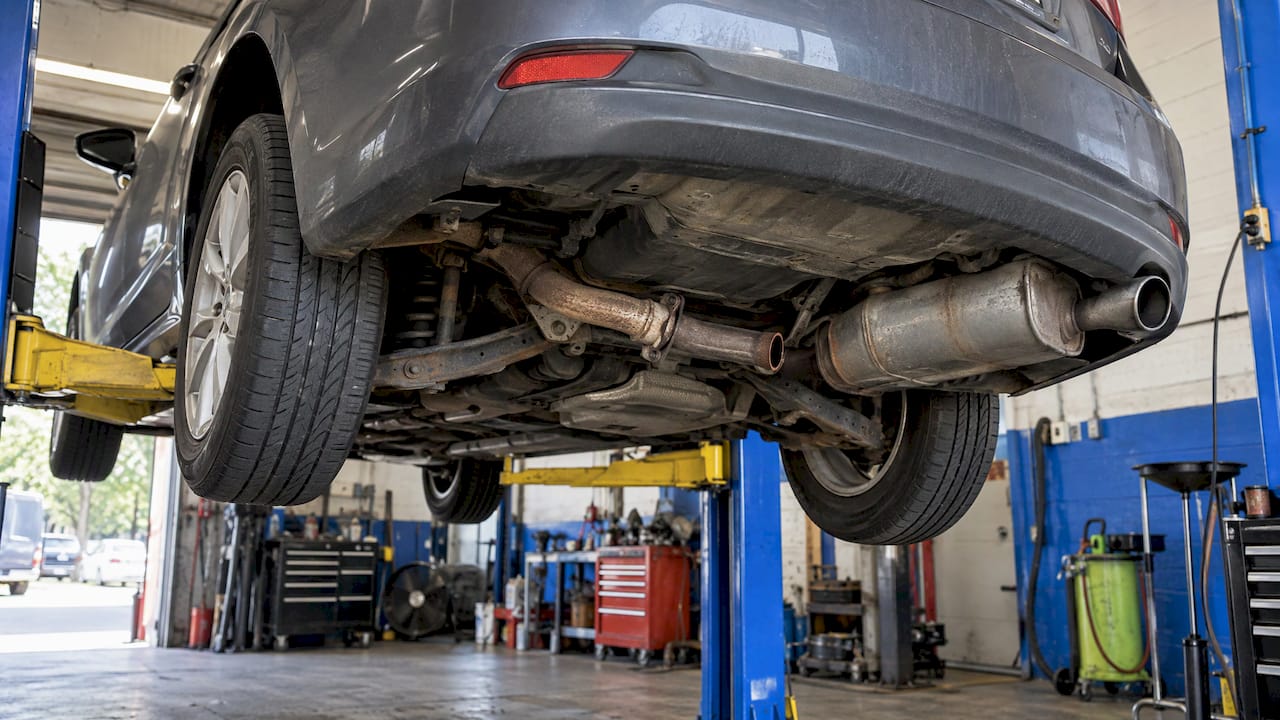
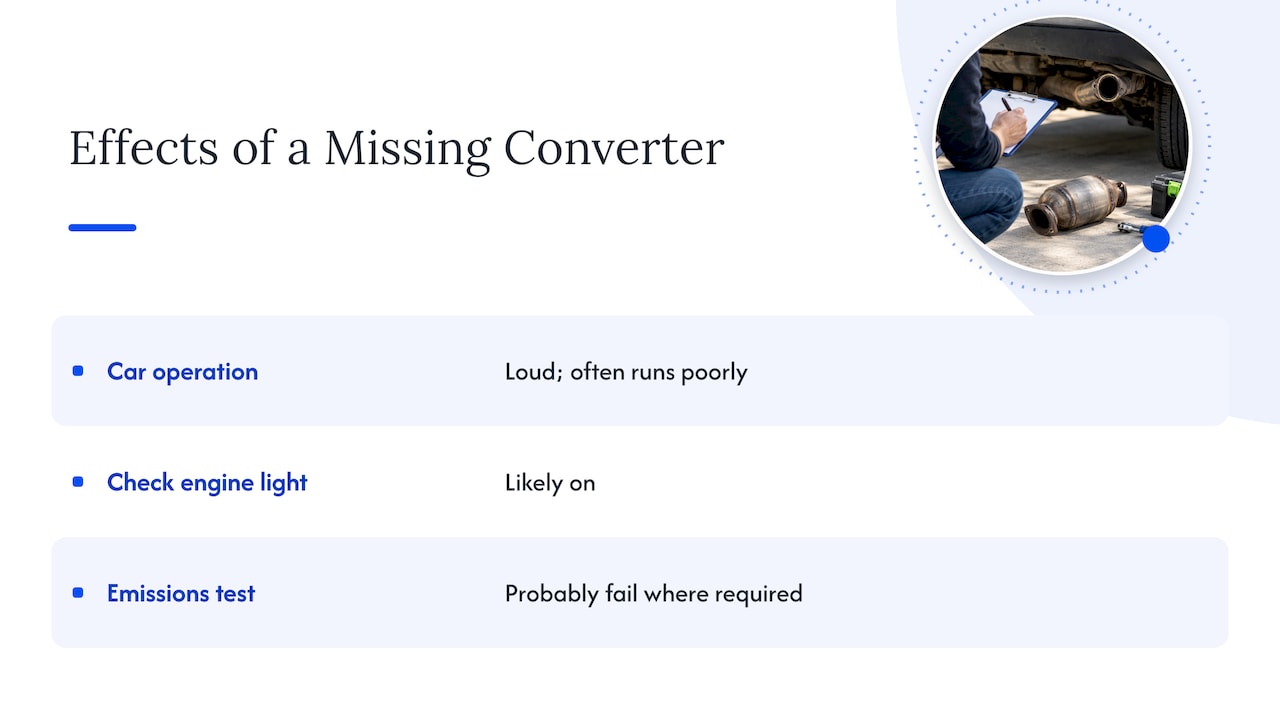
The catalytic converter is part of the exhaust system. It reduces the pollutants the engine puts out, and cars sold in the US are built to run with it. When it is gone, usually from theft or a failed repair, three things change.
First, the car is loud and often runs poorly. Second, the check engine light is likely on. Third, the car will probably fail an emissions test where one is required. A buyer who plans to register and drive the car has to cover the replacement part, labor, any related exhaust repairs and the inspection. That is why offers for these cars look low from buyers who only want to drive them.
If you also have a check engine light on, our guide to selling a car with the check engine light on covers that side of it.
Missing versus failing
The two situations are treated differently by buyers and by the law.
| Missing converter | Failing or clogged converter | |
|---|---|---|
| What it means | The part has been removed or stolen | The part is there but not working |
| Typical signs | Loud exhaust, rattling or roaring, check engine light | Poor power, check engine light, failed emissions test |
| Legal sensitivity | Highest: removal can count as tampering with emissions equipment | Lower: it is a defect, not removal |
| Disclosure | Written statement that the converter is missing | Written statement of the known fault and any inspection report |
| Best buyer | One that takes the car as it sits and prices the whole vehicle | Same, or a buyer who will repair it |
With a failing converter, a shop diagnosis helps, because the same warning light can come from other problems. With a missing one, the problem is obvious, so what matters is documenting it honestly.
The rules you need to know before you sell
There is no single nationwide rule that makes every sale of a car without a converter automatically illegal. But federal anti-tampering law, state inspection requirements and the terms of the sale all matter, and a car sold for road use generally has to meet emissions requirements where it is registered and driven. States differ a lot, so here are examples of how.
Some states bar the sale outright for road use. The Minnesota Pollution Control Agency says state law prohibits offering for sale or transferring ownership of a vehicle unless all air pollution control systems are in place and working, even when the car is sold as is, and that even a trade-in counts as a sale.
Some states allow it with a signed warning. Delaware’s motor vehicle code says a seller must first advise the buyer in writing and get a signature on a notice that the converter is missing and the car may not pass inspection. A seller who skips this must pay restitution covering parts and labor to replace the converter, plus reasonable costs and attorneys’ fees.
Some states have their own routes. The pattern across states is that the answer depends on who the buyer is, where the car will be registered and who is responsible for the inspection.
We are not your lawyer, and we have not summarized the exact NY, NJ or CT statutes here, because they change. Before you sell, ask your state motor vehicle agency or emissions program a few direct questions:
- Can the car be sold to a private buyer in its present condition?
- Who has to get any inspection or emissions certificate, and when?
- Must the converter be replaced before the sale?
- Which disclosures and title steps apply?
- Does the buyer’s destination change the requirements?
Those are the questions a state agency is the right place to answer. If a lawyer’s view is what you need, for example because you already sold a car without telling the buyer, see a licensed attorney in your state.
Why the buyer matters more than the part
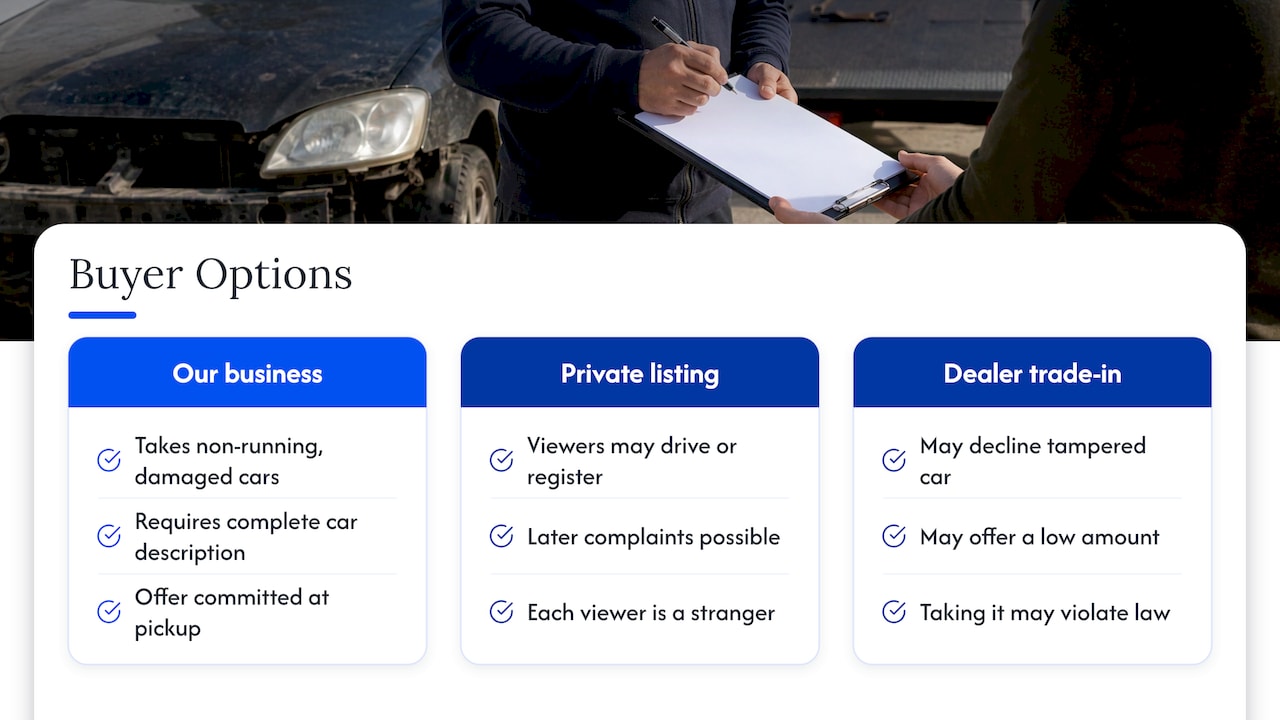
The rules above mostly target selling a car for ordinary road use. The cleanest way through them is to sell to a buyer whose business is taking vehicles in all conditions, who knows what they will do with the car and who signs the paperwork accordingly. Private listings work the other way around: every viewer is a stranger who may drive the car, register it or complain later.
This is also why dealer trade-ins can be a dead end. As the Minnesota agency explains, accepting a tampered vehicle as a trade-in can itself violate the law, so a dealer in that position may decline the car or give a low number.
Our business is buying cars from owners for cash, including non-running and damaged vehicles, in NY, NJ and CT. If you sell to us, you give a complete description of the car, we give a cash offer, and the offer we state is the amount we commit to pay at pickup.
How to price a car with a missing or bad converter
The mistake most sellers make is subtracting a single number for the part. Buyers account for more than the part: diagnosis, exhaust repairs, towing, inspection fees and registration delays, so one national figure for the discount is rarely reliable. Use this method instead.
- Find what the car is worth running and legal. Check similar cars in your area with the same year, mileage and trim.
- Get one itemized written quote. Ask a qualified repair shop for a quote covering the converter, associated repairs, labor and testing, and ask which replacement part is compliant for your vehicle and state.
- Compare the two numbers. One seller-focused guide suggests that if the quote is a small fraction of the car’s passing-condition value, fixing first usually pays more, but if it is a third or more, or emissions equipment is missing, selling as-is almost always nets more.
- Check your warranty. Federal emission warranty rules for covered light-duty vehicles run 2 years or 24,000 miles generally, and 8 years or 80,000 miles for specified major components, including catalytic converters. If your car is young and the converter failed rather than disappeared, a dealer repair under warranty may cost you nothing and change the whole calculation.
A worked example
Say a similar car in running, inspected condition is worth $9,000 in your area. A shop quotes $3,200 for the converter, exhaust repair and testing. That is more than a third of the value, so repairing first means spending $3,200 and waiting on the shop before you even start listing. Selling as-is trades that cost and delay for a lower, but immediate, price. The numbers here are illustrative, not an offer or a market figure. Your own quote and local comparisons are what count.
If your quote is small compared with the car’s value, repair first and sell the car at its better price. If it is large, sell as-is.
Do not sell the converter by itself without checking the law
A detached converter contains precious metals, so owners who replace one sometimes wonder about selling the old part. Be careful. States have adopted restrictions on converter transactions to deter theft, and the rules can require proof of ownership, identification, records or sales through authorized businesses. A scrap-metal business may not be permitted to accept a converter from every seller. If the converter is still on a car that is being sold whole, it simply stays part of the vehicle and part of what the buyer pays for.
What to put in writing
Whatever route you take, paperwork protects you. Disclosure should be specific. Saying the car “needs minor exhaust work” can understate the issue. Instead, include:
- A plain statement that the catalytic converter is missing, or that it has failed.
- A statement that the vehicle may not pass emissions inspection and that the buyer should confirm local registration requirements.
- The VIN, the sale price, the date, the odometer reading, both parties’ names and addresses and both signatures.
- An as-is clause, so the sale terms are clear.
- A copy of any inspection report or repair quote you have.
Take dated photos of the exhaust underside and any visible damage before the buyer arrives. Then complete the title transfer and any seller notice your state requires, and never provide false documentation. Avoid claims such as “cheap fix” or “will pass emissions” unless you can prove them.
Two seller habits are worth keeping with any buyer. Confirm payment before you sign anything, and remove your license plates after the sale. If you owe money on the car, the lender’s payoff has to be sorted before the title can move, and our six-step guide to selling safely, even with a loan walks through it.
If your title is missing or branded, or the car has a history of damage, read our guide to legally selling a salvage title car. And if the converter problem came up when the car failed inspection, our pages on selling a car that failed inspection in New York and same-day cash for a car that failed emissions cover that case.
Your three options compared
| Option | Time | What you handle | What to expect |
|---|---|---|---|
| Sell to us for cash | Pickup arranged at your location; payment at pickup | Describe the car honestly, sign the paperwork | A stated cash offer we commit to paying at pickup |
| Repair, then sell privately | Weeks | Quote, repair, inspection, listing, viewings | Higher price only if repair is cheap relative to the car |
| Trade in at a dealer | A day or two | Negotiation | May be refused or heavily discounted |
Our preference is plain: for a car with a missing converter, selling to a buyer that takes the car as it is gives you the shortest path from problem to payment.
Selling to us: how it works
We buy cars, SUVs, trucks, vans and commercial vehicles in New York, New Jersey and Connecticut, running or not, with or without a title, including damaged and older vehicles. Here is the process.
- You describe the car. Tell us the year, make, model, mileage and what is wrong, including the missing or failing converter. An accurate description is what keeps the offer accurate. See how we think about instant offer accuracy.
- You get a cash offer. We stand behind the price we state: we commit to paying that amount at pickup.
- We come to you. Our team travels to your location, so you do not need to tow the car or have it drivable. More on pickup sales from home.
- We handle the paperwork. You are not left filling in forms alone.
- You get paid. Cash in hand within an hour is what we aim for, which matters when you need money now.
One point on odometer and title details: surprises there are what usually change an offer at pickup, so our guide to a guaranteed car offer lists what to check beforehand.
Our view
We buy cars that other buyers hesitate over, and the missing converter is a good example. A dealer sees an emissions problem and a risk. A private buyer sees a repair bill and a stranger’s guess. Both of them price in uncertainty, which is why the offers come in low.
We start from a different place: the whole vehicle, where it is, and what you need. We come to the car, so there is no tow and no test drive. We give a cash offer and stand behind it, paying the price we stated at pickup. We handle the paperwork, so you are not guessing at forms that carry legal weight.
If you want our advice in one line: write down honestly what the car is missing, get your offer and let a buyer who works with these cars every day take it from there. For many of the owners we work with in the tri-state area, that is faster and simpler than a repair or a listing.
Eric
Get your offer
If your car is missing its converter, will not pass inspection or simply will not start, you do not need to repair it to get paid. Tell us about your car and get your cash offer for pickup anywhere in New York, New Jersey or Connecticut, with payment at pickup.
If you are comparing us with other ways of getting rid of a car that does not run, our breakdown of a scrapyard versus cash for cars in the tri-state area shows how the two differ on price, speed and paperwork.
FAQ
Is it illegal to sell a car with no catalytic converter?
It depends on the state and the buyer. Some states, such as Minnesota, prohibit transferring a vehicle without working emissions controls. Others, such as Delaware, require a signed written notice before you sell. Ask your state motor vehicle agency what applies to your sale, and disclose the missing part in writing every time.
How much is my car worth without a catalytic converter?
There is no single figure. Compare similar cars in your area, then get one written repair quote for the converter and related work. The gap between those two numbers is the starting point for a fair price. Our offer is based on the car you describe, so the more accurate you are, the more accurate the number.
Can I sell the old converter separately?
Only after checking your state’s rules. Laws aimed at theft can require proof of ownership, ID and records, or sales through authorized businesses. If the converter is still on the car, it is part of the sale.
Should I fix the converter before I sell?
Only when the repair is a small share of the car’s value. If the quote is around a third of the value or more, or the equipment is missing, selling as-is usually nets more once you count the repair, the wait and the listing effort.
Can I sell a car with a failing converter that still runs?
Yes. Disclose the fault in writing, include any inspection report and sell as-is. We buy running and non-running vehicles in NY, NJ and CT.
Sources
- Vehicle tampering, Minnesota Pollution Control Agency
- 2024 Delaware Code Title 21, Chapter 25, Section 2515
- 40 CFR 85.2103, Emission warranty
- Can You Sell a Car Without a Catalytic Converter? Laws, Risks, Options
- Can You Sell a Car With a Missing Catalytic Converter?
- Can You Sell A Car Without A Catalytic Converter?
- How to sell a car that fails emissions