How to Sell a Commercial Truck in NJ: Value, Paperwork, Payment
To sell a commercial truck in New Jersey, work out a realistic value from a pricing guide and current listings, gather the title (and a lien release if you owe money), pick the buyer type that fits your timeline, sign the title and a bill of sale, and surrender the plates. The sale is only finished when you have been paid and the buyer has the title in hand. Most of the delay and risk comes from the paperwork and the payment, not from finding someone who wants the truck.
This guide walks through each step for box trucks, dump trucks, flatbeds, work trucks, tractors and other commercial units, running or not.
TL;DR
- Value the truck with a commercial pricing guide plus matching live listings, then adjust for mileage, engine, equipment and condition.
- You need a signed title and a bill of sale. If a lender holds a lien, get the release first.
- Take the plates off when the truck leaves, unless you are moving them to another vehicle you own.
- A private sale can bring the highest price but the slowest and riskiest process. A direct cash buyer trades some upside for speed and certainty.
- Get paid in full before the truck leaves and the title changes hands.
Table of Contents
- Start with a realistic value
- Get the truck ready to sell
- Choose how you will sell
- The New Jersey paperwork, step by step
- Taxes and exemptions that affect the price
- Avoid payment and title problems
- Selling for cash when time matters
- A quick checklist before you hand over the keys
- FAQ
- Sources
Start with a realistic value
The first mistake most owners make is pricing a work truck like a passenger car. Commercial values move with the chassis, the engine, the body and whatever is bolted to it. Two trucks of the same year and make can sit thousands of dollars apart.
Pricing guides are the starting point. Price Digests offers a VIN-based commercial truck value search that covers model years from 1981 to the present. It lets you adjust for engine, transmission, axles, mileage, condition and options, and it lets you add a body to an incomplete chassis, which matters for dump bodies, box bodies and liftgates. J.D. Power’s Official Commercial Truck Guide covers Class 2 through 8 trucks, including local delivery, construction and vocational units, with wholesale, retail and loan values and monthly updates.
Two details about how those numbers work:
- Price Digests describes its base value as the nationwide average for a standard-equipped unit in average working condition. The total value is then adjusted for location, usage, options and condition. Treat the base number as a starting point, not an offer.
- If you enter actual mileage, the guide compares your truck with others in its size class. Without mileage it assumes average market mileage. It also notes that mileage adjustments may not be available for some older vehicles, because mileage no longer affects their value in the same way.
Check the guide against the market
A guide value is only one data point. One fleet-valuation publisher recommends triangulating from a guide, current listings that match the year, make, model and spec, and recent auction results, then adjusting for mileage, engine, emissions equipment, maintenance records and local demand. In practice:
- Pull the guide value with your exact specs.
- Find three to five listings of similar trucks and note the asking prices. Remember asking prices run above what trucks actually sell for.
- Look at recent auction results for the same class if you can access them.
- Subtract what a buyer would spend to get your truck sale-ready.
That last step is where condition comes in.
Know what buyers look at
Appraisers and dealers inspect the same things you should. A trade publication report on used-truck appraisals says a practical condition check looks for exhaust smoke, head gasket or transmission leaks, water in the oil, oil in the coolant, tire tread and type, rear-end and sleeper configuration, aftertreatment codes, regeneration history and possible DPF tampering. The same report says dealers weigh specifications, mileage, condition and expected reconditioning costs when setting a trade-in value.
One equipment appraisal firm adds that value also depends on maintenance records, engine hours, weight ratings, body and upfits. If you run several trucks, it notes that a desktop appraisal can be quicker when you can supply complete unit lists, records and photographs, while an on-site inspection helps when identity and condition need confirming.
Gather proof that the truck was looked after
Federal rules help here. The FMCSA’s Safety Audit Guidebook states that every commercial motor vehicle, including each unit in a combination, must be inspected at least once every 12 months, with inspection documentation kept on the vehicle. If your annual inspection reports are current and tidy, put them in a folder next to your service records. Buyers pay more for a truck they can verify.
Get the truck ready to sell
You do not need a full rebuild. You need a clear picture of what the truck is.
- Clean it. A washed cab and cleared-out bed photograph better and signal care.
- Photograph everything. Take exterior shots from all sides, the cab interior, the odometer, the engine bay, tires, the body and any equipment such as liftgates, PTOs, racks or reefer units.
- Write down the specs. Engine model, transmission, axle setup, GVWR, mileage, and what the chassis did versus what the equipment did. A truck with 60,000 miles that idled eight hours a day on a job site is not a 60,000-mile truck in mechanical terms.
- Be upfront about problems. Warning lights, leaks and known repairs are cheaper to disclose than to have discovered at pickup, when the price gets renegotiated.
- Remove your stuff. Tolls transponders, GPS units, company decals, tools, fuel cards and anything personal.
If the truck does not start or cannot be driven, say so in your listing. Buyers who handle non-running vehicles arrange a tow or flatbed; those who do not will waste your time. Our guide to moving a non-running vehicle explains how pickup works when the vehicle cannot move under its own power.
Choose how you will sell
There is no single best place to sell a commercial truck. The right choice depends on how fast you need the money, how much work you will do, and how risky the truck’s condition is for a buyer. Here are the main routes for a New Jersey seller.
| Route | Typical speed | Effort for you | Price potential | Main risk |
|---|---|---|---|---|
| Private buyer (online listing, word of mouth) | Weeks to months | High: listings, calls, test drives, negotiation | Highest on a well-kept truck | Time wasters, payment fraud, liability if paperwork is sloppy |
| Commercial dealer or trade-in | Days to weeks | Moderate | Mid-range; trade-in often below retail | Offer depends on their inventory needs and may be adjusted after inspection |
| Auction | Scheduled sale dates, then payout later | Moderate: consignment, fees, possibly reserve | Variable, can be strong for in-demand units | Fees and uncertain final price |
| Direct cash buyer | Often same day to a few days | Low: they come to you and handle the paperwork | Below a perfect retail sale, often above a rushed low trade-in | Must verify the offer is guaranteed and paid at pickup |
These are general tradeoffs rather than fixed rules, so weigh them against your situation.
Selling privately
A private sale can net the most money when the truck is in good shape and you can wait. You also carry every task: writing the ad, answering buyers, meeting strangers, and checking that payment is real. Never release a truck or title on a personal check or a payment you cannot confirm with your bank. Meet at a bank branch for a certified payment, and keep a copy of everything.
Selling to a dealer
Dealers know the market, and for late-model units in popular configurations they may pay well. Their offer, though, accounts for reconditioning and their own margin. If you are buying a replacement truck from the same dealer, a trade-in simplifies the sales tax and the logistics. Ask for the offer in writing and ask what could change it.
Selling at auction
Auctions suit trucks with many comparable buyers and sellers who are comfortable with an uncertain final number. Ask about consignment fees, reserve prices, how soon you are paid after the sale, and who is responsible for transport.
Selling to a direct cash buyer
A direct buyer fits when time matters: a business closing, a fleet being downsized, a truck that failed inspection, a repair bill that outweighs the value, or a lender calling. You trade a portion of the top-dollar retail price for a quick, low-effort close. Our guide to selling a commercial vehicle for same-day cash in NJ covers how pricing works and how to avoid common scams.

The New Jersey paperwork, step by step
New Jersey’s Motor Vehicle Commission (MVC) is clear on what the seller does. Mistakes here are what come back to bite sellers months later through tickets, tolls or accident claims.

1. Sort out the title and any lien
You must be able to sign the title over. If a bank or finance company holds a lien, you need it released before the buyer can retitle the truck. The MVC lists form OS/SS-54 as the application used to request a lienholder’s release of a title so the vehicle can be retitled in New Jersey. The practical route is to ask your lender for a payoff figure, pay it from the sale proceeds (or beforehand), and get the lien release or the cleared title in writing.
If the title is lost, request a duplicate from the MVC before you list the truck. If a buyer can work with a vehicle without a title, it will change the offer and the timeline, so ask before assuming.
2. Sign the title and write a bill of sale
The MVC instructs sellers to sign the seller section on the title and give it to the buyer with a bill of sale. The bill of sale should include the buyer’s name and address, the sale date, the odometer reading and the sale price. Keep a copy, and photograph the signed title before it leaves your hands. Our walkthrough of NJ title transfer shows the seller shortcuts, and our list of forms to have before an MVC visit covers the rest. For what to sign at the moment of handover, see our pickup paperwork checklist.
3. Deal with the plates
Per the MVC, you remove the plates and surrender them, unless you are transferring them to another vehicle you own. Do not let them ride off on the truck, since the plates and registration tie back to you. If you plan to move them to a replacement truck, our guide to transferring plates in NJ lists the documents and steps.
4. Cancel insurance only after the sale is complete
Keep coverage until the truck is gone and the paperwork is signed. Then cancel or remove the unit from your policy. A truck sold on paper but still on your policy can create confusion; a truck that left your possession without coverage but still in your name can be worse.
5. Know what the buyer must do
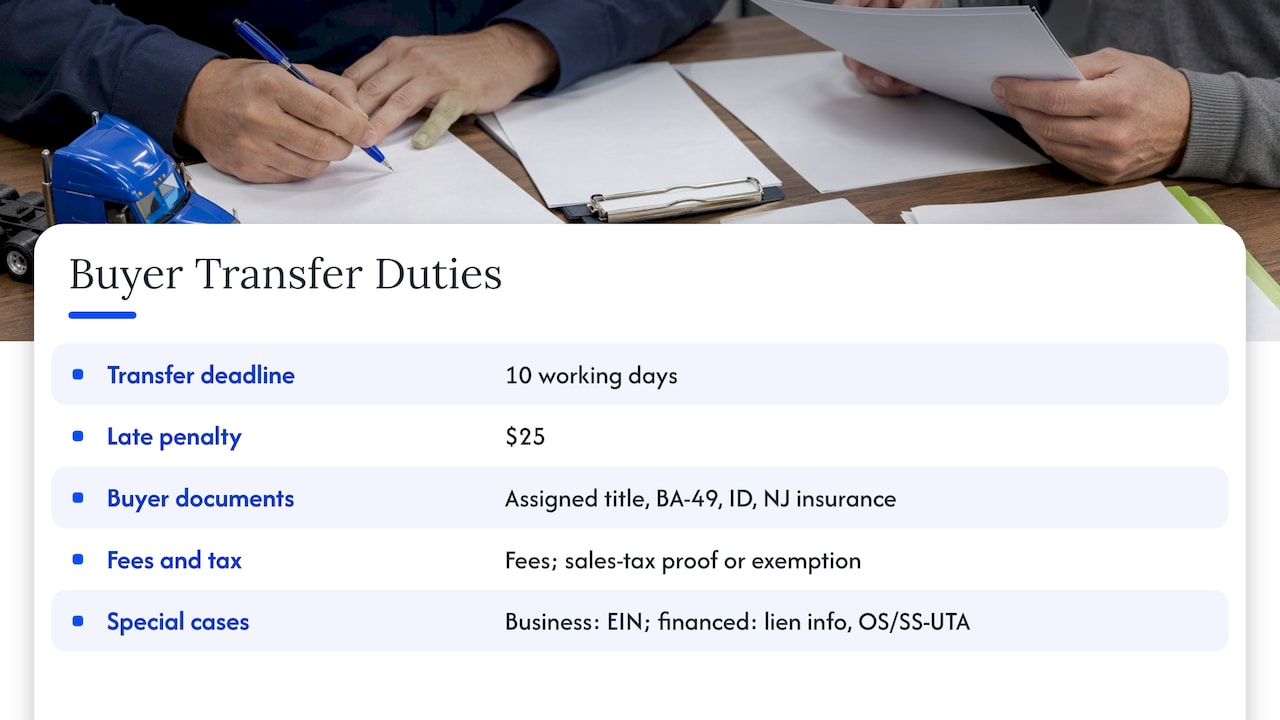
The buyer has 10 working days to transfer the title at an MVC agency, or a $25 penalty applies. That is the buyer’s duty, but a delayed transfer can leave your name on a truck you no longer have, so watch the timeline and keep your bill of sale.
For a pre-owned vehicle, the MVC says the buyer generally needs the properly assigned title, form BA-49, identification, proof of New Jersey insurance, fees and proof of sales tax paid or an exemption. A business buyer needs an EIN, and a financed truck needs lienholder information and the Universal Title Application OS/SS-UTA. You do not complete these, but knowing the list helps you spot a buyer who is not prepared.
The BA-49 registration application includes commercial fields for the requested registration code, registration weight and passenger count, and commercial applicants declare knowledge of applicable federal motor carrier safety regulations. If your truck is a solid-waste vehicle, the signer also certifies applicable NJDEP approvals.
Taxes and exemptions that affect the price
Sales tax is the buyer’s cost, but it shapes how buyers think about your price.
- The New Jersey Division of Taxation states the motor vehicle sales tax rate has been 6.625% of the purchase price for new or used vehicles since January 1, 2018. It also says the correct tax must be certified as paid on the actual purchase price, or that none was due where an exemption applies.
- Some commercial trucks are exempt. The MVC identifies exemptions for commercial trucks, truck tractors, trailers and semitrailers with a manufacturer-specified GVWR above 26,000 pounds, vehicles used actively and exclusively in interstate freight under the stated federal certificate or permit, and qualifying farm vehicles above 18,000 pounds GVWR.
If your truck is heavy enough to qualify, say so in the listing, and record the GVWR on the bill of sale. A buyer who can claim an exemption will net a lower total cost, and that may support your asking price. Put the real sale price on the bill of sale, because tax is figured on the actual purchase price. For business tax treatment of the gain or loss on the sale, speak with your accountant.
Avoid payment and title problems
Most bad sales follow the same pattern: the seller hands over the title before the money is truly theirs.
- Get paid before you sign over. Verify funds at the bank for anything beyond cash you can count.
- Match names. The buyer’s name on the bill of sale should match their ID.
- Disclose the odometer reading in writing, especially on a truck with a replaced or failing cluster.
- Be wary of overpayment requests, buyers who want to send a “shipper,” and offers far above guide value.
- Photograph the truck at handover, including the odometer and the plates you removed.
- Keep your documents (bill of sale, payoff letter, signed title copy) for as long as your accountant advises.
If the truck was repossessed or sold after default, the rules differ and are strict. The MVC’s instructions for a default of a security agreement call for notice of seizure, notice of the proposed sale to the debtor and a reasonable redemption period of roughly 10 to 14 days before a public or private sale. Paperwork submitted more than 10 days after such a sale can bring a $25 penalty. If you are in that situation, get legal advice before you sign anything.
An instant or quick offer should also stay the same when the buyer arrives. Our piece on closing the gap in instant offer accuracy explains which details (mileage, title status, condition) usually move a number, and our page on a guaranteed offer covers odometer and title surprises to settle before pickup.
Our view from the pickup side
Most commercial truck owners we talk to are not short on buyers. They are short on certainty. A private buyer may promise a high number and then disappear after a test drive, or a dealer’s offer shifts after an inspection.
That is why we built our process around a guaranteed offer. We quote a price, send a team to the truck, and our commitment is to pay the stated price at pickup. We handle the paperwork, and we buy vehicles whether they run or not, with or without a title. For an owner who needs the truck gone and the cash in hand, that predictability is worth more than a few weeks of chasing a slightly higher number.
Our advice is the same whichever route you take: know your numbers, get the lien and title sorted early, and never release the truck until payment is settled.
Eric
Selling for cash when time matters
If you want the truck gone without listing, haggling or driving to an MVC agency, we can help. Tri State Cash For Cars buys cars, SUVs, trucks, vans and commercial vehicles in New Jersey, New York and Connecticut. We send a team to your location, give you a cash offer, handle the paperwork and, by our commitment, pay the quoted price at pickup. Our goal is same-day payment, and we buy running and non-running vehicles alike.

Ready to see what your truck is worth? Request your offer from Tri State Cash For Cars and have your mileage, title status and photos handy.
A quick checklist before you hand over the keys
- Value confirmed from a guide and live comparables.
- Lien payoff letter or release in hand (OS/SS-54 if needed).
- Clean title, signed by every owner listed.
- Bill of sale with buyer’s name and address, date, odometer and price, in two copies.
- Payment received and verified.
- Plates removed, to be surrendered or transferred to another vehicle you own.
- Insurance cancelled after the truck is gone.
- Photos and copies of everything filed away.
FAQ
Where is the best place to sell a commercial truck in New Jersey?
It depends on your priority. A private sale can bring the most money if you can wait and screen buyers, a dealer or auction suits well-specified, in-demand trucks, and a direct cash buyer fits when you need speed and little effort. Price the truck first, then match the route to your deadline.
What do I need to sell a commercial truck in NJ?
You need the title signed by the seller and a bill of sale that lists the buyer’s name and address, sale date, odometer reading and price. If a lender holds a lien, you need a release first. Remove the plates unless you are moving them to another vehicle you own.
Can I sell a commercial truck that does not run?
Yes. Some buyers, including us, purchase non-running trucks and arrange pickup. Describe the problem honestly, provide photos and tell the buyer where the truck is parked and whether it can be reached by a tow or flatbed.
Do I pay sales tax when I sell my truck?
No, sales tax is paid by the buyer when they title the truck. New Jersey’s rate is 6.625% of the purchase price, and certain heavy commercial and farm trucks may qualify for exemptions. Record the true price on the bill of sale and ask your accountant about the tax treatment of your own gain or loss.
Sources
- NJ MVC: Transferring Vehicle Ownership
- NJ MVC: Pre-owned Vehicle Title
- NJ MVC: Forms
- NJ MVC: Application for Vehicle Registration (BA-49)
- NJ MVC: Vehicles Exempt From Sales Tax
- NJ Division of Taxation: Motor Vehicle Casual Sales
- NJ MVC: Instructions for Default of Security Agreement
- Price Digests: Commercial Truck Values
- Price Digests: Values Product Guide
- J.D. Power: Official Commercial Truck Guide
- Truck Parts and Service: Determining values for used trucks and trailers
- All Equipment Appraisal: Truck, Trailer and Fleet Appraisal
- LogRock: How to Determine Semi-Truck Value
- FMCSA: Safety Audit Guidebook