How to Sell a Car That Failed Inspection in NY
Yes, you can sell a car in New York after it fails inspection. You have three realistic routes: repair it and get it re-inspected, sell it as-is to a private buyer who knows about the problem, or sell it to a cash buyer who takes cars in any condition and handles the paperwork. The route that makes sense depends on what failed, what the repair costs, and how fast you need the car gone.
This guide walks through the rules that apply to you as a seller, what to say to a buyer, the forms to sign, and how to decide between fixing and selling.
TL;DR
- A failed inspection does not stop a private sale in New York. The inspection certificate does not transfer to the buyer anyway, and the buyer has to get the car inspected after registering it.
- You can’t legally drive an uninspected car on public roads without a valid certificate or extension, so plan how the car will get to the buyer, a shop, or a tow.
- Be upfront about what failed. Written, honest disclosure protects you if the buyer comes back later.
- Sign the title and a bill of sale (MV-912), then handle your plates and insurance in the right order.
- If you want it done in one visit, a cash buyer can quote the car as-is, pick it up, and take care of the paperwork.
Table of Contents
- What happens when a car fails a New York inspection
- Can you legally sell it as-is?
- What to tell the buyer
- Can you drive it while you arrange the sale?
- Fix it or sell it as-is?
- The paperwork for a New York seller
- Where to sell a car that failed inspection
- How selling to us works
- Our perspective
- FAQ
- Sources
What happens when a car fails a New York inspection
When a vehicle fails a New York State inspection, the owner gets an inspection rejection notice. That notice says repairs can be done by a person or facility of your choice before the car comes back for reinspection, according to the DMV’s inspection regulations (CR-79). You are not forced to use the station that failed the car.
Timing matters. The DMV’s inspection checklist explains that a reinspection within 30 days means a full inspection in whichever category failed, safety or emissions. After 30 days the whole inspection starts over. If you are thinking about repairing before selling, keep that window in mind.
Most vehicles registered in New York must pass an annual safety inspection at a state-licensed station before the current certificate expires, per the DMV’s vehicle ownership chapter. Emissions testing is part of that for most cars, and that is where many failures come from, such as an illuminated check engine light.
Safety failures versus emissions failures
The two behave differently when you sell.
A safety failure covers things like brakes, steering, tires, lights, or wipers. These are usually fixable by any competent shop, and a buyer can often estimate the cost from the rejection notice.
An emissions failure often comes from a fault in the onboard diagnostic system. For certain OBD II and other covered vehicles, the DMV says a waiver may be possible if a genuine repair attempt was made and repair costs reach at least $450, per the same DMV chapter. Some vehicles are also exempt from the emissions requirement: those 26 or more model years old, those less than two model years old, and those registered as historic.
If your car failed on emissions specifically, our page on selling a car that failed emissions in NY, NJ, or CT covers how that sale works.
Can you legally sell it as-is?
For a private sale, yes. Two points from the rules help you here.
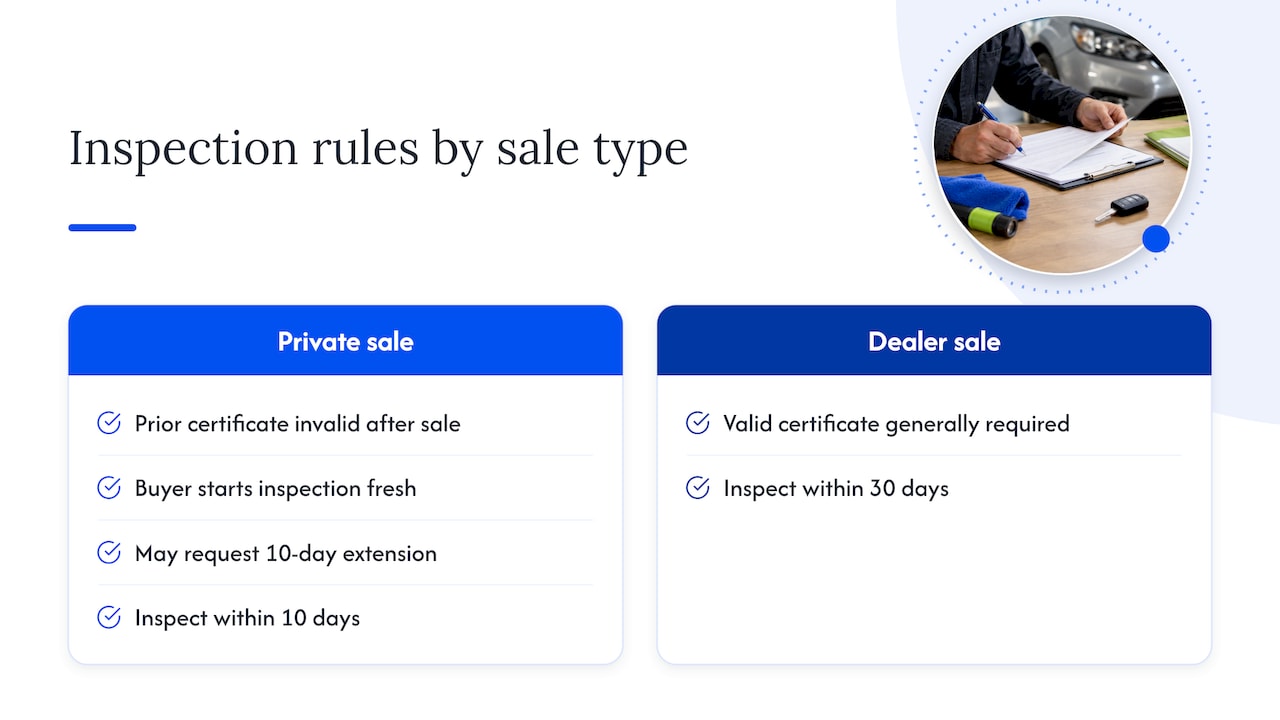
First, any inspection certificate issued before a private sale or transfer is invalid afterward. That is written into 15 NYCRR 79.2. So even a car that passed last month does not hand its certificate to the next owner. Your failed result is not something that “transfers” to the buyer either. The buyer starts fresh.
Second, when someone registers a car bought from anyone other than a New York registered dealer, the DMV says they can request a 10-day inspection extension sticker and must have the vehicle inspected within those 10 days. The DMV chapter on owning a vehicle spells it out. In practice, a private buyer is expected to deal with inspection after the purchase.
Dealers play by different rules. Vehicles sold by dealers generally must carry a valid inspection certificate and be inspected within 30 days of sale, with limited exceptions such as sales to another dealer. That is why a car that failed inspection often loses its appeal at a retail lot, and why many owners look at private or cash-buyer sales instead.
The Lemon Law question
New York’s Used Car Lemon Law protects buyers from dealers. The Attorney General’s guide states that private vehicle sales are not covered by it. That does not mean anything goes. It means you should sell honestly and put the terms in writing, because the buyer’s remaining remedies would come through other legal routes.
What to tell the buyer
Disclose what you know. Say the car failed inspection, what the rejection notice lists, and whether you have had any repairs quoted.
There are two reasons beyond basic honesty:
- It speeds up the sale. Buyers who know the problem up front price it in and don’t walk away at the last minute.
- It protects you. New York courts treat a fraud claim built on a material omission as requiring a duty to disclose and a failure to do so, as discussed in Nissan Motor Acceptance Corp. v Scialpi. Whether a duty applies depends on the facts, so the safest habit is to put the problem in writing and avoid the question entirely.
Salvage is a separate case. New York requires a specific disclosure statement when selling a rebuilt salvage vehicle, and skipping it can bring a fine of up to $2,000, according to the DMV’s salvage disclosure page. If your car has a salvage history, use that form.
A simple as-is line for the bill of sale
Write something plain and factual on the bill of sale, for example: the vehicle failed the New York State inspection on the date shown, the seller has disclosed the rejection notice, and the vehicle is sold as-is with no warranty. Both of you sign and date it, and each keeps a copy. If you are unsure how to word it for your situation, a New York attorney can review it.
Can you drive it while you arrange the sale?
The safe answer is only if you can lawfully do so. The DMV’s inspection regulations say a vehicle that must be inspected cannot be operated on New York public highways unless a valid inspection certificate, an inspection extension, or a CVIS-generated extension is displayed or can be presented, per CR-79.
That has practical consequences:
- Don’t plan a long test-drive route with prospective buyers if the car has no valid certificate or extension.
- Meeting buyers where the car is parked is simpler.
- If the car has to move, a tow or a buyer who picks up the car removes the question completely.
This is one reason owners with failed or expired inspections lean toward buyers who come to them. If your registration has also lapsed, see our page on selling a car in NY with expired registration.
Fix it or sell it as-is?
There is no universal answer, but a quick comparison helps.
| Factor | Repair first | Sell as-is |
|---|---|---|
| Up-front cost | You pay for repairs and reinspection | None |
| Time | Days to weeks, depending on parts and shop | Can be same day with a cash buyer |
| Buyer pool | Wider, since the car can pass | Narrower, buyers price in the repair |
| Risk | Repair quote may grow once the shop opens things up | Offer is what you accept |
| Best when | Failure is cheap and the car is otherwise strong | Repair costs approach the car’s value, or you need cash or space now |
A useful test: get one written repair estimate from a shop. If the estimate is a small share of what the car would be worth once it passes, repairing can pay. If the estimate is a large share of the value, or you do not want to spend money on a car you are leaving, selling as-is is usually the cleaner move.
Note that a repair estimate also helps in an as-is sale. It tells the buyer exactly what they are taking on, which keeps negotiations short.
The paperwork for a New York seller
The DMV lays out the basics on its buy, sell, or transfer ownership page. As the seller you sign the transfer section of the title and a Vehicle Bill of Sale (MV-912), or provide other acceptable proof. The buyer then registers and titles the vehicle at a DMV office and pays sales tax or shows an exemption.
For the buyer’s trip, the MV-82.1 form lists the documents: proof of ownership, insurance, and sales tax clearance. In a private sale, DTF-802 handles sales tax; if Section 6 is not required, a bill of sale signed by the seller is needed.
A short checklist for you:
- Find your title. If it is missing, see how to sell a car without a title in NY.
- Sign the title transfer section exactly as your name appears, and read our guide on New York title transfer forms and notarization before you sign anything in the wrong box.
- Complete the bill of sale. Our MV-912 and DTF-802 guide shows how the two forms fit together.
- Record the odometer reading and the sale date and price.
- Take photos of the signed documents before the buyer leaves.
- Handle your plates and insurance in the right order, covered below.
If you are unsure what the DMV treats as acceptable ownership evidence, our page on proof of ownership in NY explains it.
Plates, registration, and insurance
The plates belong to you, not the car. After you sell or give away a vehicle, the DMV says you can transfer the registration and plates to another vehicle you own. Sellers often make the mistake of cancelling insurance before the plates are dealt with, which can create trouble with the DMV. Our guide on NY car sale paperwork for private sellers walks through the order, and the page on reporting a car sale in NY covers the notice you give the DMV after the handoff.
Where to sell a car that failed inspection
You have three types of buyer.
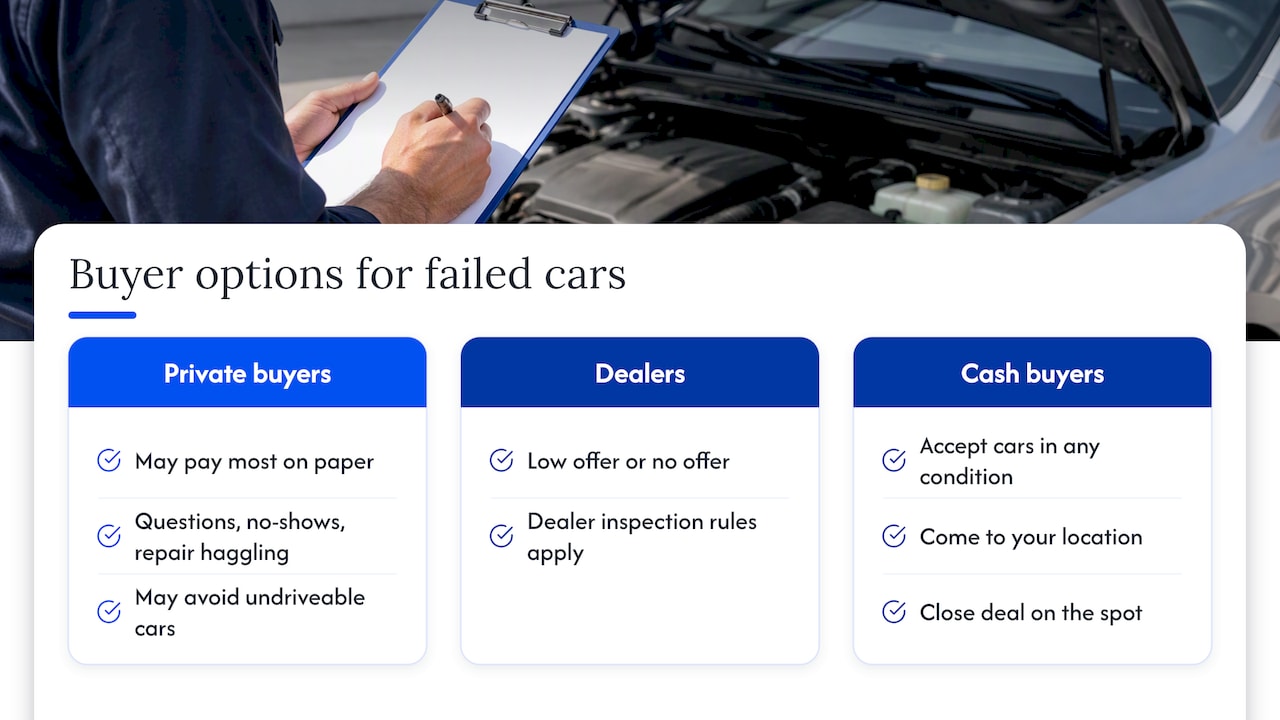
Private buyers. They may pay the most on paper, but expect questions, no-shows, and haggling over repair costs. Many will not drive to see a car that cannot legally be driven.
Dealers and trade-ins. Because dealer sales carry their own inspection requirements, a failed car usually pulls a low offer, or no offer. If you already got a low number, our page on raising a low dealer trade-in offer has scripts you can use.
Cash car buyers. These buyers are set up for cars in any condition. They quote the car as it sits, come to your location, and close the deal on the spot. This is the route we work in every day.
How selling to us works
Tri State Cash For Cars buys cars, SUVs, trucks, vans, and commercial vehicles in New York, New Jersey, and Connecticut, running or not, with or without a title, damaged or old. We send a team to you, give you a cash offer, and handle the paperwork. Our guarantee is that we pay the price we quoted when we pick the car up.
If your car failed inspection and you would rather not repair it, request your offer here. We designed our process so most sellers are paid the same day, and we aim for cash in hand within about an hour of pickup. For the details of that process, read our same-day cash guide, or see what happens at the curb in our guide to car pickup paperwork.
Living in the five boroughs? We also serve sellers in NYC and Brooklyn.
Get an accurate quote
Quotes go wrong when details are missing. Have these ready:
- Year, make, model, and mileage
- Whether the car starts and drives
- What the rejection notice says failed
- Whether you hold the title, and whose name is on it
- Any known body damage or missing parts
Accurate details are what make a quote hold at pickup. Our pages on guaranteed car offers and instant offer accuracy explain what moves a number and why.
Our perspective
Most people who call us after a failed inspection have already assumed the worst: that the car is now worthless, or that they must spend money before anyone will talk to them. Neither is true. A failed inspection is a repair question, and a repair question has a price. A buyer who is set up to take cars as they are can put that price into an offer and move on.
What we see hurting sellers is not the failure itself. It is the scramble afterward: a car that cannot be driven to a shop, a title in a drawer nobody can find, a buyer who haggles after seeing the rejection slip, plates and insurance handled in the wrong order. We built our service around removing those steps. We come to you, we quote the car as it is, we stand behind the number when we arrive, and we handle the paperwork.
Our advice is simple. Get one repair estimate if you are curious, then compare it with a firm as-is offer. If the offer is the easier and cleaner outcome, take it and be done.
Eric
FAQ
Is it illegal to sell a car that failed inspection in New York?
No rule in the sources we reviewed bars a private owner from selling a car after a failed inspection. The inspection certificate is not transferable in a private sale anyway, and the buyer is expected to inspect the car after registering it. Disclose the failure honestly and put the as-is terms in writing.
Can I drive my car to a buyer or a shop after it fails?
Only with a valid inspection certificate or an extension displayed or presentable. The DMV’s regulations say a vehicle required to be inspected may not be operated on public highways without one. Ask the buyer to pick the car up, or arrange a tow.
Do I have to tell the buyer the car failed inspection?
You should. Disclosing it keeps the sale quick and shields you from later disputes. If the car has a rebuilt salvage history, New York requires a specific disclosure statement, and leaving it out can mean a fine of up to $2,000.
What if I have lost the title?
You can still sell. You will either need to request a duplicate title or use another form of proof the DMV accepts. Our guide on selling without a title in NY explains the options, and we buy cars with or without a title.
Does a failed emissions test make my car worthless?
No. It lowers what a buyer will pay by the expected repair cost, but the car still has value as a vehicle, for parts, or for resale after repair. For some covered vehicles the DMV also allows an emissions waiver once repair spending reaches at least $450, which can matter for the next owner.
Sources
- NY DMV, Chapter 3: Owning a Vehicle
- 15 NYCRR 79.2, Cornell Legal Information Institute
- NY DMV, CR-79 Motor Vehicle Inspection Regulations
- NY Attorney General, Used Car Lemon Law guide
- NY DMV, Sell a Salvage Vehicle
- Nissan Motor Acceptance Corp. v Scialpi, NY Courts
- NY DMV, Buy, Sell, or Transfer Vehicle Ownership
- NY DMV, MV-82.1 Register/Title a Vehicle
- NY DMV, Transfer a registration to another vehicle