How to Negotiate the Sale Price of Your Car
The best way to negotiate a car sale is to settle three things before anyone makes an offer: what the car is worth, the lowest price you will accept, and what you will do if a buyer will not reach it. With those set, a low offer is just a starting point. If you would rather skip the haggling, we offer a guaranteed price: we quote an offer, and we commit to paying that price at pickup.
TL;DR
- Research your car’s value from several sources, then set an asking price and a walk-away number before the first offer arrives.
- Expect a low opening offer. Explain how you reached your price, counter politely, and stay above your floor.
- Back your number with service records and a clean, complete set of paperwork.
- Confirm payment and title details before you agree to anything. The price is not final until the money is real.
- If you want a firm number without weeks of back and forth, a guaranteed cash offer removes the negotiation.
Table of Contents
- Why negotiating a sale feels harder than buying
- Step 1: Find your car’s real market value
- Step 2: Build the evidence that supports your price
- Step 3: Respond to a low offer without losing your footing
- Step 4: Decide with timing in mind
- Step 5: Lock down payment and paperwork before you shake hands
- Negotiating with a dealer or a cash buyer
- Which route fits which seller
- Promo: sell without the negotiation
- Our perspective
- FAQ
- Sources
Why negotiating a sale feels harder than buying
When you buy a car, you can walk away from one seller and find another. When you sell, the buyer holds that option. Every person who messages you about your listing is comparing your car with others, and many open with a number far below your ask because it costs them nothing to try.
That is why the work happens before the first message. Sellers who lose money in negotiation are usually the ones who never decided what a good outcome looked like, so each counteroffer feels like a guess.
There are three common ways to sell, and each changes how much negotiating you do:
| Way to sell | Who sets the price | How much haggling | Typical trade-off |
|---|---|---|---|
| Cash buyer with a guaranteed offer | A quoted offer you accept or decline | Little to none | Fast, with the amount fixed up front |
| Dealer trade-in | The dealer, based on its resale plans | Some, mostly on their side | Convenient, but often a lower number |
| Private sale to another individual | You and the buyer, by negotiation | The most | Potentially higher price, more time and risk |
The rest of this guide covers the private-sale skills in detail, because they are useful whenever a number is on the table, including when you compare a cash offer with what a buyer is telling you.
Step 1: Find your car’s real market value
Start with research, not with a hunch or what you paid. The Better Business Bureau recommends comparing valuation estimates with dealer and private-party listings for the same make, model, year and mileage, then deciding both an asking price and the least you will accept.
A practical way to do this:
- Pull value estimates from at least two or three reputable valuation tools. They will not match, and the spread is useful.
- Search listings near you for the same year, trim and similar mileage. Asking prices are not sale prices, but they show what you compete against.
- Note your car’s condition honestly: tires, brakes, dents, warning lights, accident history, number of owners.
- Adjust for condition. A car with worn tires and a cracked windshield belongs at the low end of the range, not the middle.
Pricing tools help here too. Autotrader’s negotiation guide says its pricing tool gives average prices for similar vehicles in your area, and it advises knowing both the vehicle’s value and your own flexibility before you start haggling.
Worked example: three numbers
Say your 2016 SUV shows a market range of $9,500 to $11,000 for similar cars near you, and yours has higher mileage and a few cosmetic flaws.
- Asking price: $10,900. Slightly above where you expect to land, so you have room to give.
- Counteroffer range: $10,200 to $10,500. Where you expect a serious buyer to settle.
- Walk-away number: $9,800. Below this, you decline politely and move on.
Those figures are made up for illustration, but the structure is the point. Writing all three down before you list the car means you decide with a clear head, not under pressure from a buyer standing in your driveway.
Step 2: Build the evidence that supports your price
A price is easier to defend when you can show why it is fair. Buyers who see organized proof are less likely to argue about condition.
Autotrader suggests providing paperwork, including service records, and considering a mechanic’s inspection report so you understand the car’s condition and can address buyer concerns before they become bargaining chips.
Gather these before you list:
- Maintenance and repair receipts, sorted by date
- The title, in your name, and any lien information if you still owe on the car
- Recent inspection or emissions results
- A short written summary of known issues
- Two sets of keys, if you have them
Preparation also changes what buyers offer. If you want a practical checklist, our guide on how to prepare your car for sale walks through what to do before an offer, whether it comes from a private buyer or from us.
Step 3: Respond to a low offer without losing your footing
A low first offer is normal. Autotrader’s guide says it is common and recommends explaining how you arrived at your asking price instead of panicking, knowing how low you are willing to go, and being ready to walk away if negotiations drag on.
What to say
Keep replies short, friendly and tied to facts.
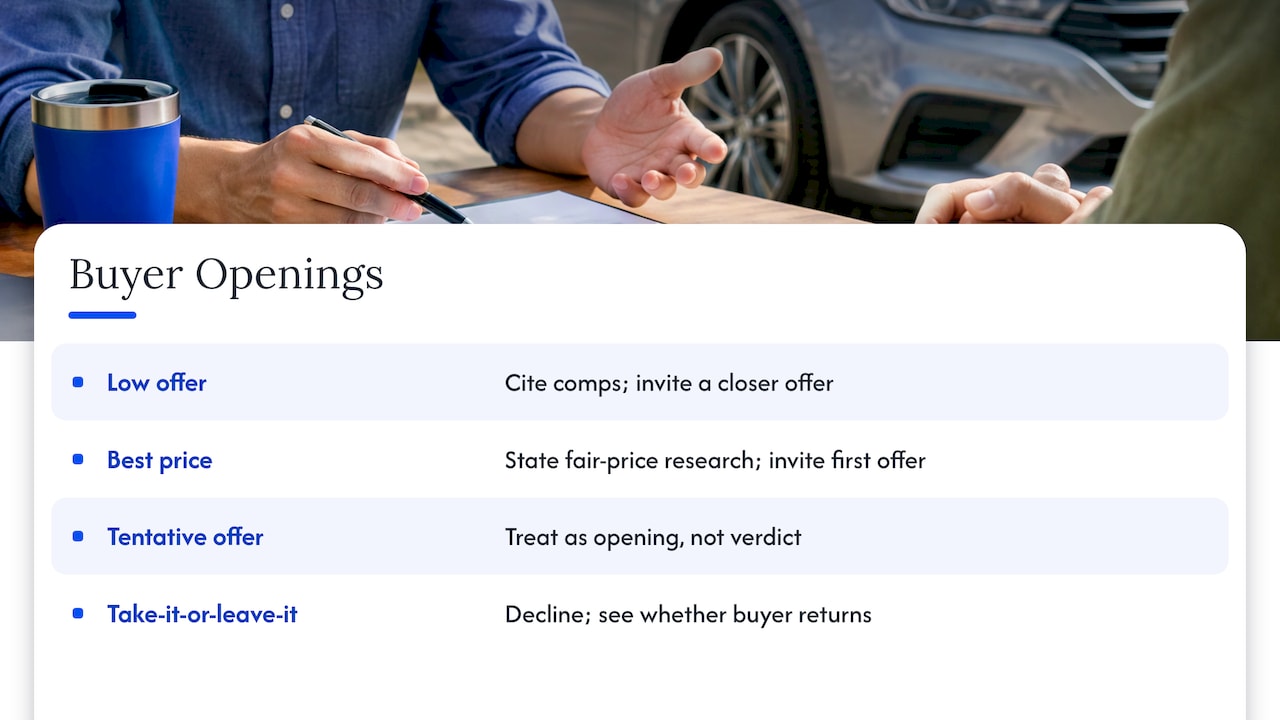
When the buyer opens low: “Thanks for the offer. I priced it based on similar cars near me and the service history. Is there a number closer to that you could do?”
When the buyer asks “What’s your best price?” Edmunds describes this as a buyer probing for a reduction and suggests saying you researched a fair price and inviting the buyer to make the first offer.
When the buyer asks “Would you take…?” Edmunds notes a polite offer like this leaves room to counter. Treat it as an opening, not a verdict.
When you hear “take it or leave it”: Edmunds says you can test that by declining and seeing whether the buyer comes back. Many do.
Stay polite and firm
The BBB’s guide stresses staying polite and firm, never crossing your bottom line, and allowing compromise only when an offer remains above your threshold. That is the whole discipline: give a little on offers above your floor, and none below it.
Moves that work in practice
- Counter once, with a reason. “I can do $10,400 because the tires are new” lands better than a bare number.
- Move in smaller steps each round. Shrinking concessions signal that you are nearing your limit.
- Do not negotiate against yourself. After you counter, wait for the buyer to respond.
- Ignore pressure from a single buyer. One message is not a market. Other buyers can still show up.
- Trade price for convenience when it helps you. A buyer who can collect the car promptly and pay in full may be worth a slightly lower number than one who wants weeks to arrange funds.
Step 4: Decide with timing in mind
Timing affects how much leverage you have. Edmunds says trade-in values have historically tended to be higher in the first two quarters than the last two, while noting that age, mileage, brand and market conditions also matter.
CarEdge’s February 2026 guidance identifies November through February as weak months for trade-in value, pointing to quieter lots, holiday spending and bad weather. That advice is about trade-ins, not a rule for every private sale, but it explains why sellers who list in late fall often hear lower offers. Earlier in the year, CarEdge’s 2025 guidance described spring as a strong time to sell, with rising buyer demand.
What does that mean for you? If you are not in a hurry, timing can help your number. If you need money now, waiting for spring may cost more in rent, insurance, registration and a car sitting unused than the seasonal bump would give you. That is the moment a firm same-day offer is worth comparing.
Step 5: Lock down payment and paperwork before you shake hands
A price you agreed on is only worth something if the payment clears and the transfer is done correctly. Do not let a pleasant negotiation make you casual at the finish.
Payment
Edmunds advises that for a higher-value cash transaction, you can meet at the buyer’s bank to watch the withdrawal or verify a cashier’s check with the issuing bank, and it warns sellers to guard against cashier’s-check fraud. Do not hand over keys or title on the strength of a check you have not verified.
Title and bill of sale
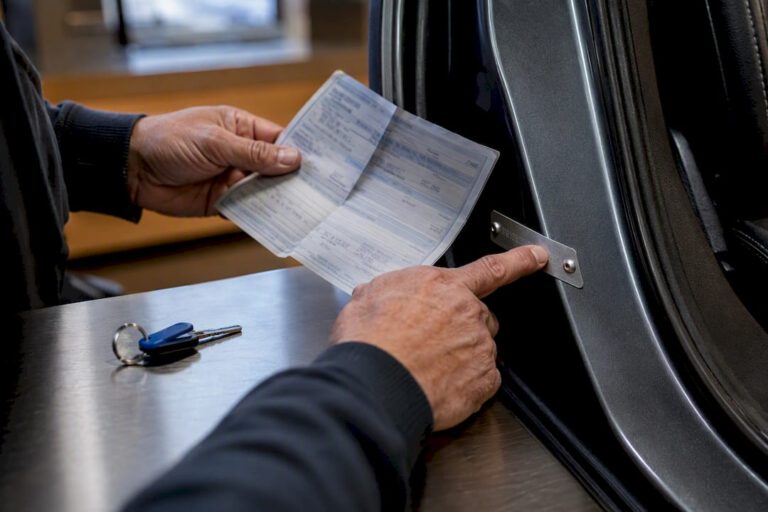
The BBB recommends including the VIN, sale price, and buyer and seller names in the bill of sale, and signing over the title to complete the sale. One state DMV, Utah’s, lists the same basics, adding a vehicle description and noting a bill of sale can be handwritten or printed. Rules differ by state, so check yours.
If you are in the tri-state area, we have guides for each state:
- New York car sale paperwork for private sellers, including what to handle with your plates
- New York bill of sale and forms
- New Jersey car sale paperwork before an MVC visit
- What to sign at pickup before the buyer drives away
Miss one of these steps and a deal that looked settled can turn into a headache later, such as a car still tied to your name.
Negotiating with a dealer or a cash buyer
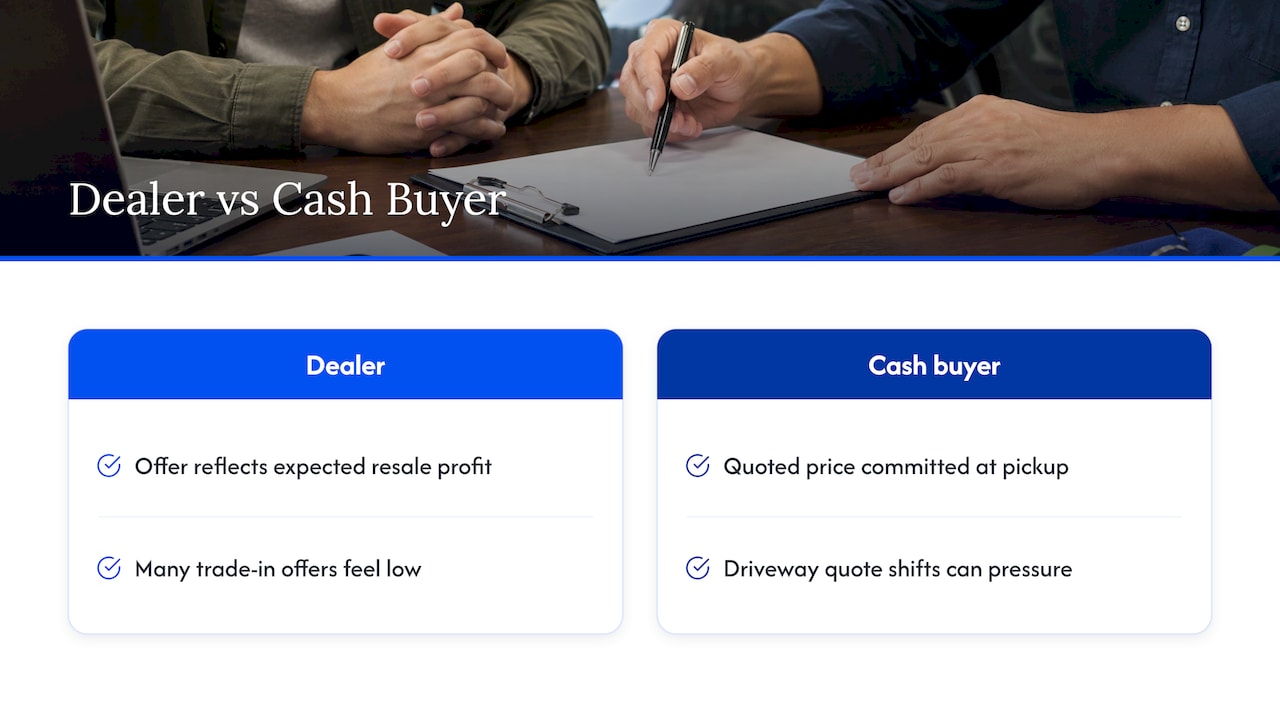
Dealer trade-ins have their own dynamic. The dealer has to resell the car at a profit, so the offer reflects what it expects to make, which is why many trade-in offers feel low. We explain the reasons in why dealer trade-ins are low, and if you already have an offer in hand, our page on how to raise a low dealer trade-in offer has scripts you can use.
A cash buyer works differently. Instead of a listing, buyers and a back-and-forth, you get a quoted offer. The question is whether that quote holds up. A quote that shifts at your driveway is the one place where negotiation turns into pressure. Our approach is a guarantee on the offer: we commit to paying the stated price at pickup. That means the number you agree to is the number you receive.
If you want to understand how an instant quote becomes a real one, see our walkthrough on closing the gap in instant offer accuracy.
Which route fits which seller
Pick the route that matches your priorities, not the one that sounds best in theory.
- You want the highest possible price and have time: a private sale, with all the preparation above, can reward patience.
- You want the sale done quickly: a guaranteed cash offer gets you paid without scheduling a string of showings.
- Your car does not run, is damaged or has a title problem: private buyers often walk away from these. We buy both running and non-running vehicles, and we can work with sellers who have no title.
- You are a busy professional: every message, test drive and no-show costs time. A single visit from our team does not.
Our fast car sale options guide compares the 24 to 72 hour cash route with the slower, higher-effort one, so you can see what each costs you in time.
Promo: sell without the negotiation
We buy cars, SUVs, trucks, vans and commercial vehicles in New York, New Jersey and Connecticut. You get a cash offer, our team comes to your location, we handle the paperwork, and we pay the offered price at pickup. Many sellers are paid within an hour of our arrival.
We designed this around the problems in this article: low offers, a drawn-out back and forth, and paperwork mistakes. To see how it works, read how pickup sales work, or get your offer from Tri State Cash For Cars.
Our perspective
Most people think negotiating a car sale is about being tough. In our experience it is about being certain. Sellers who know their number, their floor and their paperwork stay calm, and calm sellers get better results.
The problem is that private sales ask you to do all of that while strangers test your patience. Dealers, meanwhile, make an offer built around their own resale margin. Neither is built around your time.
That is why we built our service around a guarantee: the price we quote is the price we pay at pickup. We come to you, we handle the paperwork, and we aim to have cash in your hands within the hour. For a seller tired of low offers and long waits, that is a simpler way to be sure of the outcome. We also stand behind our view that our offers compare well with local dealers.
Eric
FAQ
How do I negotiate when selling a car?
Research the car’s value, then set an asking price, a counteroffer range and a walk-away number before you list. When a buyer opens low, explain how you priced the car, counter politely and stay above your floor. If a buyer will not reach your minimum, be ready to walk away.
What should I say when a buyer asks for my best price?
Tell them you researched a fair price and invite them to make an offer first. Edmunds suggests this approach because the question is often a probe for a discount. It keeps you from naming a lower number than you need to.
What is the hardest time of year to sell a car?
CarEdge identifies November through February as weak months for trade-in value, citing quieter lots, holiday spending and bad weather. That is trade-in guidance, so private-sale demand can differ. If you need to sell during those months and want a fixed number, a guaranteed cash offer takes seasonal haggling out of the picture.
Can I negotiate with Tri State Cash For Cars?
You do not need to haggle: we give you a cash offer and commit to paying that stated price at pickup. If you have another offer, such as a low dealer trade-in, you can compare the two and choose. We buy vehicles in New York, New Jersey and Connecticut, running or not.
What should I confirm before I agree on a price?
Confirm how you will be paid and that the funds are real, then make sure the bill of sale lists the VIN, price and both parties’ names. Sign over the title as part of completing the sale. Check your state’s DMV or MVC rules for anything specific to your state.
Sources
- BBB: How to sell a car to a trustworthy, honest buyer
- Autotrader: 8 tips when negotiating a used car sale
- Edmunds: How to sell a car
- Edmunds: When is the best time to trade in a car
- CarEdge: Best time to trade in your car
- CarEdge: Spring 2025 used car market
- Utah DMV: Responsibilities of buyer and seller