How to Spot and Avoid Car Selling Scams Before You Lose Money
Slow down, verify every payment independently, and never click a link a buyer sends you for a “vehicle report” site. Hold the title and keys until funds actually clear your bank account, not just your inbox. The three highest-risk car selling scams right now are overpayment or fake-check schemes, fake escrow services, and phishing sites disguised as vehicle history reports.
- Verify all payments directly with your bank, not through screenshots the buyer sends you.
- Refuse to use any payment or “report” website the buyer suggests. Only use sites you already know.
- Meet in a public location during daylight, and never hand over the title before funds settle.
- If something feels rushed or too generous, report it to the FTC and pause the deal.
Key Takeaways
Independent verification of every payment, before releasing a title or vehicle, is what actually stops nearly all car selling scams.
| Point | Details |
|---|---|
| Never refund overpayments | If a check exceeds your price, it’s a scam; the FTC says don’t send back the difference. |
| Verify payments with your bank | Call your bank directly rather than trusting screenshots or buyer-sent confirmations. |
| Avoid unfamiliar report sites | Only use Carfax, AutoCheck, or NMVTIS; share your VIN so buyers run their own report. |
| Meet safely and verify identity | Meet in public daylight, ride along on test drives, and photograph the buyer’s ID. |
| Consider a guaranteed cash sale | Tristatecashforcars pays on-site with a guaranteed offer, cutting out payment and buyer-verification risk entirely. |
Where to Get Help and Report Scams
- FTC Car Buying Scams guidance
- FTC fake check scam alert
- Internet Crime Complaint Center (IC3)
- Minnesota Attorney General: online car sales guidance
- Tristatecashforcars: options to sell your car
Table of Contents
- Common Car Selling Scams You’ll Actually Run Into
- What Red Flags Should Make You Screen a Buyer Harder?
- Which Payment Methods Actually Protect You as a Seller?
- How Do You Handle Test Drives and Meetings Safely?
- What to Do If You’ve Already Been Scammed
- Why a Reputable Cash Buyer Cuts Out Most of the Risk
- Watch for Scams That Surface After the Sale Closes
- How Do You Verify an Escrow or Payment Hold Is Real?
- How Scammers Find You on Selling Platforms
- How to Keep Test Drives From Turning Into Theft
- Skip the Screening Entirely With a Guaranteed Cash Offer
- Sources
- FAQ
Common Car Selling Scams You’ll Actually Run Into
Most common car selling scams follow a handful of well worn scripts, and once you’ve seen the pattern, they’re easy to spot.
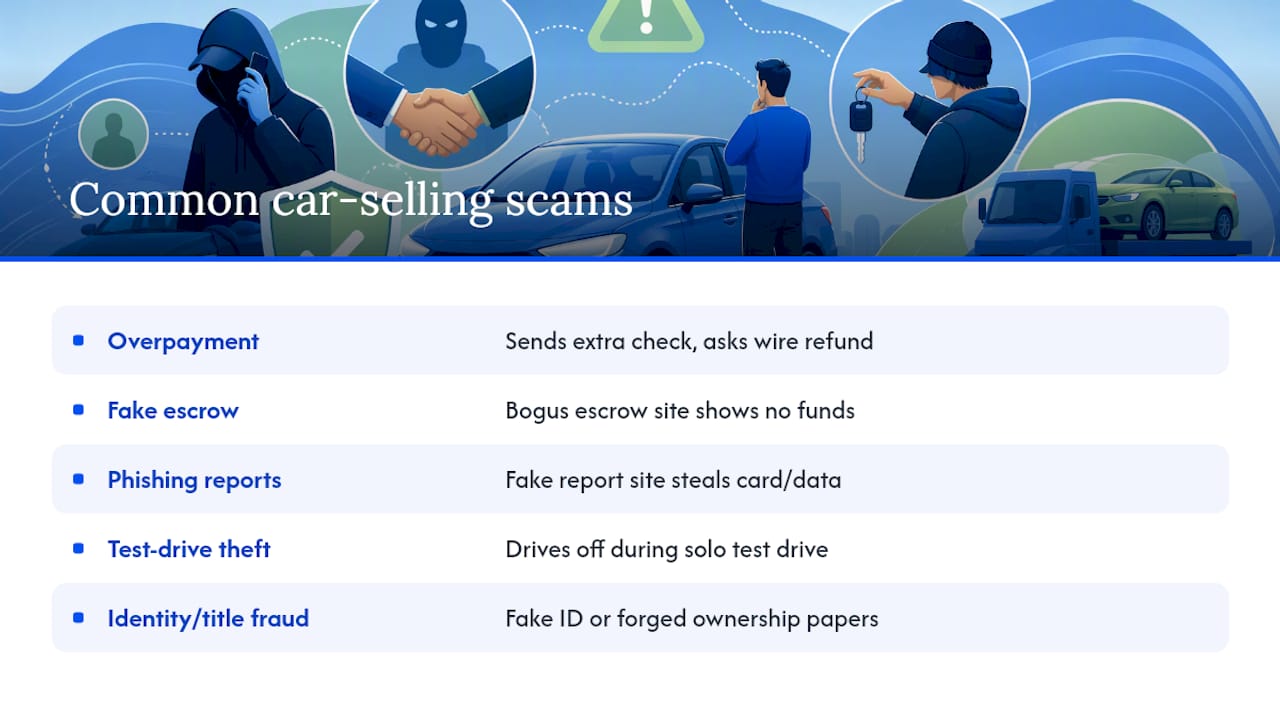
The overpayment scam is the most reported version. A “buyer” sends a check for several thousand dollars more than your asking price, then asks you to wire back the difference for a shipping company or agent fee. The check looks real and might even show as deposited. Weeks later, your bank flags it as fraudulent, reverses the deposit, and you’re out whatever you wired. The FTC’s fake check scam warning is explicit on this: never accept a check for more than your asking price, and never refund the difference.
Fake escrow works similarly but adds a layer of fake legitimacy. The buyer directs you to a third-party “escrow” site that isn’t a real escrow company at all. It shows a fake confirmation that funds are “held” and waiting for release once you ship the car or hand over keys. There’s no money behind that screen.
Phishing-style vehicle report sites are newer and nastier. A buyer insists you run a report through a specific, unfamiliar site before they’ll commit. That site collects your credit card number and personal details, and some versions also try to extract the buyer’s information from you. A Fox News investigation documented exactly this pattern on Craigslist listings. Stick to Carfax, AutoCheck, or NMVTIS, and share your VIN so buyers can run their own trusted report instead of steering you toward theirs.
Round out the list with test-drive theft, where a “buyer” takes off during a solo test drive, and identity or title fraud, where a scammer uses a fake ID or forged paperwork to complete a transfer that later unravels on you.
Pro Tip: If a buyer offers to overpay “for convenience” or insists on a payment method you’ve never used before, that’s the scam talking, not generosity.
What Red Flags Should Make You Screen a Buyer Harder?
Certain behaviors show up in nearly every fraudulent inquiry. Spotting them at the first message saves you from wasting a weekend on a buyer who was never real.
- They offer more than your asking price without negotiating, often citing a shipping company or overseas relocation.
- They push for speed, pressuring you to skip normal steps and finalize “today” or “before the weekend.”
- Their answers are vague when you ask specific questions about the car’s condition, mileage, or your local pickup logistics.
- They insist on one specific website for payment, escrow, or vehicle reports that you’ve never heard of.
- Their contact info doesn’t match, with a phone number in one area code and claimed residence in another.
Before agreeing to meet, ask for a callable phone number, a home address, and a photo of their driver’s license. A legitimate buyer won’t hesitate.
Pro Tip: Treat any above asking price offer or out-of-area buyer as a reason to pause, not celebrate. Real buyers negotiate down, not up.
Which Payment Methods Actually Protect You as a Seller?
Cash counted in person remains the safest method for private car sales, followed by a bank transfer you personally confirm has posted to your account, and finally a cashier’s check verified directly with the issuing bank before you release the vehicle.
Screenshots of a completed transfer prove nothing. Scammers fake payment app confirmations and doctored bank alerts routinely, and a payment “pending” is not a payment received. The FTC’s guidance on secure payment verification specifically warns against trusting buyer-sent confirmations over your own bank’s records.
Here’s the sequence that protects you:
- Accept cash and count it in full before handing over keys, or accept a bank transfer and log into your own account to confirm it posted.
- If a cashier’s check is the only option, call the issuing bank directly using a number you look up yourself, not one printed on the check.
- Wait for funds to fully clear, which can take several business days even when a deposit shows immediately.
- Complete a bill of sale, record the odometer reading, and keep a copy of the buyer’s ID before transferring the title.
- Never sign over the title until the money has cleared your account, confirmed by your own bank.
Documentation matters as much as payment method. A private sale guide covering the full paperwork checklist can help you avoid gaps that come back to bite you months later.
How Do You Handle Test Drives and Meetings Safely?
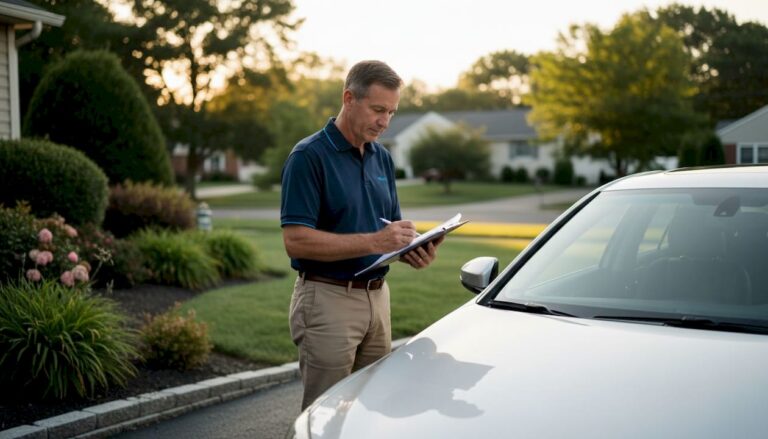
Meet buyers in a public, well-lit location, ideally a bank parking lot or busy shopping center, and bring a friend along whenever possible. Avoid meeting at your home unless you have no other option, since that reveals your address to a stranger you haven’t vetted.
- Verify identity first. Ask for a valid driver’s license and proof of insurance before anyone gets behind the wheel.
- Write down their information including full name, license number, and phone number, and take a photo of their ID with your phone.
- Ride along during the test drive. Never let a stranger take your car alone, and keep the route short and familiar.
- End the meeting immediately if the buyer wants to drive somewhere else “to show a friend,” asks to keep the keys briefly, or becomes evasive about basic questions.
These steps also support the documentation and buyer-verification advice covered in a best-way-to-sell guide for private New Jersey sellers.
What to Do If You’ve Already Been Scammed
Contact your bank the moment you suspect fraud, whether that means a reversed deposit, a bounced check, or a wire you sent that shouldn’t have gone out. Banks can sometimes freeze or claw back funds if you act within hours, not days.
- File a police report with your local department, since it creates an official record for any bank or credit dispute.
- File a complaint at ReportFraud.ftc.gov and, if the scam happened online, submit a report to the Internet Crime Complaint Center.
- Preserve every message, screenshot, VIN record, and title copy tied to the transaction.
- Place a fraud alert with the credit bureaus and monitor your credit if you shared personal identifying information.
Reporting to official channels doesn’t just help your own case. IC3 and the FTC use these reports to flag repeat offenders, and platforms can shut down accounts once a pattern surfaces.
Why a Reputable Cash Buyer Cuts Out Most of the Risk
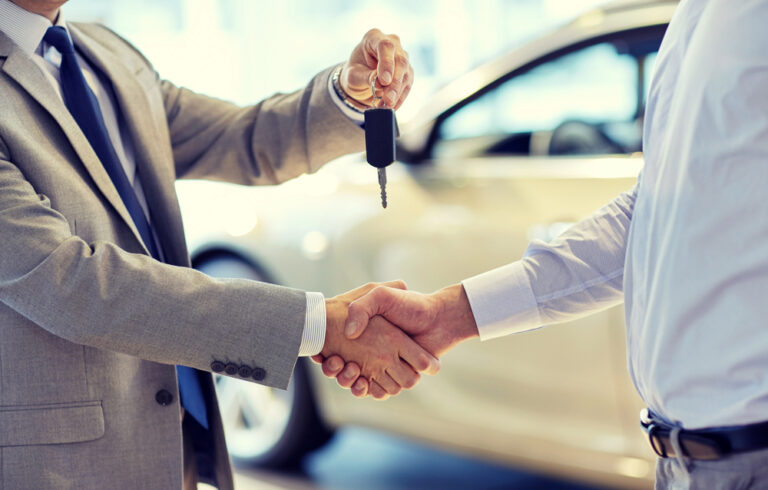
A licensed, local cash buyer removes the two biggest exposure points: unverified payments and unfamiliar buyers you’ve never met. Payment happens on-site, in person, at pickup, and the buyer’s business handles title paperwork directly instead of leaving it to chance.
- Demand a guaranteed offer that’s honored at pickup, not adjusted after inspection.
- Confirm payment is delivered before the vehicle leaves your possession.
- Expect the buyer to manage title transfer paperwork on the spot.
Private sale can still net a higher price if you’re patient and thorough with verification. If speed and certainty matter more, a professional buyer removes the guesswork.
Watch for Scams That Surface After the Sale Closes
Closing the deal doesn’t end your exposure. A handful of scams specifically target sellers weeks or even months after the car has changed hands, and they rely on you having let your guard down.
The most common follow-up scheme involves a buyer or someone posing as the buyer claiming the vehicle had undisclosed damage or a mechanical failure, then demanding a partial refund or threatening a chargeback. Without a signed bill of sale documenting the car’s condition “as-is” at the time of sale, you have little to point to. This is exactly why the documentation step matters as much as the payment verification step. Keep dated photos of the car’s condition on the day you handed it over, along with the signed bill of sale and odometer disclosure.
A second pattern involves title and registration fraud. If a buyer never actually transfers the title into their name, unpaid parking tickets, tolls, or even a vehicle involved in a crime can trace back to you as the last registered owner. Confirm the sale by checking with your state’s motor vehicle agency weeks after the transaction to verify the title has moved out of your name. Some states let you file a notice of transfer or release of liability specifically to protect against this.
Watch also for a fake “insurance refund” or “registration fee return” contact claiming you’re owed money and asking for your bank details to process it. Legitimate refunds never require you to provide account credentials over phone or email. Treat any unsolicited post-sale contact requesting financial information as a scam attempt, full stop.
How Do You Verify an Escrow or Payment Hold Is Real?
Legitimate escrow services are licensed, independently searchable, and never suggested unilaterally by a buyer you just met online. If a buyer names a specific escrow site, stop and verify it exists as a real, licensed company before proceeding, using a state licensing database or a simple independent search, not a link the buyer sent you.
Call the company directly using a phone number you find independently, not one listed on the site the buyer shared. Ask the representative to confirm, by name, that a specific transaction and dollar amount is actually being held for you. A real escrow company will have account records and a compliance team that can verify this in real time. A fake one will stall, redirect you back to a website, or refuse to answer basic verification questions.
Never wire money or ship a vehicle based solely on a screenshot showing “funds held” on an escrow platform. Those confirmation pages are trivial to fake, and they’re the core mechanism behind the fake escrow scam. If the buyer resists a phone verification or pushes you to trust the website exclusively, that resistance is itself the red flag.
For any third-party payment hold, the safest rule is simple: independent verification through a phone call or an official channel beats any confirmation the buyer controls. If a buyer can’t tolerate that level of scrutiny, they were probably never planning to pay you honestly in the first place. Real escrow transactions also typically involve fees disclosed upfront, not buried or waived suspiciously to make the deal look more attractive.
How Scammers Find You on Selling Platforms
Scammers scan classified and marketplace listings for specific signals: a low-mileage vehicle, a clear phone number in the ad, and language suggesting the seller is motivated or in a hurry. Once they identify a target, the first message often arrives within minutes of posting, frequently before a real buyer has even seen the listing.
Watch for accounts that were created recently, have no reviews or transaction history, and use a profile photo that looks stock or mismatched with the name attached. A quick reverse image search on the profile picture often reveals it’s been lifted from an unrelated source. Genuine buyers on established platforms usually have some history, whether that’s past listings, verified reviews, or a longer account age.
Verify buyer profiles the same way you’d verify a stranger anywhere else. Ask for a phone number and actually call it. Cross-check the name they give against their payment method or ID. If they claim to be relocating, deployed overseas, or unable to view the car in person, treat that as an immediate red flag rather than a reasonable explanation, since it’s one of the most common cover stories scammers use to justify skipping an in-person meeting entirely.
Platforms themselves vary in how much scam activity they attract. Choosing a trusted platform to list your car with built-in buyer verification reduces your exposure before a scammer ever reaches your inbox. Report suspicious accounts directly to the platform too. Most marketplaces will suspend accounts once enough sellers flag the same behavior, which protects the next person in line.
How to Keep Test Drives From Turning Into Theft
A test drive is the single highest-risk moment in a private car sale, because it’s the point where you hand physical control of your vehicle to a total stranger. Treat it with the same caution you’d use handing someone the keys to your house.
Never let a prospective buyer test drive the car alone, no matter how trustworthy they seem or how convincing their excuse. Ride along every time, and sit in the passenger seat rather than letting them go it alone “just around the block.” If a buyer resists having you along, that alone is reason enough to end the meeting.
Photograph their driver’s license before the test drive begins, and confirm the name matches the person standing in front of you. Text a photo of the license plate on their own vehicle, if they arrived in one, to a friend or family member along with your location. Keep your phone on and easily accessible throughout.
Choose the route yourself rather than letting the buyer suggest it, and keep it short, familiar, and away from remote areas. A five to ten minute loop through streets you know well tells you everything you need to know about how the car drives without giving a stranger the chance to disappear down an unfamiliar highway.
If at any point the buyer suggests stopping somewhere unplanned, mentions wanting to “show a mechanic friend,” or becomes cagey when you ask basic questions about financing, end the test drive immediately and return to the meeting point. Trust that instinct. Sellers who’ve been through a close call almost always say the same thing afterward: something felt off before anything actually went wrong.
Skip the Screening Entirely With a Guaranteed Cash Offer
If everything above sounds like a lot of vetting for one transaction, that’s because it is. Private buyers can offer a higher price, but every extra dollar comes with extra risk: verifying identities, chasing bank confirmations, and hoping a cashier’s check clears before you hand over a title.
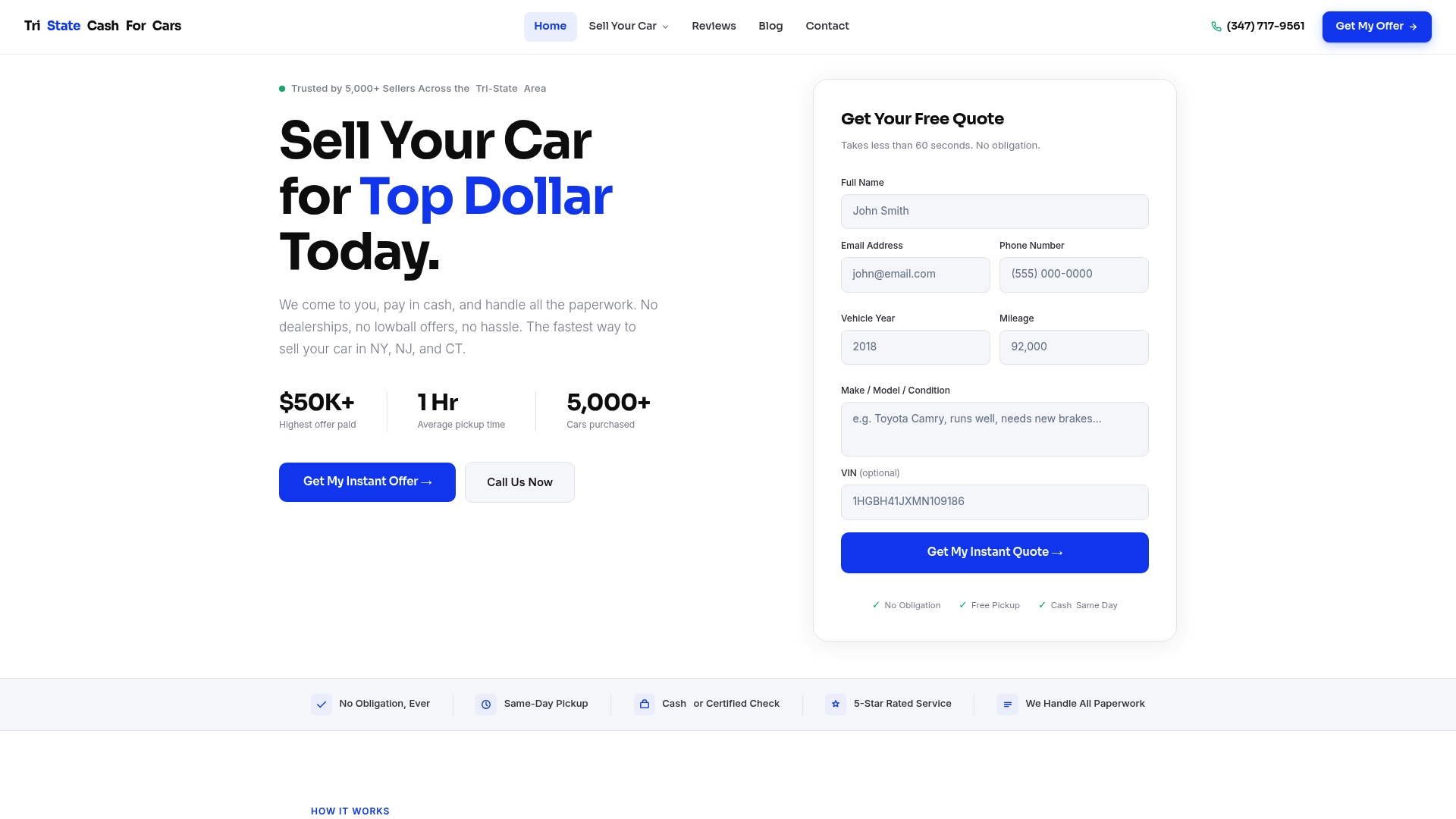
Tristatecashforcars removes that entire risk equation. A team comes to your location, gives you a guaranteed offer, and pays you on the spot, with cash in hand often within an hour of arrival. There’s no waiting on a check to clear, no verifying a stranger’s bank transfer, and no shipping the car to someone you’ve only spoken to online. This works whether your vehicle runs perfectly or has been sitting with mechanical issues, since Tristatecashforcars buys cars, SUVs, trucks, and vans in running or non-running condition across New York, New Jersey, and Connecticut.
Sellers who need funds fast, or who simply don’t want to gamble on an online buyer’s promises, get the same protection professional resale buyers rely on: paperwork handled, price locked in before pickup, and payment that doesn’t depend on trusting a screenshot. If a fast, low-risk sale sounds better than another week of screening strangers, see what your vehicle is worth by checking your options to sell your car today.
A Note From Eric on the Mistake Most Sellers Make
The sellers who get burned almost always skip the same step: they trust a confirmation screen instead of calling their own bank. Verification takes five extra minutes and kills nearly every scam on this list. If you want more on pricing and paperwork, our step-by-step selling guide covers the rest.
— Eric
Sources
- Craigslist car scam uses fake vehicle reports to steal your money | Fox News
- Fake check scam targets online car sellers | Consumer Advice (FTC)
- Car Buying Scams | Consumer Advice (FTC)
- Internet Crime Complaint Center (IC3)
FAQ
How Do You Know If a Car Buyer Is Scamming You?
Warning signs include an offer above your asking price, pressure to close the deal fast, insistence on an unfamiliar payment or report website, and vague answers to specific questions about the vehicle or their own location.
What Are the Latest Car Selling Scams to Watch For?
Fake vehicle-report phishing sites and fake escrow confirmation pages are among the more sophisticated current schemes, both designed to look legitimate while extracting money or personal data before you ever meet the buyer.
What Are the Most Common Scams When Selling a Car?
The most reported schemes are the overpayment or fake-check scam, fake escrow services, and phishing sites disguised as vehicle history reports, all of which rely on rushing you before you can verify anything independently.
Is It Safer to Sell My Car to a Cash Buyer Instead of a Private Buyer?
A verified cash buyer that pays on-site and handles paperwork, like Tristatecashforcars, removes most payment and buyer-verification risk, though a patient private sale can sometimes bring a higher price.
What Should I Do Immediately If I Think I’ve Been Scammed?
Contact your bank right away, file a report with ReportFraud.ftc.gov and IC3, and preserve all messages, screenshots, and payment records tied to the transaction.