Get Guaranteed Cash and Paperwork for NJ Cars That Failed Inspection
If your New Jersey vehicle failed inspection and you need cash fast, your fastest legal options are: sell to a cash buyer that picks up and handles paperwork, sell privately as-is, or repair and resell. Each path works, but they differ in speed and payout. Transfer the title properly and disclose the inspection failure to stay clear of legal trouble. Below you will find the paperwork checklist and NJ-specific rules for each route.
TL;DR:
- Selling to a cash buyer who handles pickup and paperwork is the fastest way to get cash, especially for non-driving or damaged cars.
- Private sales can yield higher prices but require careful disclosure, completing paperwork, and meeting in person, which takes longer.
- Repairs are only worthwhile if the cost is clearly less than the price increase from passing inspection, particularly for common safety and emissions issues.
- The repair window after a failed inspection is typically one month, with a 48-hour limit for safety hazards, and driving on a failed sticker risks fines.
- Commercial vehicles face stricter inspection rules and immediate out-of-service statuses that can delay or prevent resale.
Table of Contents
- Practical fast-sale options compared for speed, price, and effort
- Step-by-step private sale checklist for a failed-inspection car
- Paperwork you need and MVC rules to avoid delays or fines
- Legal disclosure rules and risks you want to avoid
- How a guaranteed on-site cash buyer speeds up the sale
- New Jersey’s re-inspection window and what a failed sticker means
- Law enforcement risk and fines for driving on a failed sticker
- Typical repairs that fail New Jersey inspections
- What common failed-inspection repairs tend to cost
- How a failed inspection affects resale value and negotiation
- Commercial vehicles face a different inspection path than private cars
- Choosing fast cash, a private sale, or parts based on your situation
- Get a guaranteed cash offer for your failed-inspection vehicle
- FAQ
- Sources
Practical fast-sale options compared for speed, price, and effort
Once your car has a failed inspection sticker, the clock matters as much as the price. Each option trades speed against payout, and the right pick depends on how urgently you need the cash and how much time you can spend on a listing.
- Cash buyer with pickup: the fastest route, often same-day, with minimal paperwork hassle for you, though the offer may land below what a patient private seller could get.
- Private party sale as-is: can bring a higher sale price, but it takes longer, requires careful disclosure, and means meeting strangers to show the car.
- Sell for parts or salvage: the right call when the failure points to frame damage, a blown engine, or repair costs that exceed the car’s value.
- Repair and re-inspect before selling: worth it only when the repair bill is clearly smaller than the price bump you would get from a passing inspection.
A cash buyer who handles pickup and paperwork removes the two biggest friction points in a failed-inspection sale: finding a buyer willing to take on a car that cannot legally be driven far, and handling the title transfer correctly. For a non-running car or one with a serious safety defect, this is often the only realistic option without sinking more money into it.
Private sales can net more money, especially for vehicles that failed on something minor like a burned-out bulb or worn wiper blades. But you are responsible for an honest listing, safe meetups, and making sure the buyer actually completes the transfer. If the failure involves structural damage or a salvage-level issue, parting out the car or selling it to a salvage buyer is usually faster and avoids the liability of selling a car that is dangerous to drive. Repairing first only makes sense when you have run the numbers and the repair cost is clearly below the price gap between a passing car and a failed one.
Step-by-step private sale checklist for a failed-inspection car
If you choose the private-sale route, speed comes from having everything ready before you ever post the listing.
- Write an honest listing that states the vehicle failed inspection, lists the specific reason if known, and includes the VIN and current odometer reading.
- Gather your documents: the signed title, a bill of sale with the buyer’s name and address, the Vehicle Inspection Report if you have one, and an odometer disclosure statement.
- Screen buyers and meet in a public, well-lit location, ideally during daylight, and bring a second person if possible.
- Accept payment in full before releasing the title, using cash, a verified cashier’s check, or an electronic transfer you can confirm immediately.
- Sign the title over to the buyer and keep a signed copy of the bill of sale for your own records.
- Remind the buyer they must transfer the title at a motor vehicle agency within 10 working days, since a late transfer carries a $25 penalty.
If a buyer backs out after you’ve signed the title, the sale isn’t final and the title may become “spoiled.” You’ll need to request a title correction from the New Jersey MVC, which typically costs $60 unless the MVC caused the error.
Pro Tip: Photograph the signed title and bill of sale with your phone before handing anything over, so you have timestamped proof of the sale terms if a dispute comes up later.
For a longer walkthrough of pricing, listing photos, and meetup safety, our guide on selling a car privately in NJ covers the full process.
Paperwork you need and MVC rules to avoid delays or fines
Getting the documents right the first time saves you from repeat trips to a motor vehicle agency. New Jersey requires the seller to sign the back of the title and complete a bill of sale, while the buyer files a BA-49 Vehicle Registration Application and completes the title transfer process.
- Transfer window: the buyer has 10 working days to complete the transfer.
- Late penalty: missing that window triggers a fine of $25, according to NJ MVC’s transfer guidance.
- Title correction fee: if a deal falls through after signing, correcting a spoiled title runs a fee of $60 in most cases, per NJ MVC’s title correction page.
- Reinspection paperwork: state inspection facilities require the Vehicle Inspection Report along with an Emission Repair Form and repair receipts for emissions-related fixes, and reinspection will not proceed without them.
- Odometer accuracy: New Jersey regulations require a truthful odometer disclosure on every private sale, and knowingly misstating mileage carries legal exposure.
Our title transfer checklist walks through each of these steps in order if you want a printable reference before meeting a buyer.
Legal disclosure rules and risks you want to avoid
Private sales in New Jersey are generally “as-is,” and the dealer protections under the state’s lemon law typically do not extend to private party transactions. That puts more weight on you to disclose problems upfront rather than let a buyer discover them later.
- Disclose the failed inspection and the specific reason, along with any salvage notation on the title.
- State the odometer reading accurately; misrepresenting mileage can expose you to legal penalties under state and federal rules.
- Never alter inspection paperwork or try to hide a failed sticker, since inspection facilities and emission repair shops operate under licensing rules with real penalties for fraud.
- Ask about a referee inspection if you believe a failure was recorded in error, or request a title correction if the paperwork itself has a mistake.
Being upfront protects you from a buyer coming back later claiming you concealed a known defect, which is a far messier problem than a slightly lower sale price.
How a guaranteed on-site cash buyer speeds up the sale
When a car has failed inspection and driving it is legally risky, a cash buyer that comes to you removes the two hardest parts of a private sale: finding someone willing to take on the car’s condition, and making sure the paperwork gets filed correctly.
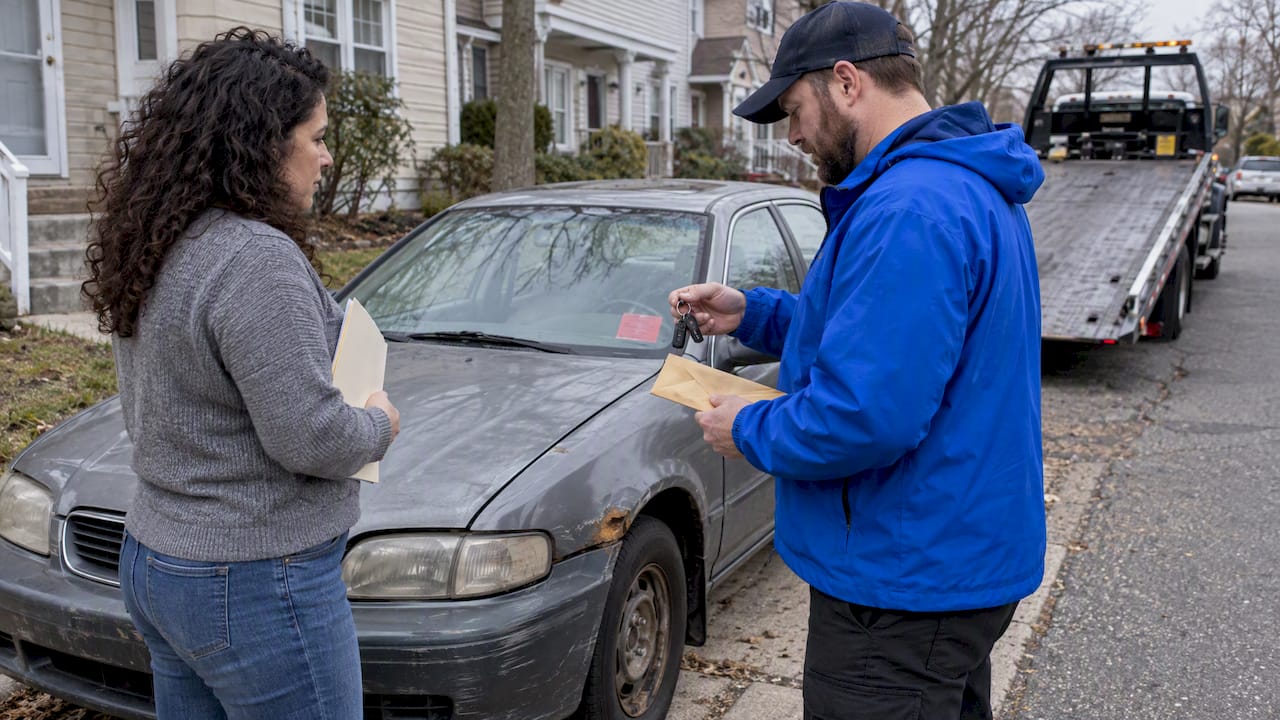
We arrange for an in-person vehicle evaluation, offer cash on the spot, and handle the paperwork at pickup rather than leaving it for you to sort out later. For a car that cannot be safely driven to a buyer’s test drive, or one where repair costs would eat up most of its value, this kind of direct pickup is often the most realistic path to cash.
Before agreeing to any cash offer, whether from us or another buyer, it helps to check a few things:
- Get the offer in writing before the buyer arrives for pickup.
- Confirm the pickup date, time, and location in advance.
- Ask who handles the title transfer and plate surrender, since this varies by buyer.
- Get a signed receipt at the moment of pickup, documenting the price paid and the date.
Pro Tip: A buyer who won’t confirm pickup logistics or put an offer in writing before showing up is a red flag, not a shortcut.
New Jersey’s re-inspection window and what a failed sticker means
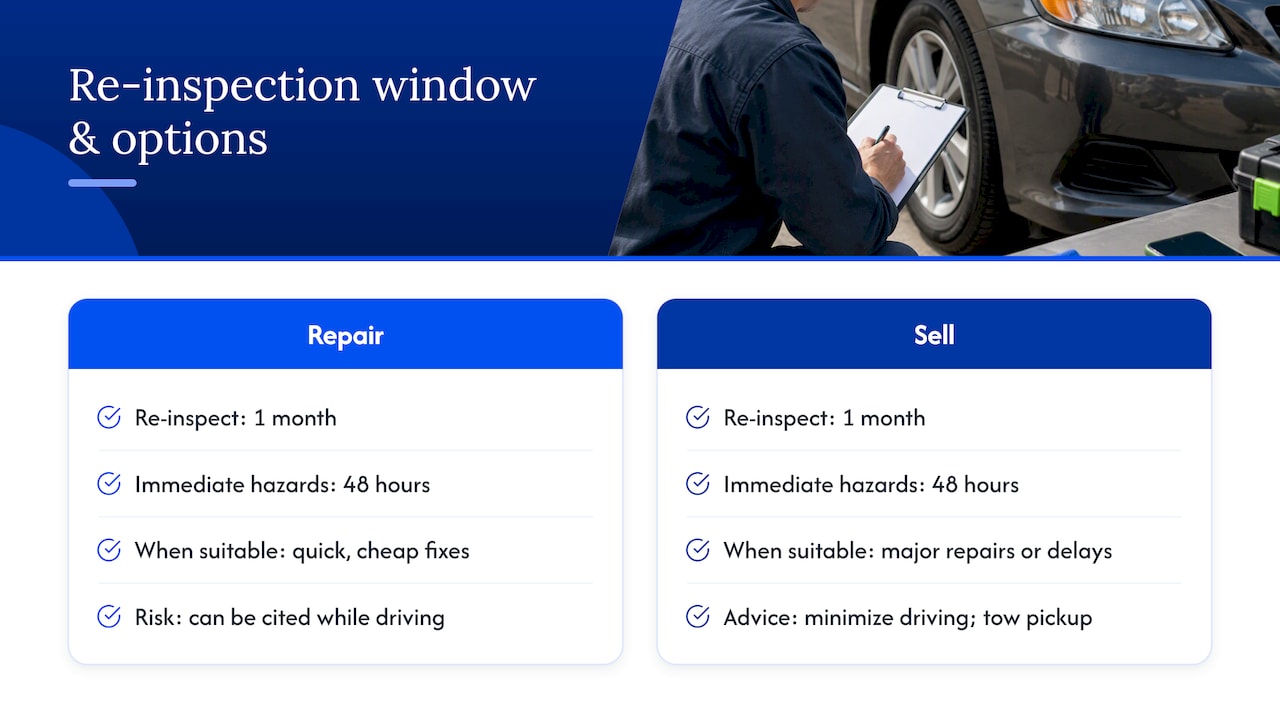
A failed inspection sticker in New Jersey doesn’t mean the car is permanently off the road, but it does come with a deadline. According to NJ MVC’s failed inspection guidance, you generally have until one month from the last day of the month shown on your inspection sticker to get repairs done and return for a re-inspection. If the failure involves an immediate safety hazard, such as brakes that don’t function properly, the repair window shrinks to 48 hours.
That one-month allowance is an administrative grace period, not a shield from a traffic stop. The MVC’s own framing makes clear it governs when you need to return for re-inspection, not when or whether a police officer can cite you for driving on a failed sticker in the meantime. If you plan to sell the car rather than repair it, the safest approach is to minimize driving it on public roads at all, arranging pickup at your home or having a tow service move it instead.
This window also shapes your decision between repairing and selling. If the fix is quick and cheap, say replacing a headlight or wiper blade, repairing before the deadline and reselling a passing vehicle is usually worth the short delay. If the failure points to something larger, like emissions system faults or suspension problems, the 30-day window can pass quickly once you factor in parts availability and shop scheduling, which pushes many owners toward selling as-is instead.
Law enforcement risk and fines for driving on a failed sticker
Beyond the MVC’s repair deadline, there’s a separate and more immediate risk: getting pulled over. Driving with an expired or failed inspection sticker is something law enforcement can cite you for, independent of whether you’re still inside your repair window with the MVC. According to NJ MVC’s inspection FAQ, fines for this kind of citation generally range between $100 and $200, and repeated or unresolved violations can lead to registration consequences.
This is one of the clearest reasons to avoid treating the one-month repair window as a free pass to keep driving normally. A failed sticker is visible on your windshield, and officers can and do cite vehicles for it during routine stops, not just when pulled over for another violation.
If you’re planning to sell rather than repair, this risk is also a practical argument for choosing a buyer who will pick the car up rather than one who expects you to drive it to a meeting point. Limiting your mileage on a failed-inspection vehicle reduces both the chance of a citation and the chance of a secondary mechanical failure making things worse before the sale closes.
Typical repairs that fail New Jersey inspections
New Jersey’s inspection checks a defined set of safety and emissions systems, and certain failures show up more often than others. Brake system issues, including worn pads, low fluid, or uneven braking, are among the most common safety failures. Tire tread depth below the legal minimum and visible sidewall damage also trigger failures regularly, as do non-functioning headlights, taillights, or turn signals.
On the emissions side, a check engine light that’s on, a missing or damaged gas cap, or a failed OBD (onboard diagnostics) readiness check are frequent causes. Exhaust leaks and a missing or tampered catalytic converter also show up as failure points, particularly on older vehicles.
Windshield wipers that don’t clear the glass properly, a cracked windshield obstructing the driver’s view, and horn malfunctions round out some of the simpler, cheaper fixes that still cause failures. Knowing which category your failure falls into, safety versus emissions, matters because the repair paperwork requirements differ: emissions repairs need an Emission Repair Form and receipts for reinspection, while straightforward safety fixes like a bulb replacement generally don’t.
What common failed-inspection repairs tend to cost
Repair costs vary by vehicle and shop, but some patterns hold across most failed-inspection fixes. A single burned-out headlight, taillight, or turn signal bulb is one of the cheapest repairs, often requiring only the part itself and a few minutes of labor. Wiper blade replacement and a basic horn repair fall into a similar low-cost category.
Brake jobs cost more, since pads, rotors, and fluid service each add to the bill, and the price climbs further if calipers or lines need attention. Tire replacement costs depend heavily on how many tires fail tread requirements and the vehicle’s tire size.
On the emissions side, a loose or damaged gas cap is an inexpensive fix, but a catalytic converter replacement is one of the more expensive repairs a failed inspection can trigger, particularly on vehicles where the part has been stolen or damaged, a known issue that has pushed converter theft rates up in recent years. A reliable shop can usually tell you within a visit or two which category your repair falls into, which is the key number to know before deciding whether fixing the car makes more financial sense than selling it as-is. For a general sense of what independent repair shops check and typically charge, this pre-purchase inspection overview breaks down common line items buyers and sellers both run into.
How a failed inspection affects resale value and negotiation
A failed inspection sticker changes the negotiation from the moment a buyer sees it. Private buyers tend to assume the worst about an unexplained failure, so being specific about the exact reason, rather than leaving it vague, usually works in your favor. A car that failed because of a cracked taillight lens reads very differently to a buyer than one that failed for emissions or brake issues, even though both are “failed inspections” on paper.
Expect buyers to factor the cost of repairs into their offer, and expect that factoring to run higher than the actual repair bill, since buyers typically build in a cushion for the inconvenience and uncertainty of fixing it themselves. This is where disclosing the specific issue helps you negotiate from facts rather than assumptions. If you’ve already gotten a repair quote, sharing it can anchor the conversation to a real number instead of a buyer’s guess.
For vehicles with more serious failures, especially anything tied to frame integrity, airbags, or a branded title, the negotiating room narrows considerably, and a private sale may take longer to close at a price that reflects the real condition. In those cases, a cash buyer who evaluates the car as-is and makes an offer without requiring repairs first can save weeks of back-and-forth with private buyers who keep asking for a lower price as they learn more about the failure.
Commercial vehicles face a different inspection path than private cars
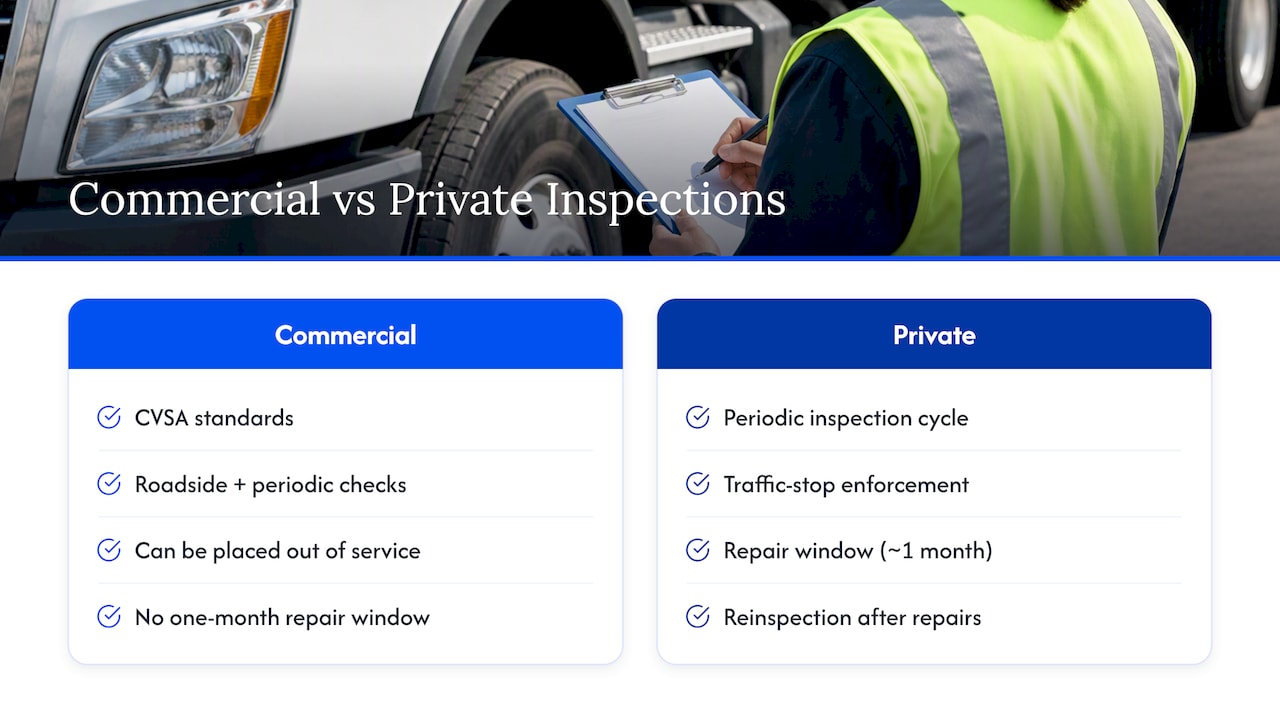
New Jersey treats commercial vehicle inspections differently from private passenger car inspections, and the gap matters if you’re selling a work truck or van that failed. Commercial vehicles, including those over a certain weight threshold, go through inspections tied to Commercial Vehicle Safety Alliance standards and are subject to roadside inspections by state police in addition to the standard periodic inspection cycle private vehicles use.
A commercial vehicle that fails roadside inspection can be placed out of service immediately, which is a more severe and immediate consequence than the one-month repair window private vehicle owners get for a routine sticker failure. That out-of-service designation affects how quickly you can realistically sell the vehicle, since it may need to be transported rather than driven even short distances.
Private vehicle owners dealing with a standard failed sticker have more flexibility: the repair window and reinspection process described earlier apply, and enforcement is generally limited to traffic stops rather than proactive roadside checks. If you’re selling a commercial vehicle that failed inspection, expect buyers (particularly other small business owners or fleet operators) to ask pointed questions about out-of-service history, since that status can follow a vehicle’s record and affect resale value more than a routine private-car failure would.
Choosing fast cash, a private sale, or parts based on your situation
My rule of thumb after seeing how these decisions play out: if you need cash now, a cash buyer who picks up the car and handles the paperwork is the practical choice. If the car is in decent shape and you have a few weeks, a private sale as-is can bring more money. If the damage is extensive, selling for parts or salvage usually beats sinking more into repairs.
— Eric
Get a guaranteed cash offer for your failed-inspection vehicle
If your car failed inspection and you need cash without repairs, listings, or buyer meetups, some services offer on-site vehicle evaluations with cash offers and handle paperwork to simplify the process. This works well for New Jersey sellers whose car has an expired or failed sticker, a non-running vehicle, or repair costs that make fixing it not worth the trouble.
- Who this fits: NJ owners who want cash now rather than weeks of private-sale back and forth.
- What to have ready: your signed title, current registration, and a photo ID.
- How to start: request an on-site offer and we’ll schedule pickup around your timeline.
| What you get | Detail |
|---|---|
| Offer type | Guaranteed cash at pickup |
| Paperwork | Handled by our team |
| Vehicle condition | Running or non-running accepted |
Start by requesting your offer on our Sell Your Car page, and for non-running vehicles specifically, our cash for clunkers near me page covers pickup logistics for cars that can’t be driven.
FAQ
How long do I have to fix a failed inspection in New Jersey?
You generally have until one month from the last day of the month shown on your inspection sticker to repair the issue and return for re-inspection. Immediate safety hazards, such as non-functioning brakes, require repair within 48 hours instead.
Can I sell a car in NJ that failed inspection?
Yes, selling a car that failed inspection is legal in New Jersey as long as you disclose the failure and complete the title transfer correctly. Private sales are typically “as-is,” so an honest description of the failure protects both you and the buyer.
What happens if the buyer doesn’t transfer the title in time?
The buyer has 10 working days to complete the transfer at a motor vehicle agency, and missing that window carries a $25 penalty according to NJ MVC’s transfer guidance. If the sale falls apart before the transfer completes, the seller may need a title correction, which generally costs $60.
Will I get less money for a car that failed inspection?
Buyers typically factor in the cost of repairs when making an offer, often assuming a higher cost than the actual fix requires. Sharing a specific repair quote or the exact reason for the failure usually helps you negotiate from facts rather than a buyer’s worst-case guess.
Does Tri State Cash For Cars buy vehicles that failed inspection?
Some cash buyers evaluate vehicles on-site, including those with a failed or expired inspection sticker, and provide cash offers that they commit to paying at pickup. They may also handle the paperwork at pickup rather than requiring repairs or re-inspection first.
Sources
- NJ MVC | What If My Vehicle Failed Inspection?
- NJ MVC | Transferring vehicle ownership
- NJ MVC | Title corrections
- NJ MVC | Reinspection at state inspection facilities