How to Sell a Financed Car in New York
Yes, you can sell a financed car in New York. The lender holds a lien on your title until the loan is paid, so the sale has to do two things at once: pay off what you owe and move the title to the buyer. If the sale price is higher than your payoff, you keep the difference. If it is lower, you cover the gap. Everything else in this guide is how to do that cleanly, in the right order, without getting stuck holding a car you no longer own and a loan you still owe.
TL;DR
- A loan puts a lien on your car. You can still sell it, but the payoff has to be settled so the lien is released and the buyer gets a clean title.
- Ask your lender for the payoff amount. It is often different from the balance on your statement. Subtract it from your car’s value to find your equity.
- Positive equity means the extra money is yours. Negative equity means you pay the shortfall, or you risk making it more expensive by rolling it into a new loan.
- New York expects lenders to deliver the lien release within three business days of payment clearing, but a lien-free title mailed by DMV can take far longer.
- A cash buyer that handles the paperwork and pays at pickup can shorten the whole process. Tri State Cash For Cars does this for New York sellers.
Table of Contents
- What a lien means when you sell
- Step 1: Get your real payoff amount
- Step 2: Work out your equity
- If you have positive equity
- If you have negative equity
- Who can buy a financed car
- The paperwork for a financed car in New York
- How the lien release works, and how long it takes
- Selling a car you only just financed
- Selling to Tri State Cash For Cars
- Our view: the payoff is the whole job
- Mistakes that cost sellers money
- FAQ
- Sources
What a lien means when you sell
When you finance a car, the lender takes a security interest in it. New York’s Department of Financial Services explains that a vehicle loan creates a lien, the lender’s security interest, until the debt is fully repaid. The lien is usually held by the bank or finance company that lent the money, and it is listed on the title and in DMV records.
In practice, that means you are not the only party with a say in the sale. A buyer will not want a car with someone else’s claim on it, and DMV will not give the buyer a clean title until the lien is cleared. The sale itself is not blocked. The money just has to reach the lender first.
If you want the deeper walkthrough of our process for this exact situation, we cover it in selling a car with a lien in New York.
Step 1: Get your real payoff amount
Start by calling or logging in to your lender and asking for a payoff quote. Do not use the balance on your monthly statement. The Consumer Financial Protection Bureau says the payoff can differ from the statement balance because of interest calculation, late fees, other charges, or another reason. Capital One’s guidance adds that prepayment penalties can also play a part, and that each lender has its own procedure for selling a car with an outstanding loan, so contact the lender before you list or schedule anything.
When you call, ask these things:
- What is the payoff amount, and until what date is that quote good?
- What is the daily interest amount after that date?
- Is there a prepayment penalty?
- Where and how should the buyer send the payoff: wire, cashier’s check, or in person at a branch?
- How long after payment will you release the lien, and in what form (paper or electronic)?
- Who do I contact if the release is late?
Write down the name of the person you spoke with and the date. If a release gets delayed later, that note helps.
Step 2: Work out your equity
Equity is what the car is worth minus what you owe. Capital One gives the formula as vehicle value minus payoff amount: a positive number is positive equity, and a negative number means the car is worth less than the debt.
For the value side, the CFPB recommends comparing the payoff quote with the car’s actual cash or trade-in value, using multiple valuation sources and local comparable listings. One online estimate is a starting point, not a number. Look at what similar cars with similar mileage are listed for near you, then remember that a cash buyer’s offer will sit below a retail listing price because the buyer has to resell the car.
Two illustrative examples (made-up numbers, to show the math):
| Example A | Example B | |
|---|---|---|
| Offer for the car | $18,000 | $14,000 |
| Lender payoff | $12,500 | $17,000 |
| Equity | +$5,500 | -$3,000 |
| What happens | Lender is paid $12,500; you receive $5,500 | You bring $3,000 to close the loan |
In Example A, the sale is simple. In Example B, you have a decision to make, covered next.
If you have positive equity
This is the easy case. Capital One notes that when the buyer pays more than the payoff, the buyer could pay you the remaining amount separately. So the payment is split: one amount goes to the lender, the rest goes to you.
The same source says a lender may require the buyer to pay the payoff at a bank or credit-union branch. That is why the lender’s instructions come first. If your lender insists on a branch payment, plan the meeting around the branch’s opening hours, not around the buyer’s convenience.
If you have negative equity
Negative equity is common, especially on a car financed recently, because cars lose value fastest early on while early loan payments go mostly to interest. The Federal Trade Commission describes it as the car being worth less than the outstanding loan, where a seller may need to pay the shortfall or have it included in replacement financing.
You have three realistic options:
- Pay the gap in cash. You hand the lender the difference at closing. It is the cleanest option, and it ends the debt.
- Get a personal loan for the gap. Compare the rate with your current auto loan before you do this, and read the terms.
- Roll it into your next car loan. This is the option to be most careful with. The FTC warns that rolling negative equity into a new auto loan increases the amount financed, and interest accrues on the carried-over shortfall. You end up paying interest on a car you no longer have.
If the gap is small, waiting a few months and making extra principal payments may close it. If you need to sell now, a higher offer matters more than usual, because every dollar of the offer reduces the gap dollar for dollar. That is a reason to get more than one offer.
Who can buy a financed car
Three kinds of buyers handle financed cars. They differ mostly in speed, effort and how much risk lands on you.
| Route | How it works with a lien | Speed | Effort for you |
|---|---|---|---|
| Dealership trade-in or purchase | Dealer pays off the lender and handles title work | Fast | Low |
| Private buyer | You and the buyer coordinate the payoff and title release | Slow | High |
| Cash car buyer | Buyer pays at pickup, handles paperwork, settles the lien | Fast, often same day | Low |
Dealerships are convenient, particularly if you are buying another car from them. The tradeoff is price: a trade-in offer is often lower than what you can get elsewhere, and a negative balance can get folded into the next loan, which is the situation the FTC warns about above.
Private buyers can pay the most, but this is the hardest route with a lien. The buyer has to trust that you will deliver a clean title after they hand over money, and you have to trust them with a car you may not have been paid for yet. Meeting at your lender’s branch solves much of this, because the payoff and the handover happen in the same place. Expect screening calls, test drives and no-shows along the way.
Cash buyers sit in between. You get a firm offer, the buyer comes to you, and the paperwork is handled. For a financed car, the useful questions to ask any cash buyer are whether the offer is guaranteed, whether it holds at pickup, and how the lender gets paid.
We lay out the comparison in more detail in our guide to the options to sell your car.
The paperwork for a financed car in New York
The documents depend on whether the lien is still on the title when you sell.
For any ordinary New York sale, DMV requires the seller to complete and sign the transfer section on the title and sign a Vehicle Bill of Sale, form MV-912, even for a gift. The buyer then takes those documents to a local DMV office to title and register the car. Our page on the New York bill of sale covers how the MV-912 fits into a same-day sale.
With a lien, add proof the lien is gone. DMV says that when you sell, you can give the buyer the original title and the original lien release. If you want the lien removed from the title first, DMV requires the original proof of satisfaction, the original title and a $20 check or money order.
Here is the checklist:
- Payoff quote and payment instructions from your lender.
- Original title (or, if the lender holds it, the lender’s process for releasing it).
- Lien release or proof of satisfaction once the loan is paid.
- Signed title transfer section.
- Signed MV-912 bill of sale.
- Your ID.
If you cannot find the title, or the lender has not sent it, see our pages on proof of ownership in New York and selling a car without a title. For the signature and notarization details, read about New York title transfer forms.
How the lien release works, and how long it takes
After the payoff clears, the lender has obligations. DFS says that New York requires the lienholder to execute and deliver the lien release and notify DMV that the loan is paid in full. New York regulation 15 NYCRR 20.17 says that once a lien is satisfied, the lienholder must immediately submit the notice of recorded lien showing satisfaction to the title holder or the holder’s designee.
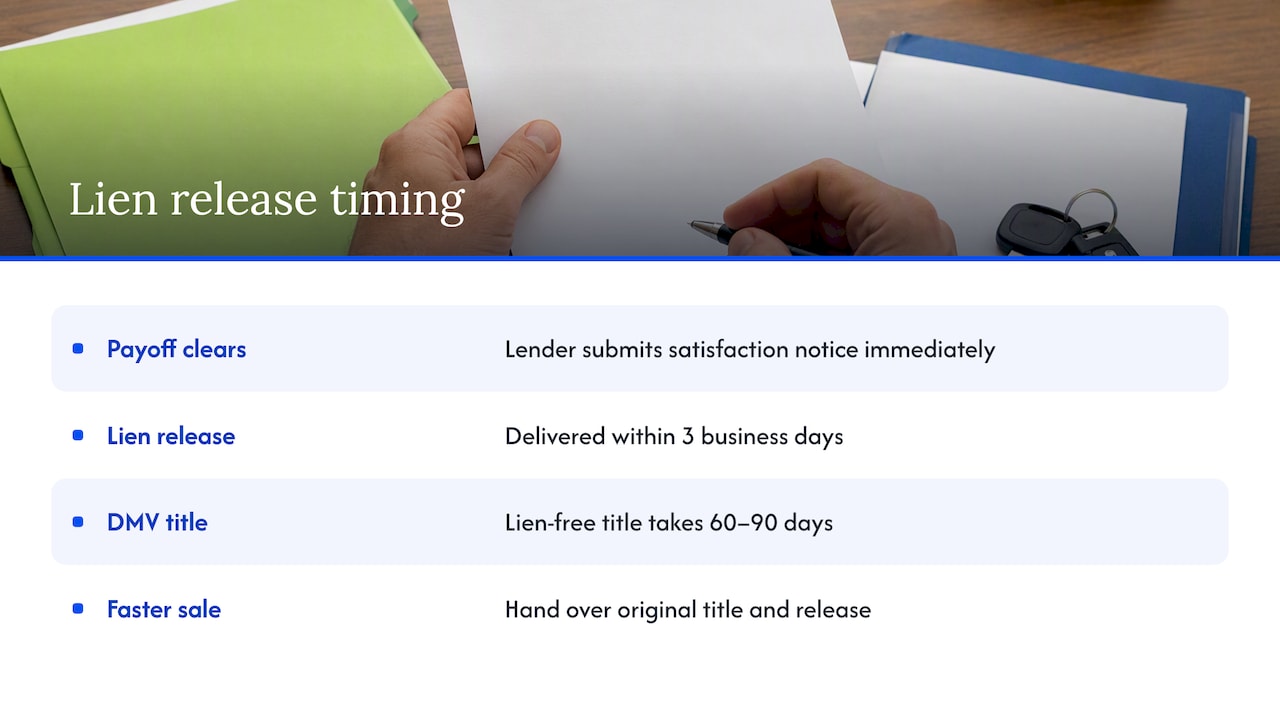
On timing, DFS says regulated lenders should deliver the release no later than three business days after payment clears. It also warns that delays in mailing or delivery cause problems for purchasers and dealers, since a delayed release can keep the buyer from registering and legally operating the car.
There is a second clock to know about. If you ask DMV to remove the lien and mail you a lien-free title, DMV says that can take 60 to 90 days. That is a reason not to remove the lien yourself before a sale when a buyer is waiting: handing over the original title and the original lien release is the faster path.
If a lender drags its feet, the same regulation gives dealers a remedy. It allows a dealer that arranged the payoff to seek a duplicate or lien-free title from DMV if the lienholder fails to provide satisfaction paperwork, subject to notice, application, consent and payoff-document requirements. That is one more reason to sell to a buyer who deals with these transfers regularly.
Selling a car you only just financed
Nothing in the research we reviewed bars a quick resale in New York. What matters is the math. A car financed within the last few months usually has little or negative equity, since the value drop in the first months can outrun your payments, particularly if you put little down or financed fees and add-ons. Get the payoff quote, get at least two offers, and check the result before you commit.
Also read your loan contract for early-payoff terms, and ask your lender directly about prepayment penalties. If you bought the car from a dealership and want to reverse the deal, that is a separate question for the dealer or a consumer attorney, and not something a car buyer can fix.
Leased cars are different: you do not own them, so the lessor decides how a buyout works. See our guide to selling a leased car in New York.
Selling to Tri State Cash For Cars
We buy cars from owners in New York, New Jersey and Connecticut, including cars that still have a loan. The offer is guaranteed: we commit to paying the price we quote at pickup. We come to you, handle the paperwork and pay cash on the spot, often the same day. We buy running and non-running vehicles, and cars with or without a title.
If you want to see where your car stands, start at our main page with the car’s details and your payoff amount in hand. Our car buying service process explains the six steps for selling safely when a loan is involved, and our Brooklyn page covers pickups in that borough.
Our view: the payoff is the whole job
We see the same pattern with financed cars. Owners worry about the buyer, the price and the paperwork, and the real work is the payoff. If you know the exact number, the lender’s instructions and how long the release takes, the rest follows. If you do not, the sale stalls, usually at the title.
So we tell sellers to do four things before they take any offer. First, get the payoff in writing and learn the lender’s payment rules. Second, compare offers on what you will actually walk away with, after the lender is paid. Third, make sure the buyer will honor the price at pickup, because a number that drops at your driveway is worse than a low number up front. Fourth, keep copies of everything you sign.
Our guarantee exists for that third point. People sell to us because they have been burned by a price that shrank at the last minute, and we would rather quote honestly and pay what we quoted.
— Eric
Mistakes that cost sellers money
- Using the statement balance as the payoff. It can be wrong, as the CFPB notes above.
- Letting the quote expire. Payoff quotes are good until a date, and interest adds up daily after it.
- Handing over the car before the lender is paid. A promise to pay later is not a payoff.
- Skipping the release. Without it, the buyer cannot clear the title, and the problem comes back to you.
- Rolling negative equity into the next loan without comparing. It raises the new loan and the interest on it.
- Cancelling insurance or returning plates too early. Check our guide to New York sale paperwork for private sellers for the order to do things in.
- Listing with a messy car. A clean, prepared car gets better offers. See how to prepare your car for sale.
FAQ
Can I sell a car I still owe money on in New York?
Yes. The loan puts a lien on the title, so the payoff has to be settled as part of the sale. Once the lender is paid, it must release the lien and tell DMV the loan is satisfied. Call the lender first, because each one has its own procedure.
What if I owe more than the car is worth?
Then you have negative equity, and you have to cover the shortfall yourself or have it included in new financing. The FTC warns that rolling it into a new loan means paying interest on the carried-over amount. Getting a higher offer is the most direct way to shrink the gap.
Do I get the extra money if the car sells for more than the payoff?
Yes. The lender is paid the payoff amount and the remainder is yours. The buyer may pay you that amount separately from the payoff, depending on the lender’s rules for how the payoff is delivered.
How long until the lien is released?
DFS says regulated lenders should deliver the lien release no later than three business days after payment clears. Mailed paperwork can be slower. If you ask DMV for a lien-free title instead, it can take 60 to 90 days, so use the lender’s original release for a faster sale.
Sources
- New York Department of Financial Services: How to obtain a lien release on a vehicle
- NY DMV: Add or remove a lienholder
- NY DMV: Buy, sell, or transfer vehicle ownership
- CFPB: Should I trade in my car if it’s not paid off?
- FTC: Auto trade-ins and negative equity
- 15 NYCRR 20.17: Satisfaction of liens
- Capital One: How to sell a financed car you still owe money on