NY Car Sale Paperwork for Private Sellers: Plates Before Insurance
Selling a car privately in New York requires a signed title transfer section, a completed Vehicle Bill of Sale (MV-912), and a plate surrender receipt (FS-6T) before you cancel insurance. Your immediate next step: sign and photocopy the title and MV-912, then hold onto the originals until the buyer files their registration paperwork.
TL;DR:
- Complete the bill of sale with the vehicle’s year, make, VIN, sale date, and price, and obtain both signatures to avoid DMV rejection.
- Model year 2011 and newer cars need signed odometer disclosure; damage disclosure applies to all vehicles, and DTF 802 Section 6 covers qualifying gifts or below market sales.
- Check for a lien before closing; if one remains, secure a written lender release and do not accept partial payment while the title is encumbered.
- Remove and surrender the plates before canceling insurance, then keep the receipt, because an insurance lapse can trigger registration suspension.
- Photocopy every signed page before handing over originals, and keep copies of the title, bill of sale, and plate surrender receipt for at least a year.
Table of Contents
- The complete checklist for a private NY car sale
- How to fill out MV-912, MV-82, MV-103, and DTF-802 correctly
- What stops a title transfer cold
- Plates, insurance, and the order that keeps you out of trouble
- After the handshake: records, letters, and the buyer’s next steps
- What sellers get wrong on paperwork day
- The paperwork problem nobody mentions until it’s too late
- Skip the paperwork entirely with a same-day cash sale
- FAQ
- Sources
The complete checklist for a private NY car sale
Before you meet a buyer, gather every document the New York DMV expects to see. Missing even one field can send a buyer back to you weeks after the handshake.
- Certificate of Title: complete the transfer section on the back, with both signatures and the odometer reading.
- Vehicle Bill of Sale (MV-912): fill in year, make, VIN, sale date, and purchase price, signed by both parties.
- Odometer and damage disclosure: required on the title itself or on a separate MV-103 for vehicles built in 2011 or later.
- Statement of Transaction (DTF-802): needed for sales tax reporting, with Section 6 completed by the seller for gifts or below-market sales.
- MV-82 (Registration/Title Application): the buyer files this, but it needs your signed title and bill of sale attached.
- Plate surrender paperwork (PD-7 and FS-6T): your proof that you’ve removed yourself from the registration.
- Lien check: confirm the title is free and clear, or get a written lien release before accepting payment.
Keep a folder with all of these together. A buyer who shows up prepared moves faster through the DMV line, and so do you.
How to fill out MV-912, MV-82, MV-103, and DTF-802 correctly
The MV-912 bill of sale only works if it has five pieces of information: the vehicle’s year and make, the VIN, the date of sale, and the purchase price. Both the buyer and seller sign it, and the DMV will not process a title transfer without that signature pair in place.
The MV-82 application is the buyer’s job, not yours, but it only moves forward with your completed title and bill of sale attached. A single crossed-out VIN or an altered purchase price on the title is grounds for rejection, so double-check before you hand anything over.
Odometer disclosure rules depend on the vehicle’s age. Cars from model year 2011 or newer require a signed odometer statement, either on the title itself or on a standalone MV-103 form when the title has no odometer section. Damage disclosure, by contrast, applies to every vehicle regardless of age. Our guide on odometer disclosure in NY walks through the exact fields that trip up most sellers.
The DTF-802 Statement of Transaction determines what the buyer pays in sales tax, and you, as the seller, complete Section 6 only when the sale is a gift or priced below fair market value to a qualifying relative or other party. Skipping this section when it applies can delay the buyer’s registration and create tax questions later.
- Use black or blue ink only, and never correct a mistake with white-out.
- Print names legibly next to every signature line.
- Photocopy every signed document before the buyer leaves with the originals.
A bill of sale missing any of the five required fields is grounds for DMV rejection, which means a trip back to you for a corrected signature.
What stops a title transfer cold
A lien is the most common dealbreaker. Check the front of the title for a lienholder’s name, and if one appears, you need a written, bank-issued lien release before the sale can close. Coordinating a payoff at the closing table, so the lender releases the title directly, often solves this without delay.
A missing title is the second major blocker. You’ll need a duplicate title or acceptable proof of ownership before you can sign anything over, a process our duplicate title guide covers in detail.
Out-of-state titles bring extra requirements and longer processing windows at the DMV, so plan ahead if your car was last registered outside New York.
- Never accept partial payment while a lien remains unresolved on the title.
- Always get the lien release in writing, not a verbal promise from the seller or lender.
Pro Tip: Don’t hand over keys or sign anything until you’ve confirmed the lien status in writing. A verbal “it’s paid off” from the other party is not a release.
Plates, insurance, and the order that keeps you out of trouble
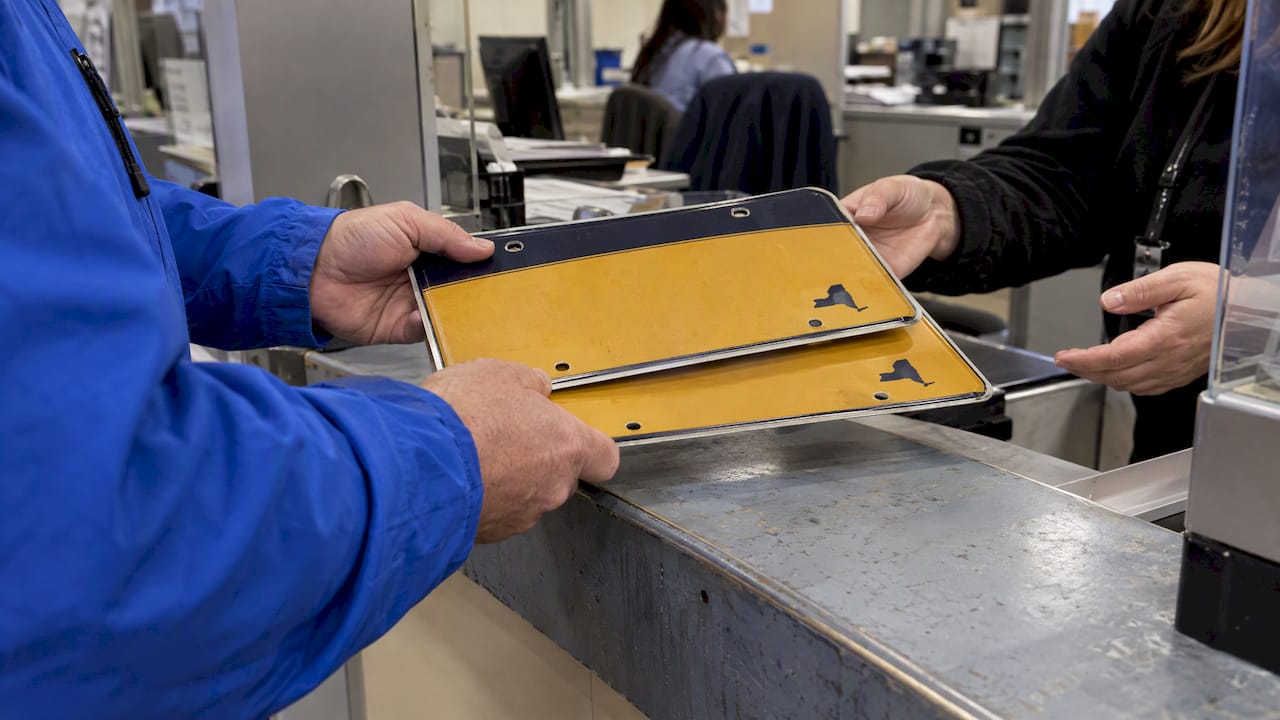
The sequence matters more than most sellers realize. Remove your plates from the vehicle, complete a PD-7 form, and surrender the plates either by mail or in person at a DMV office to receive your FS-6T receipt.
- Remove the plates from the vehicle before the buyer drives away.
- Complete the PD-7 surrender form with your registration details.
- Mail the plates to the DMV or surrender them at a county office.
- Keep the FS-6T receipt as your proof the registration is closed.
Canceling insurance before you have that FS-6T receipt is the single most common mistake sellers make. The DMV can suspend your registration automatically on an insurance lapse, and an unresolved suspension can escalate to a license suspension if you don’t address it. County offices may also charge a $1 processing fee for in-person plate surrender. Our plate surrender walkthrough covers mailing addresses and typical turnaround times.
Two-year registrations may qualify for a refund or transfer credit depending on how much time remains when you surrender, though some circumstances make you ineligible.
After the handshake: records, letters, and the buyer’s next steps
Keep copies of the signed title, bill of sale, and your FS-6T receipt for at least a year. If a DMV or insurance letter arrives asking about the vehicle, these documents are your proof the sale happened and your liability ended.
- Respond to any DMV insurance inquiry with your FS-6T receipt and bill of sale copy.
- Expect the buyer to register the vehicle and pay sales tax, with your completed DTF-802 feeding directly into that process.
- Buyer registration and title issuance typically take a few weeks once the paperwork is filed correctly.
- Store digital photos of every signed page as a backup to your paper copies.
What sellers get wrong on paperwork day
The most frequent errors we see at handoff are incomplete transfer fields on the title, a skipped odometer entry, and insurance canceled before the FS-6T receipt arrives. Each one creates a loose end that surfaces weeks later as a DMV letter or a buyer’s phone call.
A same-day cash sale removes most of this risk because the paperwork gets handled on the spot, with the transfer section, bill of sale, and plate surrender sequence checked before anyone leaves. Photographing the signed documents and the VIN during handoff, whether you sell privately or through a service, gives you a record if any question comes up later.
The paperwork problem nobody mentions until it’s too late
Most advice on selling a car in New York treats paperwork as an afterthought, something to handle after you’ve agreed on a price. That ordering is backward. The forms determine whether a sale closes cleanly or drags into a second DMV trip, a lien dispute, or a registration letter six weeks later.
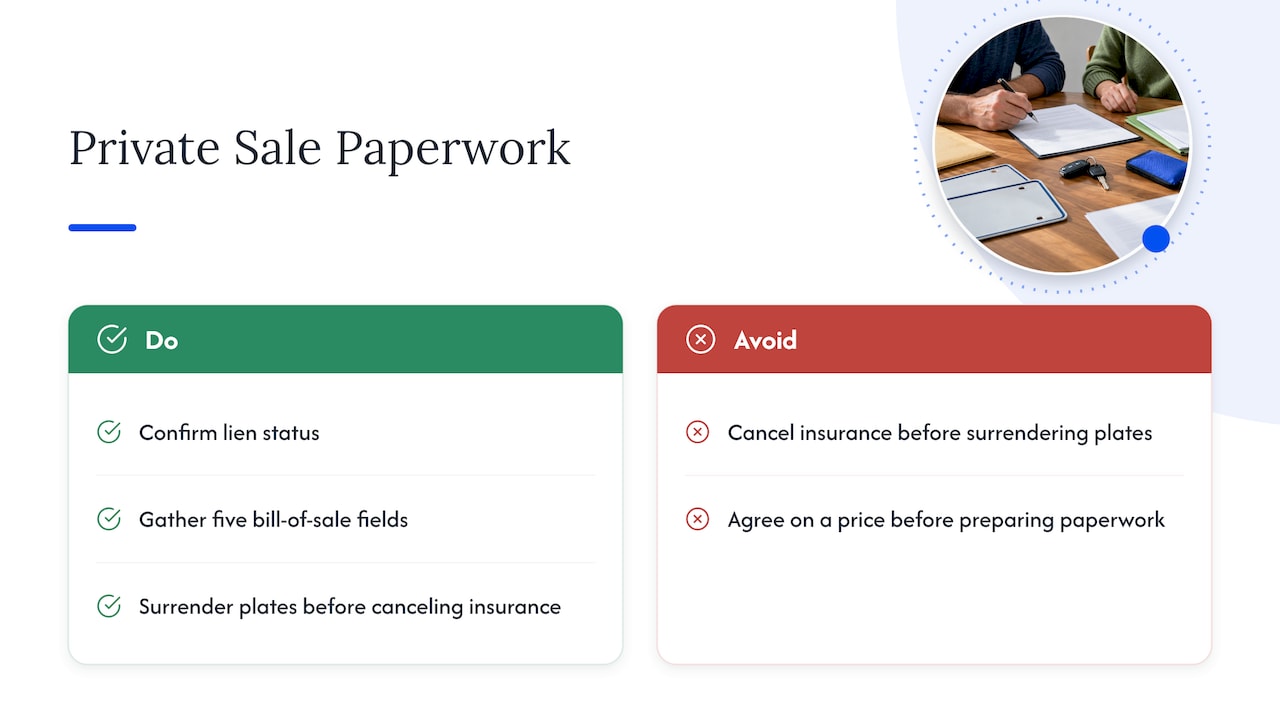
The piece sellers underestimate most is the plate and insurance sequence. People assume canceling insurance the moment the car leaves the driveway is responsible. It’s actually the step most likely to trigger a registration suspension if you haven’t surrendered your plates first. The FS-6T receipt isn’t paperwork for its own sake, it’s the only thing that proves your liability ended.
If you take one thing from this: confirm the lien status and gather your five bill-of-sale fields before you ever agree on a price with a buyer. Everything else in the process is faster once that foundation is set.
— Eric
Skip the paperwork entirely with a same-day cash sale
If the checklist above sounds like more than you want to manage, we handle it for you. We send a team to your location, give you a cash offer, and manage the title transfer, bill of sale, and plate surrender paperwork on the spot, with payment guaranteed at the price we quote.
- We complete the MV-912 and title transfer fields with you before any money changes hands.
- We help you avoid a second DMV trip by checking liens and odometer entries upfront.
- Cash in hand typically happens quickly once paperwork is signed.
This matters most for sellers who want the title and plate surrender done correctly without learning DMV form numbers first. Start with our Sell Your Car page, or if you’re in Brooklyn, our Brooklyn sell your car page sets up same-day pickup in your neighborhood.
FAQ
What paperwork do I need to sell my car privately in New York?
You need a signed Certificate of Title with the transfer section completed, a Vehicle Bill of Sale (MV-912) with the five required fields, and an odometer disclosure if the vehicle is a 2011 model year or newer. You’ll also want to surrender your plates for an FS-6T receipt once the sale closes.
What paperwork is needed to buy a car from a private seller in NY?
Buyers need the seller’s signed title and bill of sale, plus an odometer disclosure where required, to file an MV-82 registration application at the DMV. They’ll also complete a DTF-802 Statement of Transaction to report the sales tax owed on the purchase.
Can you write your own bill of sale in NY?
New York’s DMV accepts the standard MV-912 form for private sales, and using it is the simplest way to guarantee your bill of sale includes every required field. A handwritten bill of sale can work if it contains the same year, make, VIN, date, and price details with both signatures, but the official form avoids missing information.
Do both parties need to be present to transfer a title in NY?
Both the buyer and seller need to sign the title transfer section and the bill of sale, though they don’t need to sign in the same room at the same time. What matters is that every signature and required field is complete before the buyer submits the paperwork to the DMV.