How to Sell a Car in NYC: Paperwork, Payment and Pickup
To sell a car in New York City, you sign the title over, complete a bill of sale, take your plates off, and get paid in a way you can trust. You can do that yourself through a private listing, or hand the work to a cash buyer who comes to you, quotes a price and handles the forms. This guide walks through both routes, the paperwork New York actually requires, and the mistakes that cost sellers money or leave them liable for a car they no longer own.
TL;DR
- New York sellers sign the transfer section of the title and a Vehicle Bill of Sale (MV-912). Both buyer and seller sign the bill of sale.
- Take your plates off at the sale unless you are moving them to another car, and keep your insurance active until the bill of sale is signed.
- Prefer a cashier’s check made out to you over a pile of bills, and meet in a public, well-marked place.
- Non-running, damaged or older cars can be sold as-is. Be honest about the problems and the price stays fair.
- If you would rather skip listings, strangers and test drives, we buy cars across NYC and guarantee the quoted price at pickup.
Table of Contents
- Choose how you want to sell
- Get the car and the facts ready
- The New York paperwork, step by step
- Plates, insurance and telling the DMV
- Inspection: who is responsible
- Selling a car that does not run
- Getting paid safely
- Check the offer before pickup
- Sell to us, and we come to you
- Our view on selling in the city
- FAQ
- Sources
Choose how you want to sell
NYC sellers usually pick from three routes, and the right one depends on how much time you have and what shape the car is in.
| Route | Typical speed | Your effort | Best for |
|---|---|---|---|
| Private sale (online listing, street sign) | Days to weeks | High: photos, messages, test drives, all paperwork | Clean, running, in-demand cars when you are not in a rush |
| Dealer trade-in or dealer offer | Same day to a few days | Low | Buying another car from the same dealer |
| Cash car buyer with pickup | Often same day | Low: quote, pickup, signatures | Fast sales, non-running or damaged cars, no street parking hassle |
The private sale can bring the highest sticker price, but in a city where many people park on the street, the work is real. Every buyer wants to see the car, and every no-show is an hour of your day. A trade-in is simple but tied to the dealer’s purchase. A cash buyer sits in the middle: you give up the chance to haggle with a dozen strangers, and in return you get a firm number and a quick close. If speed is your priority, our page on fast car sale options in NY, NJ and CT compares quick-cash timelines with slower routes that may pay more.
Get the car and the facts ready
Before you ask anyone for an offer, spend twenty minutes collecting the details that decide price.
- Year, make, model, trim and mileage. Read the odometer, and take a photo of it.
- VIN. It is on the dashboard near the windshield and on the driver’s door jamb. It must match your title.
- Title status. Do you have the title in hand? Is there a lien listed? We cover both below.
- Condition, honestly. Note warning lights, leaks, body damage, a bad transmission or a dead battery. The BBB advises sellers to sell as-is and be upfront about mechanical problems, and to compare cars with the same make, model, year and mileage when checking value.
- Your floor price. The BBB suggests deciding in advance the lowest amount you will accept and sticking to it. Write it down before the first call.
A clean car photographed in daylight does help in a private sale. The DMV itself tells buyers to look over a vehicle in bright daylight for collision damage, rust and mechanical trouble, as noted in its warning about car sale scams. Assume any serious buyer will do exactly that, so hiding a problem only delays the price cut.
The New York paperwork, step by step
New York is not complicated, but it is strict about small errors. The state DMV explains that for most sales the seller signs the transfer of ownership section of the title and a Vehicle Bill of Sale (MV-912), and the buyer also signs the bill of sale, per the NY DMV’s buying and selling page.
Title: sign it right, once
Complete the “Transfer by Owner” section of the title, and do it at the moment of the actual handover. The DMV tells sellers not to fill in title information ahead of time, because mistakes can invalidate it. A title with cross-outs, erasures or alterations is voided and has to be replaced, which means a duplicate and a delay you did not plan for.
Things to check on the title before anyone arrives:
- Your name matches your ID.
- Nothing on it has been altered or corrected.
- Any lien listed has been satisfied, and you have the original lien release to hand over.
If you have lost the title, you cannot legally transfer ownership until you get a duplicate from the DMV, according to the DMV’s certificate of title guidance. Our guide to proof of ownership in NY covers what the DMV accepts, and title transfer forms and notarization explains how to avoid a second DMV trip.
Bill of sale
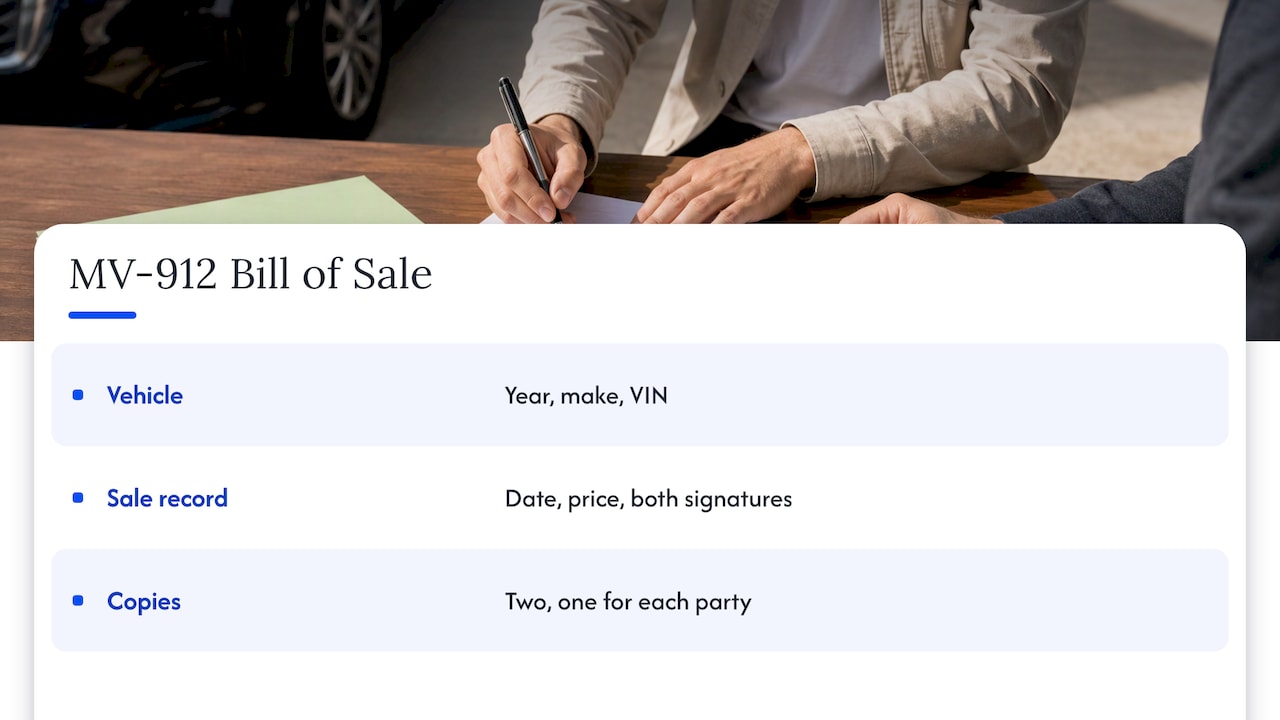
The MV-912 records the vehicle’s year, make and VIN, the date, the price and both signatures. Make two copies, one for each side. It is your proof of the date and price if a parking ticket, toll or accident shows up later with your name on it. Our page on MV-912, DTF-802 and same-day cash explains how the forms fit together in a private sale, including the sales tax form the buyer deals with at the DMV.
Odometer and damage disclosure
For a newer vehicle, an odometer disclosure statement is part of the transfer. The DMV’s MV-82.1 form states that vehicles of model year 2011 or newer transferred within 20 years of manufacture require one, and that a damage disclosure statement applies when the vehicle is 8 years old or newer. If you are unsure which form applies to your car, read odometer disclosure in NY and when MV-103 applies before the buyer shows up.
Selling a car with a loan
A lien does not stop a sale, but it changes the order of operations. The lender is paid from the proceeds, and the title or lien release has to reach the new owner. Two step-by-step pages cover this: selling a car with a lien in New York and how to sell a financed car in NY. Call your lender first for a payoff figure good through the day of sale, because interest accrues daily.
Plates, insurance and telling the DMV
This is where private sellers in NYC get burned. The car leaves, but your name is still attached to it.
- Plates. Plates belong to you, not the car. After the sale, you can transfer the registration and plates to another vehicle you own or surrender the plates to the DMV.
- Insurance. The BBB recommends keeping your policy active until the buyer has signed the bill of sale. Cancel the policy only after plates are off and the paper is signed, not before.
- Your records. Keep a copy of the signed bill of sale, a photo of the odometer, and a photo of the buyer’s ID if it is a private sale.
Our NY car sale paperwork guide lays out why plates come before insurance cancellation, and how to report a car sale in NY walks through the plates, title and bill of sale record you should leave with.
Inspection: who is responsible
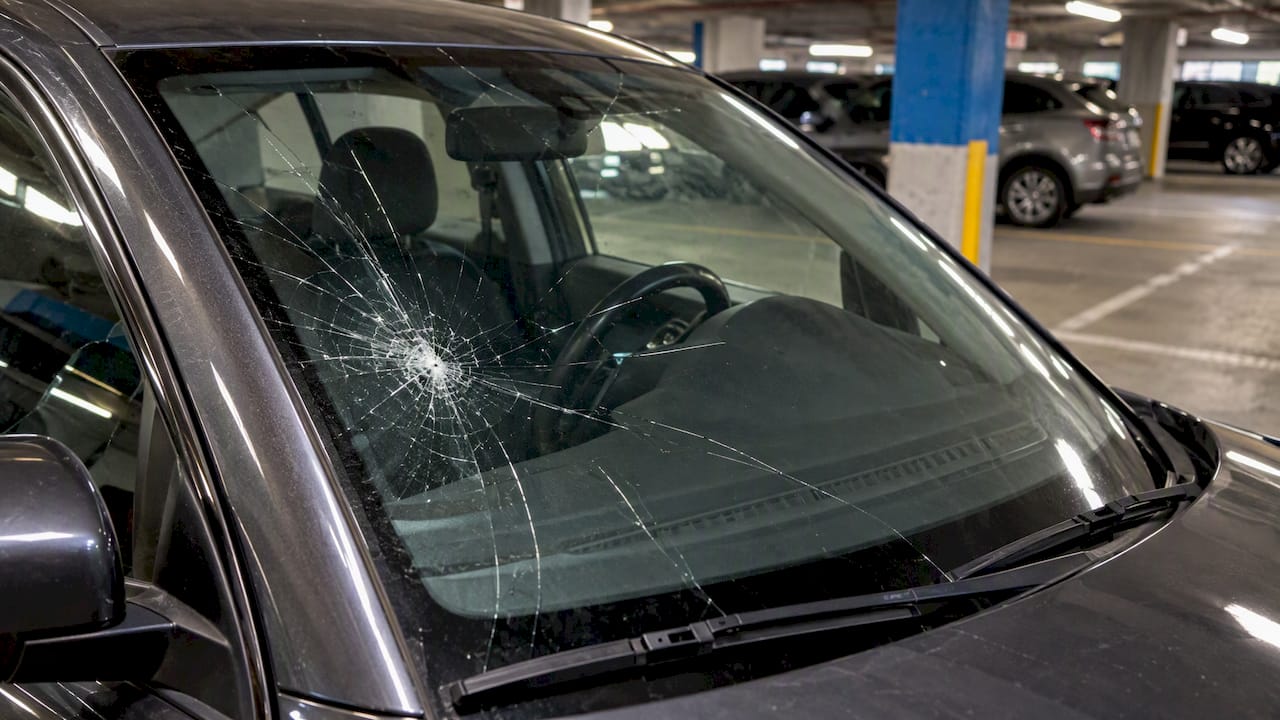
New York vehicles must be inspected every 12 months and when ownership transfers. The DMV says a private-sale buyer gets a 10-day inspection extension from registration, and that the previous registrant’s inspection is not valid for the new owner. In practice, the new owner handles the inspection after the sale. You do not need to fix a failed inspection to sell, but you should tell any buyer about problems that would make the car fail, such as an engine warning light or a cracked windshield.
Selling a car that does not run
A dead battery, a blown transmission, accident damage or a car that has sat for a year can all be sold. The approach is the same as for any as-is sale:
- Describe the problem plainly and note what you know about the cause.
- Share any repair paperwork, since the BBB notes that disclosing recent mechanical history helps build trust.
- Have the title ready. A non-running car with a clear title is far easier to price than one with questions attached.
- Ask whether the buyer collects the car from where it sits, since towing yourself costs money in NYC.
For cases without a title, or with an estate involved, see our guide to selling a tricky car for cash, including lost titles and estates. If you have an older vehicle that is not worth repairing, our cash pickup service quotes running and non-running vehicles alike.
Getting paid safely
Cash feels simple, but a large amount of it on a city sidewalk is a risk. The NY DMV’s advice for car sales is to use a cashier’s check made out to the seller instead of cash where possible, verify the other party’s credentials, and meet at a designated, signposted public exchange location.
A few habits that follow from that:
- Meet in daylight at a busy, well-marked spot. Bring a friend if you can.
- Do the bank step together. If the buyer pays with a cashier’s check, meet at the issuing bank so it can be verified before you sign.
- Sign last. Hand over the signed title and keys only after the payment is confirmed.
- Watch for pressure. The DMV warns about people who claim to be licensed dealers but have no place of business or use out-of-state dealer paperwork. A real buyer will not mind you checking.
- Expect VIN checks. The DMV tells buyers to compare the VIN on the car with the title and verify its status online. Sellers with clean paperwork have nothing to fear from that.
If you are accepting cash directly, count it at the bank counter rather than in the car, and deposit it that day.
Check the offer before pickup
Whether you sell privately or to a company, a few questions prevent surprises:
- Is the quoted price guaranteed at pickup, or an estimate that can be revised on the spot?
- Who handles the paperwork and the plates?
- How is payment made, and when?
- Does the buyer need the title in hand, or can it deal with a lien or a missing title?
- Is there any fee deducted from the offer, such as towing or processing?
Instant quotes are only as good as the details you enter. Our page on closing the gap in instant car offer accuracy explains which answers move a quote most, such as mileage, condition and title status. Enter them honestly and the number you see is the number you should get.
Sell to us, and we come to you
We buy cars, SUVs, trucks, vans and commercial vehicles from owners in New York, New Jersey and Connecticut. You tell us about the car, we give you a cash offer, and a team comes to your location. We commit to paying the price we quoted at pickup, and we handle the paperwork. We buy running and non-running vehicles, damaged and older ones, and we can work with or without a title.
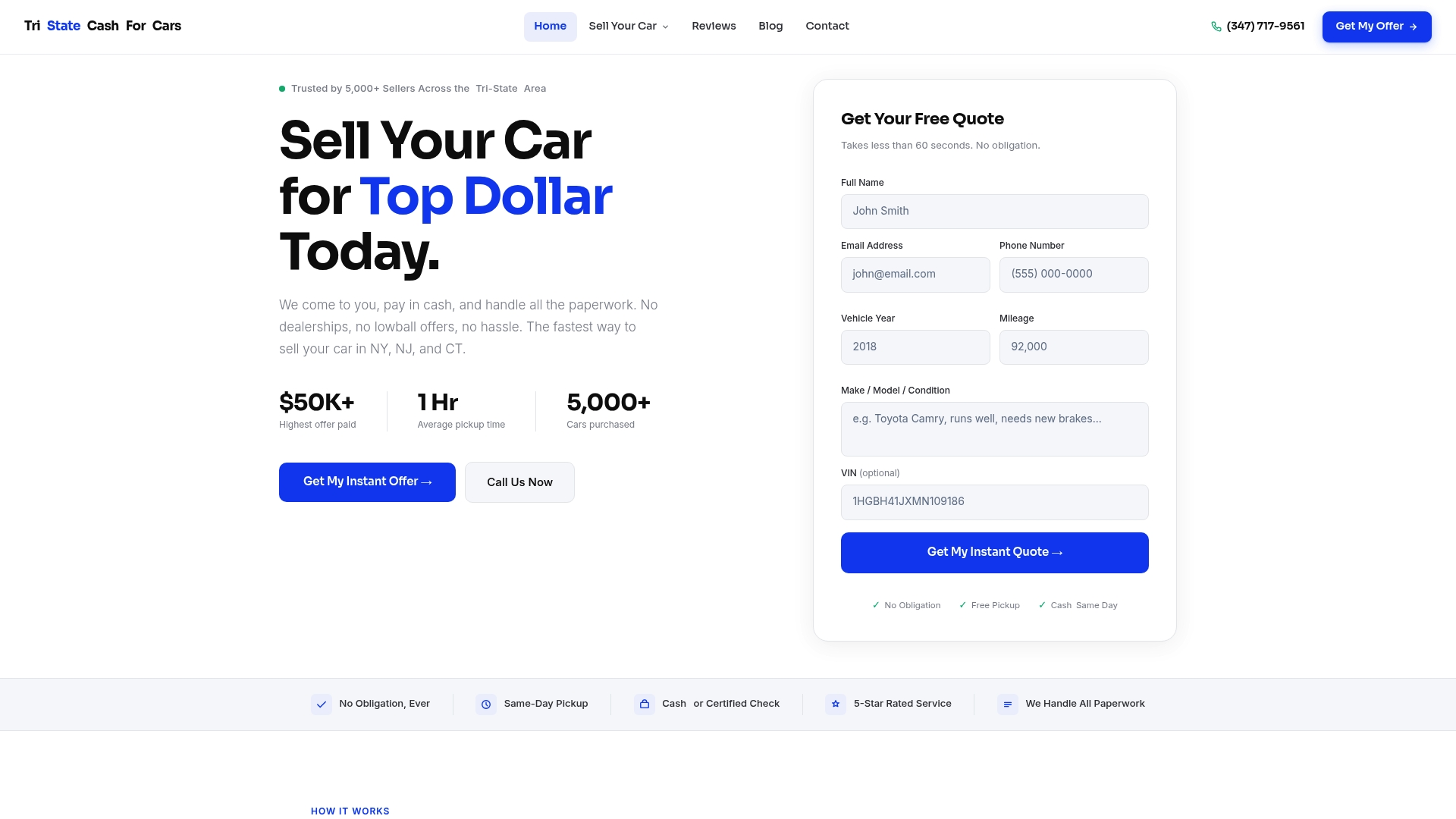
We designed the process for busy New Yorkers who do not want to run a listing for weeks: payment on the same day, no hidden fees, and no back-and-forth with strangers. You can see how it works in our six-step car buying process, or get your offer started here. Selling from Brooklyn? Our Brooklyn cash for cars page covers local details. If the car belongs to your business, see selling a company car in New York.
Our view on selling in the city
Most NYC owners we talk to are not trying to squeeze the last few hundred dollars out of a bidding war. They are trying to get a car off the street, off the insurance bill and out of their life without losing a week to it.
That is why we built our service around certainty. You get a quote, we commit to that price at pickup, and we do the paperwork that trips people up: the title section, the bill of sale, the plates. We believe a firm offer and a same-day close are worth more to most sellers than a maybe-higher number that may never show up.
Our aim is to beat what local dealers offer while skipping the listing, the test drives and the no-shows. If your car runs, great. If it does not, we still want to see it. Either way, you should know exactly what you will be paid before anyone touches your keys.
Eric
FAQ
Do I need the title to sell my car in NYC?
For a standard sale, yes: the seller signs the transfer section of the title. If yours is lost or stolen, the DMV requires you to get a duplicate before ownership can legally transfer. Some buyers, including us, can work with sellers who do not have a title in hand, so ask before you assume you are stuck.
What do I do with my license plates after selling?
Remove them at the sale unless you are moving the registration to another vehicle you own. Otherwise, surrender them to the DMV. Keep your insurance active until the bill of sale is signed, then cancel.
Can I sell a car in NYC if I still owe money on it?
Yes. Get a payoff amount from your lender, then arrange for the loan to be paid from the sale proceeds so the lien can be released. If a lien on the title was already paid off, give the buyer the original lien release. Our lien and financed-car guides walk through the order of steps.
Is it safe to accept cash for a car?
It can be, with precautions. The DMV suggests a cashier’s check made out to you where possible, and meeting in a public, signposted location. Verify who you are dealing with, and hand over the title only after payment is confirmed.
Who handles inspection after I sell?
The buyer. New York vehicles need inspection at transfer of ownership, and a private-sale buyer gets 10 days of extension from registration. The previous owner’s inspection does not carry over.
Sources
- Buy, Sell, or Transfer Vehicle Ownership, NY DMV
- Certificate of Title, NY DMV
- MV-82.1: Register/Title a Vehicle in New York State, NY DMV
- How to transfer a registration to another vehicle, NY DMV
- About New York State Inspections, NY DMV
- DMV Warns Consumers of Surge in Car Sales Scams, NY DMV
- How to sell a car to a trustworthy, honest buyer, BBB