How to Report a Car Sale in NY: Plates, Title, Bill of Sale
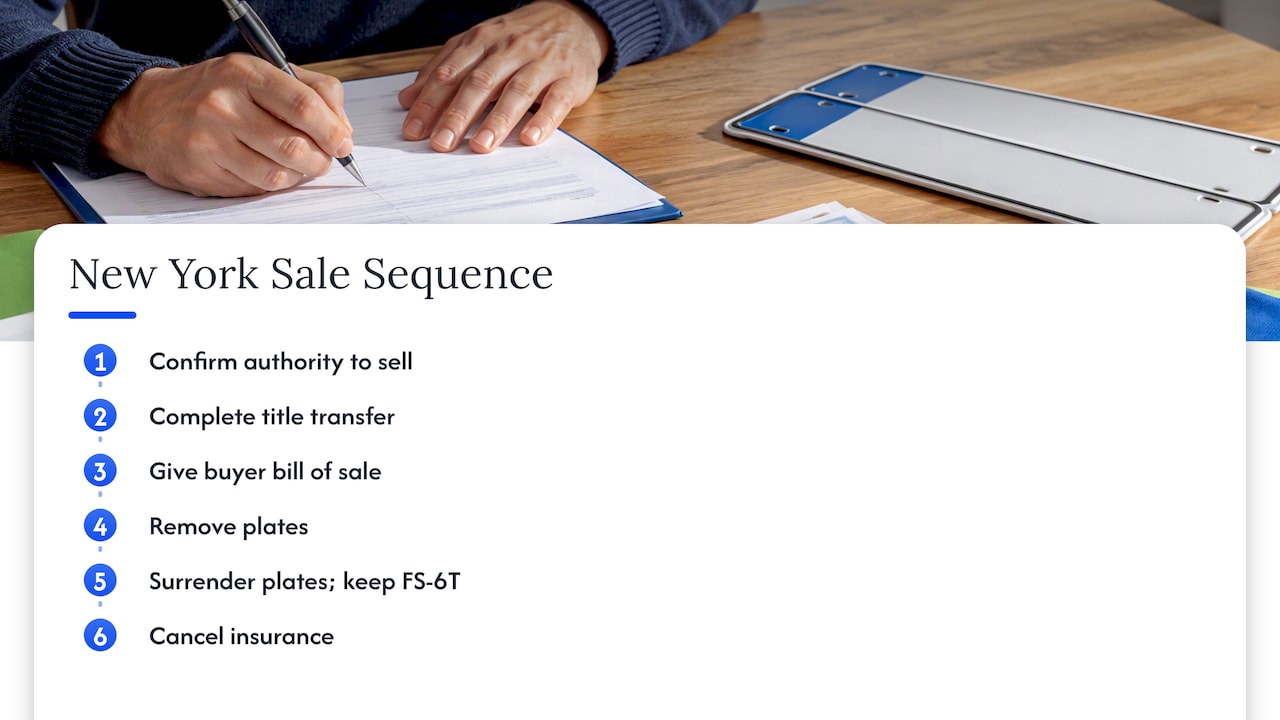
New York has no “I sold my car” form that you file with the DMV. What protects you after a sale is a short sequence: sign over the title, hand the buyer a bill of sale, take your plates off the car, surrender them to the DMV, get the FS-6T receipt, and only then cancel your insurance. Skip the order and you can end up with a suspended registration for a car you no longer own.
This guide walks through each step as the NY DMV describes it, what the buyer has to do on their side, and where sellers most often get stuck.
TL;DR
- There is no seller notification form in New York. Your liability ends when you surrender your plates and receive the FS-6T receipt.
- Surrender the plates before you cancel the insurance. Reverse the order and the DMV can suspend your registration and your driver license.
- Sign the original title over to the buyer and give them a bill of sale with the year, make, VIN, date, price and both signatures.
- The buyer, not you, files Form DTF-802 and pays sales tax. You may need to complete one section if the price is below market value.
- This applies to every vehicle, running or not.
Table of Contents
- Does New York make you report a car sale?
- The order that protects you
- What the buyer has to do, and why you should care
- A quick checklist you can screenshot
- Common mistakes that cost sellers money
- Our perspective: why we push sellers to paper the sale properly
- Selling to a private buyer vs. a cash buying service
- Selling a company car or a car you no longer have the title for
- Selling on the Jersey side
- Ready to sell without the back and forth?
- FAQ
- Sources
Does New York make you report a car sale?
Not in the way most people expect. Many states have a notice of transfer that the seller mails in. New York’s system works through plates and insurance instead. The DMV’s own page on turning in plates says you must surrender your plates and registration before you cancel the vehicle’s liability insurance, and that if you do not, it will suspend your registration and can suspend your driver license.
So “reporting” the sale really means three things:
- Transferring ownership on the title and with a bill of sale.
- Removing and surrendering your plates.
- Keeping proof (the FS-6T receipt) that you are done with the car.
The buyer handles the other side: registering and titling the vehicle in their name. The DMV explains that after a private purchase the buyer must register and title the vehicle.
The order that protects you
The sequence matters more than any single form. Here it is in practice.
Step 1: Confirm you are allowed to sell
Only a person named on the title can sell the vehicle. If two owners are listed, the DMV’s guidance is that either owner may sell, but you should check how the title is worded and have both sign wherever the title transfer calls for it. An incorrectly signed title is one of the most common reasons a sale stalls at the DMV, and the buyer is the one standing at the counter when it does.
If you have lost the title, deal with that first. The DMV lists what counts as acceptable proof of ownership: generally the original New York title, and in some cases other documents. If a lien has been satisfied, you will also need that documented before the buyer can retitle.
Step 2: Sign the title over
Fill in the transfer section of the original title with the buyer’s name and address, the date, and the sale details. For vehicles within 20 years of manufacture, the title transfer includes an odometer disclosure. Write the reading carefully and do not cross out or correct numbers in a way that makes the document look altered. If you make a mistake, ask the DMV how to correct it before handing the title over.
We cover the details and the odd cases in our guide to odometer disclosure in New York, and a more general walkthrough of New York title transfer forms.
Step 3: Give the buyer a bill of sale
The DMV accepts its own Vehicle Bill of Sale, form MV-912, and it is the easiest option. A homemade bill of sale can work, but it has to carry the essentials: year, make and VIN of the vehicle, the date of sale, the purchase price, and the names and signatures of both seller and buyer. Leave out the VIN and the buyer risks being turned away at the DMV.
Make two copies, or photograph the signed document. You want your own record of the price, date and buyer name. Our page on MV-912 and DTF-802 for same-day sales shows how those documents fit together.
Step 4: Take your plates off
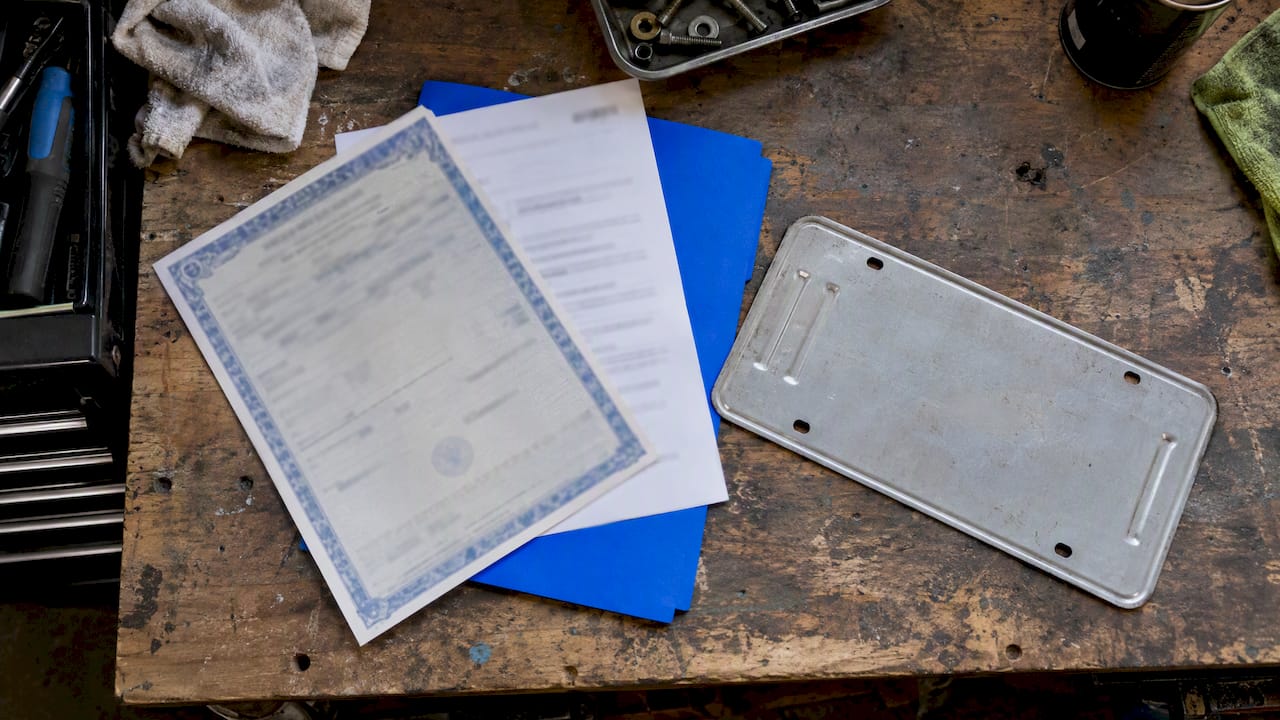
In New York the plates belong to you, not to the car. Remove them and the registration sticker before the buyer drives away. A car that leaves with your plates can keep generating tolls, tickets and insurance questions under your name.
If you are selling to someone who needs to drive the car home, they will need to arrange their own insurance and temporary registration. That is their job, not yours, and it is a good reason not to let anyone “borrow” your plates for the trip.
Step 5: Surrender the plates and get the FS-6T
The DMV lets you surrender plates by mail or in person. By mail, you complete the PD-7 application and send the plates in, and the DMV mails the plate surrender receipt, Form FS-6T, to the address on your registration. That means your address on file has to be current before you send anything. The DMV also notes that if you do not receive an FS-6T receipt, you should contact it.
Keep the FS-6T. It is your proof that you are no longer responsible for insuring that vehicle. Our walkthrough on surrendering NY plates by mail or in person covers the practical side, including timing.
If your registration still has time left and you want to know about refunds, see how to cancel a registration in NY.
Step 6: Cancel the insurance last
Only after the plates are surrendered should you cancel or transfer the liability coverage. The DMV’s rule is plain: as long as a vehicle is registered in New York, it needs liability insurance, even if it is parked and not driven. If you cancel first, the DMV’s system sees a registered car with no coverage.
If you move the coverage to a replacement car, tell your insurer which vehicle you sold and which you are adding, and ask for written confirmation of the change.
What the buyer has to do, and why you should care
You do not file the tax paperwork, but you should know what the buyer faces, because a mistake there can come back to you.
In a private sale, the buyer completes Form DTF-802, the Statement of Transaction. It is used to calculate and collect sales tax. The tax is not a single statewide figure: a state tax bulletin explains that for motor vehicles the rate is tied to the buyer’s place of residence or where the vehicle will be principally used, not where the sale happens.
A seller can be pulled in when the price is below fair market value, for example a sale between family members or a heavily discounted car. In that case, the form has a section the seller may need to complete. The form warns that false statements can bring fines of up to $10,000 for individuals. Write the real price on the bill of sale and do not agree to a “paper price” lower than what changed hands.
A quick checklist you can screenshot
| When | What | Why it matters |
|---|---|---|
| Before the sale | Check the name(s) on the title; locate the original | Only a titled owner can sell |
| At the sale | Sign the title, record the odometer reading | Buyer cannot title without it |
| At the sale | Complete a bill of sale (MV-912 or equivalent) | Proof of price, date and parties |
| At the sale | Remove plates and sticker | Plates stay with you |
| After the sale | Photograph the signed title and bill of sale | Your record if questions arise |
| After the sale | Surrender plates (mail or in person) | Ends your registration |
| After the receipt | Keep the FS-6T | Proof you are done insuring the car |
| Last | Cancel or move your insurance | Doing this earlier risks suspension |
Common mistakes that cost sellers money
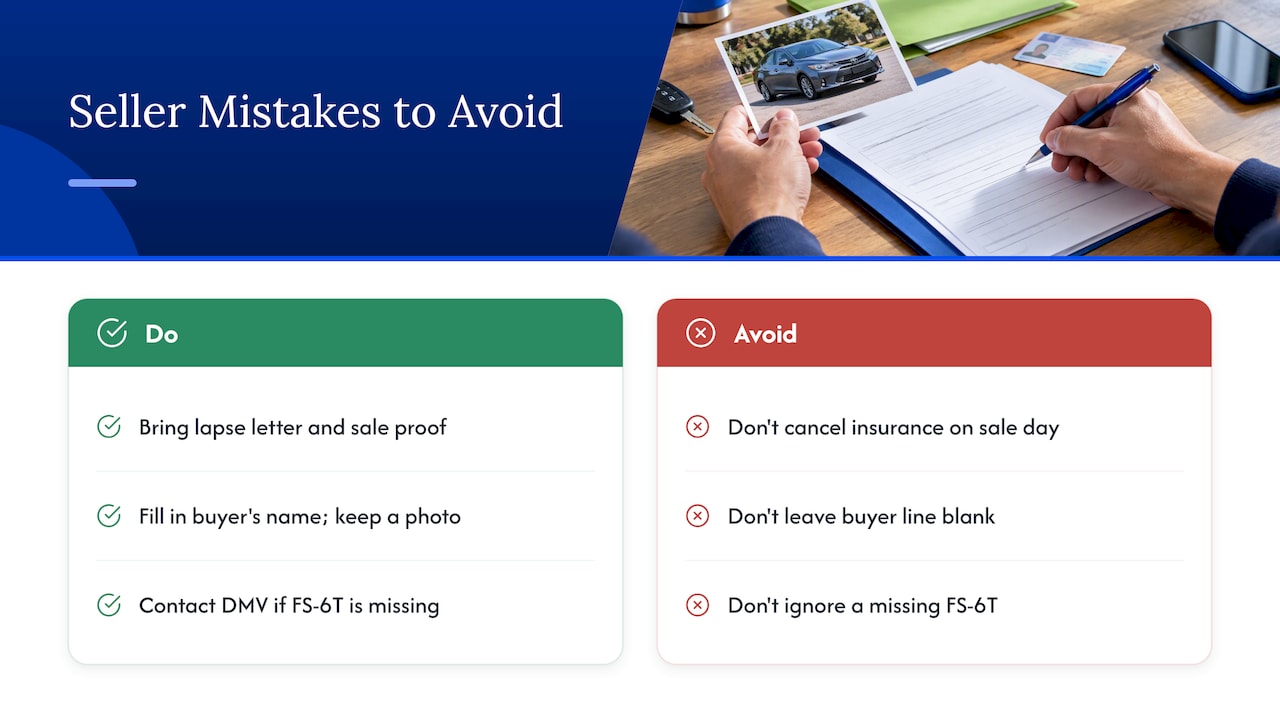
Canceling insurance the day of the sale. It feels logical: the car is gone, so the policy should be too. In New York that is the exact move that triggers a lapse flag. If you already did it, the DMV’s insurance lapse page says that if you sold a vehicle and get a lapse letter, you bring the letter and proof of sale to the DMV. Dig out your bill of sale.
Forgetting a car that does not run. A vehicle sitting in the driveway with active plates is still a registered vehicle. The insurance rule does not care whether the engine starts. If you are clearing out a damaged or inoperable car, the same title, bill of sale and plate steps apply.
Handing over a title with a blank buyer line. Some sellers sign and leave the rest empty so the buyer can fill it in later. That leaves you with no clear record of who owns the car. Fill in the buyer’s name, and keep a photo.
Waiting on a lost FS-6T. If the receipt does not arrive, contact the DMV rather than assuming it is fine. Without it you have no clean proof.
Selling with an expired registration. It complicates things, but it can be done. See our page on selling a New York car with an expired registration.
Our perspective: why we push sellers to paper the sale properly
We buy cars in New York and New Jersey every week, and the pattern is consistent. The sale itself is rarely the problem. The trouble shows up three weeks later, when a letter arrives about an insurance lapse or a toll bill for a car that is no longer in the seller’s hands.
That is why we treat paperwork as part of the service, not an afterthought. When we buy a car, we send a team to your location, give you a cash offer, and handle the paperwork with you. Our offer is guaranteed: we commit to paying the stated price at pickup, so there are no surprises when we arrive. The part we cannot do for you is the part New York puts on the owner’s side, taking your plates off and getting the FS-6T receipt, so we tell sellers about it up front and point them to the right steps.
If you are choosing between a private listing and a direct cash sale, the paperwork list above is the same either way. What changes is the number of strangers you meet, the time you spend answering messages, and how long the car sits with your plates on it. A private sale can bring a higher number for some cars, and it costs you time and risk. A direct sale is faster and simpler. Pick the one that fits your situation, then follow the order in this guide.
— Eric
Selling to a private buyer vs. a cash buying service
The reporting steps are identical, but the experience is different.
| Private buyer | Dealer trade-in | Cash buying service | |
|---|---|---|---|
| Finding the buyer | You list, answer messages, schedule viewings | Same visit as your next purchase | One request, then a pickup |
| Payment risk | You decide how to accept payment and verify it | Handled by the dealer | Payment at pickup |
| Paperwork | You complete the title, bill of sale, plates | Dealer handles most of it | Handled with you, plates still yours to surrender |
| Non-running car | Hard to sell, fewer buyers | Often discounted or declined | Accepted by services that buy these vehicles |
| Speed | Days to weeks | Same day | Same day possible |
Our own claim is that sellers get higher offers and faster turnaround with us than from local dealers, and that payment is made at pickup at the price we quoted. If you want to see how our process works from quote to handoff, the page on how our car buying service works, even with a loan lays out six steps.
Selling a company car or a car you no longer have the title for
Two cases come up often enough to mention.
Company vehicles. The person signing has to have authority to sign for the business, and the paperwork has to match the name on the title. We handle these regularly; see selling a company car in New York.
Missing title. The DMV’s page on proofs of ownership explains that the original title is the standard document, and it describes what to do when the original was lost or stolen. Start there before you list the car, because the buyer’s ability to register depends on it. For a related overview, our guide to NY private seller paperwork and plate order goes through the same sequence.
Selling on the Jersey side
If you live in New Jersey but your plates or title are New York’s, or the reverse, do not mix the rules. The DMV states that plates from another state go back to that state, not New York. For New Jersey sales, see our pages on removing plates after a NJ sale and NJ car sale paperwork.
Ready to sell without the back and forth?
If you would rather skip listings and strangers, you can request a cash offer from Tri State Cash For Cars. We come to you in New York, New Jersey or Connecticut, quote a price, handle the paperwork, and pay at pickup, for cars that run and cars that do not. You still surrender your plates and keep your FS-6T, and we will tell you exactly how.
FAQ
How do I notify the DMV that I sold my car in NY?
There is no notification form. You surrender your license plates and registration to the DMV, and the DMV mails you the FS-6T receipt as proof. Do that before you cancel your insurance.
Do I have to report the sale of a car to anyone?
Not through a seller report. Your obligations are to sign over the title, give the buyer a bill of sale, and surrender your plates. The buyer files Form DTF-802 and registers the car. If you receive a lapse letter later, bring it and your proof of sale to the DMV.
What should I do when selling a car privately in NY?
Verify you are the titled owner, sign the original title with the odometer reading, complete a bill of sale such as MV-912, remove your plates, surrender them, keep the FS-6T, then cancel your insurance. Photograph every signed document for your records.
Can I cancel my insurance as soon as the car is sold?
No. The DMV requires you to surrender plates before canceling liability coverage, and it can suspend your registration and driver license if you do not. Wait until you have turned in the plates, and keep the receipt.
Does this apply if the car does not run?
Yes. Condition does not change the rules. A registered vehicle needs insurance until you surrender the plates, so follow the same title, bill of sale and plate steps.
Sources
- NY DMV: Buy, Sell, or Transfer Vehicle Ownership
- NY DMV: Surrender Your Vehicle Plates and Registration
- NY DMV: Register and Title a Vehicle
- NY DMV: Acceptable Proofs of Ownership for Vehicles
- NY DMV: Vehicle Bill of Sale, Form MV-912
- NY DMV: Insurance Lapses
- NYS Tax Department: Form DTF-802
- NYS Tax Department: Motor Vehicles, Vessels, and Trailers