Selling a Car With a Lien in New York: Step-by-Step
Yes, you can sell a car in New York while a lender still holds a lien on it. The lien does not block the sale. It only means the loan has to be paid off, and the lender’s proof of payoff has to reach the buyer, before the car is truly yours to hand over. This guide walks through the order of operations, the paperwork the NYS DMV actually wants, and the mistakes that leave sellers owing money on a car they no longer have.
TL;DR
- A lien is the lender’s recorded claim on your car. You can sell with one, but the loan must be satisfied from the sale proceeds or from your own funds.
- You do not need a new lien-free title to sell. The DMV says you can give the buyer the original title and the original lien release.
- Selling without paying off the loan leaves you legally liable for the debt, and the lender can still go after the car.
- Call your lender first for a payoff amount, then compare it to what the car will fetch. That gap decides everything else.
Table of Contents
- What a lien means on a New York car
- Step 1: Get your payoff amount
- Step 2: Choose how the payoff happens
- Step 3: Understand the paperwork the DMV wants
- What happens if you sell without paying the loan
- Timeline: what a clean sale looks like
- Common problems and how to fix them
- Our perspective: where lien sales go wrong
- Selling to a cash buyer when you still owe money
- Before you sign: a seller’s checklist
- FAQ
- Sources
What a lien means on a New York car
A lien is a claim on property that secures a debt. When you borrow to buy a car, the lender files a lien with the state so it can take the car if the loan goes into default. In DMV terms, someone other than you has a security interest in the vehicle, usually the bank or finance company that financed the purchase.
Two practical consequences follow:
- The lender’s interest outranks your right to sell freely. Until the debt is cleared, the car is collateral.
- The lien travels with the car. If the car changes hands with the lien still open, the lien carries over to the new owner’s title record. That is why a careful buyer will refuse to pay without proof the loan is gone.
The DMV does not referee the money side. It does not rank lienholders or get involved in how sale proceeds are divided. Those matters are private agreements between you, the lender and the buyer. So the protection has to come from how you structure the sale.
Step 1: Get your payoff amount
Your monthly statement shows a balance, but that is not the number you need. Ask your lender for a payoff quote: the exact amount required to close the loan on a specific date, including accrued interest and any fees. Ask three things in the same call:
- What is the payoff figure, and through what date is it good?
- Where and how do I send it (wire, overnight check, online payment)?
- How will you deliver the lien release, and how long will it take after payment clears?
Then get a realistic value for the car. Compare the two numbers. There are only three outcomes:
| Situation | What it means | What you do |
|---|---|---|
| Car is worth more than the payoff (positive equity) | The lender gets paid, you keep the difference | Pay off from the sale, pocket the rest |
| Car is worth about the same as the payoff | Break-even | Sale covers the loan, little or nothing left |
| Car is worth less than the payoff (negative equity) | You owe the shortfall | Bring cash to cover the gap, or wait and pay down the loan |
If you are underwater, selling does not erase the gap. The remaining balance is still your debt. Because the DMV leaves that to private agreement, get the plan with your lender in writing before the car leaves your driveway.
Step 2: Choose how the payoff happens
There are three common routes, and the right one depends on how much cash you have and how quickly you need to close.
Pay off the loan yourself first
If you can cover the balance, pay it, wait for the lender to issue the release, and then sell a car with a clean record. This is the simplest transaction for any buyer. The cost is that you need the money up front, and you wait for the paperwork.
New York law gives you some leverage here. Lenders must deliver a lien release immediately once payment clears, and no later than three business days afterward. If a lender drags past that, the Department of Financial Services is the regulator to report it to.
Let the buyer’s payment close the loan
This is how most owners with a loan actually sell. The buyer’s money goes to the lender to satisfy the debt, and any remaining equity goes to you. The key is sequencing: the buyer should not hand you the full price and trust you to pay the bank later, and you should not release the car before you know the payoff is going through.
When a buyer pays the lender directly, you want the payoff confirmed in writing, the lien release promised in a specific form, and a bill of sale that records the price and date.
Trade in or sell privately
A dealer trade-in rolls the payoff into the deal, which is convenient but often the lowest offer you will see. A private sale can bring more money but exposes you to the sequencing risk above, plus strangers, test drives and payment fraud. Neither is wrong. They just trade money for time and effort in different proportions.
Step 3: Understand the paperwork the DMV wants
This is where deals stall, so it pays to be exact.
You do not need a lien-free title
The DMV is explicit: when you sell a vehicle, you do not need to remove the lien from the title certificate. You hand over the original title and the original lien release. When the buyer applies for their own title, they submit both and the DMV clears the lien from the record.
What counts as a valid lien release
The lender’s proof of satisfaction can take two forms:
- A Notice of Recorded Lien (MV-901), signed by the lender. The signature must be an original, in ink or laser printed; photocopied signatures and dates are rejected.
- A letter on the institution’s official letterhead with the vehicle and borrower details and a signed statement that the loan is paid in full. The same DMV guidance treats this as a valid and often simpler alternative.
The DMV also states that the lien release must be the original; photocopies are not accepted. Scan it for your own records, but give the buyer the original.
If you want a lien-free title anyway
Some sellers prefer to deliver a clean title. It is optional and slow. You mail the original title, the original proof of lien satisfaction and a $20 check or money order to NYS DMV Title Services in Albany. Expect 60 to 90 days for the new title to arrive by mail, and a local DMV office cannot issue it in person. For most sales that wait is unnecessary.
Other documents for the sale
Beyond the lien paperwork, you still need proof of sale and proof of ownership. The DMV describes the proof of sale as the document showing who sold, who bought, when, and for how much. Our guide to New York car sale paperwork for private sellers covers plates and insurance in the right order, and New York title transfer forms and notarization explains the signing details.
What happens if you sell without paying the loan
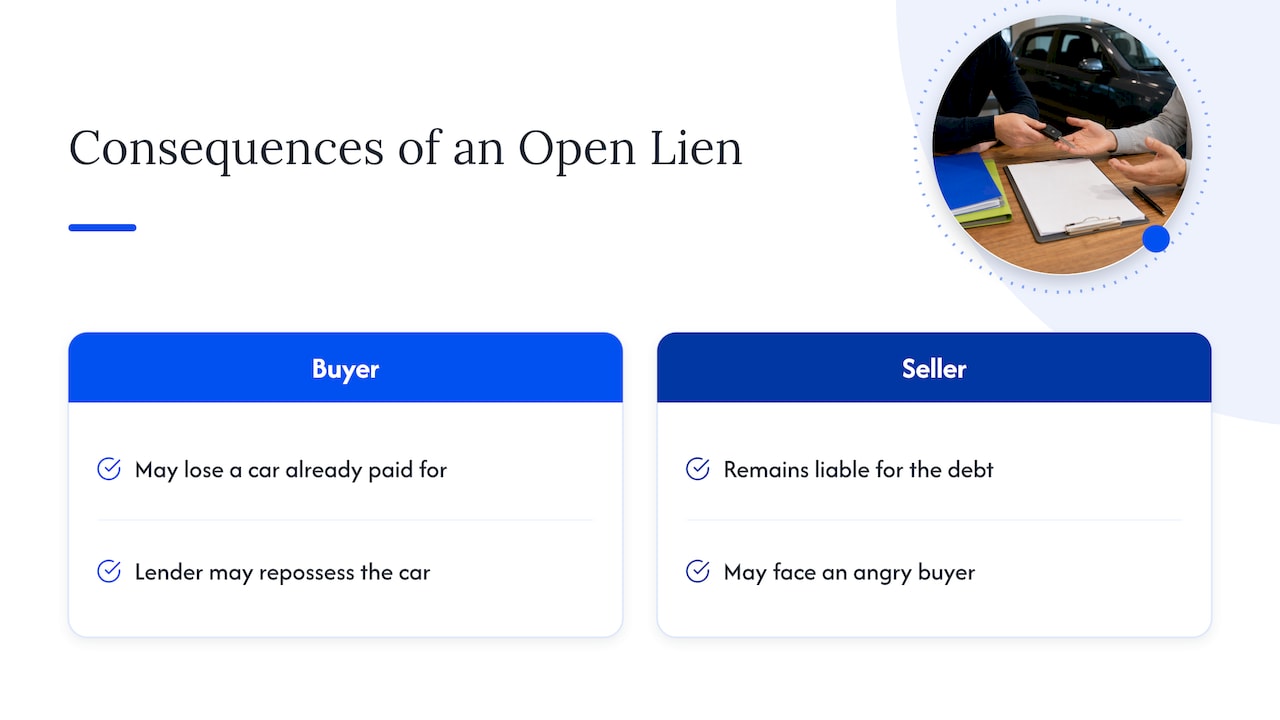
This is the scenario to avoid. Under the rules the DMV describes, New York allows a sale with an open lien, but you stay liable for the debt, and the lender keeps the right to repossess the car, even from the new owner, because the security interest persists.
That creates trouble in both directions. The buyer may lose a car they paid for. You may face a lender demanding the balance on a car you no longer own, and an angry buyer besides. Treat the payoff and the release as the core of the sale, not an afterthought.
Timeline: what a clean sale looks like
Here is a realistic sequence for a sale where the buyer’s payment settles the loan:
- Day 1. Request the payoff quote and ask how the release will be issued.
- Day 1 to 2. Get a cash offer and compare it with the payoff figure.
- Day 2 to 3. Agree on how the lender will be paid and by whom. Put it in writing.
- Sale day. Sign the bill of sale, hand over keys, and remove your plates.
- Within days. The lender confirms payoff and issues the release. Under state rules that happens no later than three business days after payment clears.
- After. Confirm that the release reaches the buyer, cancel your insurance only once the plates are returned or transferred as the DMV requires, and keep copies of everything.
If any step is vague, pause the sale. Nothing about the lien timeline justifies rushing past a missing document.
Common problems and how to fix them
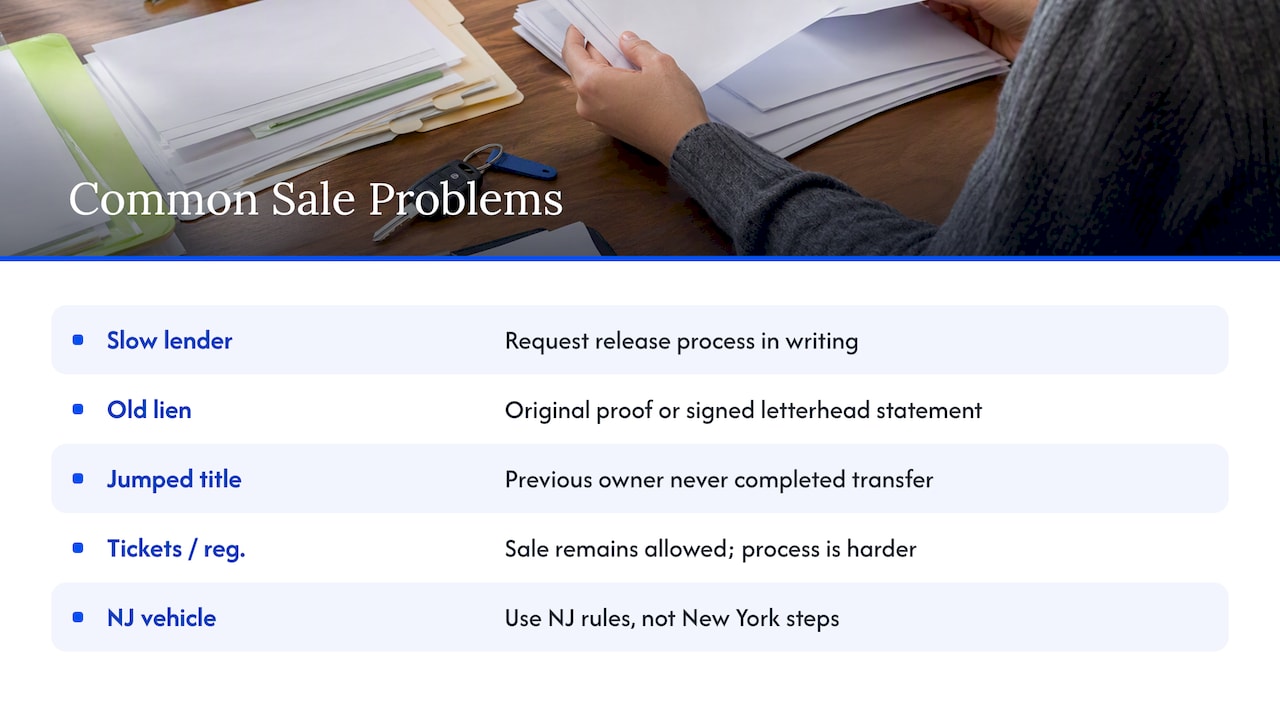
Your lender holds the title and is slow. Call and ask for the release process in writing. If it passes the three-business-day mark after payment clears, file a complaint with the Department of Financial Services.
You have a paper title with an old lien noted. An old recorded lien on the title is fine if you have the original proof it was satisfied. If you do not, ask the lender for a signed letterhead statement. Our guide on getting a duplicate title in New York helps if the title itself is missing, and selling a car without a title in NY covers the alternatives.
Your name is missing from the chain of ownership. If the previous owner never completed the transfer, you may be dealing with a jumped title. See how to fix a jumped title in New York.
You owe tickets or the registration lapsed. Neither cancels your right to sell, but both complicate things. We cover selling with unpaid tickets and selling with an expired registration separately.
The car is registered elsewhere. If you moved in from another state, read about registering an out-of-state vehicle in New York or selling it for cash.
You are across the river. New Jersey runs on different forms and rules. If your car is in NJ, see how to sell a liened car in New Jersey rather than applying New York’s steps. The NJ MVC lien page lists what New Jersey requires to remove a lien.
Our perspective: where lien sales go wrong
We buy cars for cash across New York, New Jersey and Connecticut, and the pattern we see is consistent: people worry about the lien itself, when the real risk is the order of events. A lien is a routine, solvable item. A sale where nobody agreed in advance who pays the lender, how the release arrives and who holds the title in the meantime is the one that turns into weeks of phone calls.
Our approach is built around removing surprises. We give you a cash offer and stand behind it: we commit to paying the stated price at pickup. We come to you, and we handle the paperwork so you are not driving between a bank branch and a DMV window. For a seller with a loan, that matters because the number you need to see first is simple: our offer against your payoff. If the offer clears the payoff, the rest is logistics. If it does not, you know that before anyone touches your keys, and you can decide whether to cover the gap or wait.
Our advice to any seller, whether or not they choose us: get the payoff quote before you list or call anyone, insist on the original lien release going to the buyer, and never let a car leave until the plan for the lender is on paper.
— Eric
Selling to a cash buyer when you still owe money
If you want the sale done in a day rather than a month, a cash buyer with on-site service removes most of the friction. You get a guaranteed offer, someone comes to the car, and the paperwork is handled for you. We buy cars, SUVs, trucks and vans, running or not, in New York, New Jersey and Connecticut.
To see how it works when there is a loan involved, read our six-step process for selling safely, even with a loan. When you are ready, request your offer at Tri State Cash For Cars and have your payoff quote handy so we can compare the numbers together. If speed is your priority, our guide to fast car sale options in NY, NJ and CT explains the tradeoff between a 24 to 72 hour sale and getting the most money.
Before you sign: a seller’s checklist
- Payoff quote in hand, with the good-through date.
- Offer or sale price confirmed, and compared to the payoff.
- Written agreement on who pays the lender and how.
- Plan for any shortfall if the car is worth less than the loan.
- Original lien release or Notice of Recorded Lien promised to the buyer, with an original signature.
- Bill of sale with price, date, VIN and both parties’ details.
- Plates removed after the sale, copies of every document saved.
- Date noted to follow up: three business days after payoff clears.
FAQ
Can I sell my car if there is a lien on it?
Yes. New York does not prohibit it. The loan has to be satisfied, either by you before the sale or from the sale proceeds, and the buyer needs the original title and the original lien release. If you skip the payoff, the lender can still pursue the car and you stay liable for the debt.
How do I transfer a title with a lien in NY?
You do not have to clear the lien from the title first. You give the buyer the original title and the original proof of lien satisfaction, such as a signed Notice of Recorded Lien or a lender letter on official letterhead. The buyer submits both to the DMV when titling the car, and the DMV removes the lien.
How can I remove a lien from my title in New York?
Pay the loan in full, then have the lender send you the release. If you want a new lien-free title, mail the original title, the original release and a $20 check or money order to NYS DMV Title Services in Albany. Plan on 60 to 90 days for it to come back, and note it is optional for a sale.
How long does a lender have to release the lien?
New York requires lenders to deliver the release immediately once payment clears, and no later than three business days after. If your lender misses that, you can report it to the Department of Financial Services.
What if I owe more than the car is worth?
The shortfall remains your debt even after the sale. You can bring cash to cover the difference at closing, or hold the car and pay the loan down. Settle the plan with your lender in writing before the buyer takes the car.
Sources
- NYS DMV: How to remove a lienholder from a title certificate
- NYS DMV: Information and instructions about your certificate of title
- NYS DMV: MV-909 What lenders should know about the title program
- NYS DMV: Buy, sell, or transfer vehicle ownership
- NYS Department of Financial Services: How to obtain a lien release on a vehicle
- NJ MVC: Liens

One Comment